

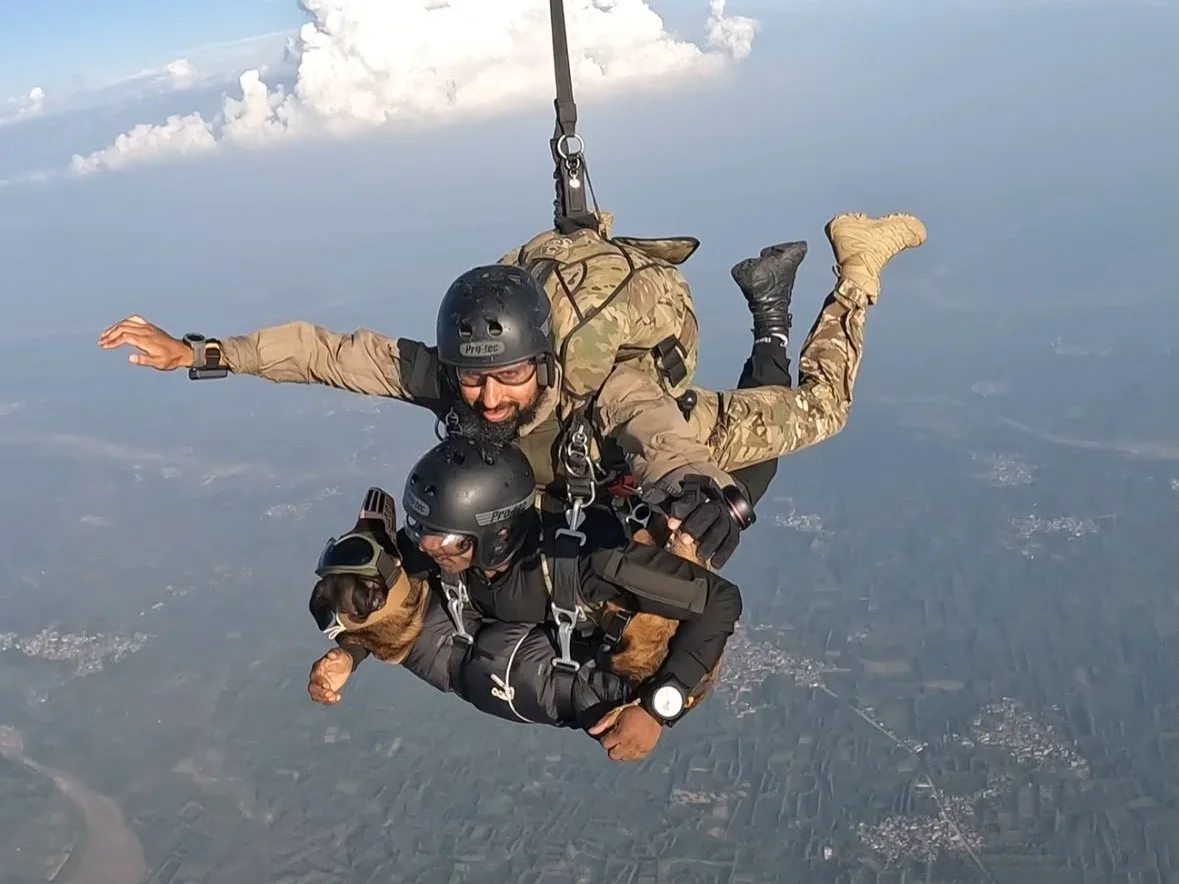
In a first-of-its-kind demonstration, an Indian Army combat canine has carried out a tandem parachute jump alongside its handler and a paratrooper, marking a significant development in the use of military dogs for airborne and specialised operations.


The jump was conducted by a paratrooper from the Army’s Surya Command over the Behat Drop Zone in central India. The combat canine and its handler participated in the descent while carrying a full combat load, demonstrating the ability to integrate trained military dogs into airborne insertion capabilities.
According to an X post by Surya Command, the exercise is believed to be among the first instances of a tandem descent involving a dog handler and his canine. The development represents an expansion of the traditional role of military working dogs, which are generally employed in ground-based tasks such as detection, tracking and security.
The airborne exercise tested the ability of a trained combat canine to undertake a parachute descent alongside military personnel. For specialised units operating in difficult or hostile environments, the ability to insert a trained dog together with its handler could potentially provide additional capabilities during missions where conventional ground access is difficult.
The exercise also highlights the importance of the relationship between a military working dog and its handler. A combat canine deployed in an operational environment is dependent on its handler for direction, communication and control. Integrating the pair into an airborne insertion therefore requires both the animal and handler to be prepared for an unfamiliar and physically demanding environment.
The tandem descent involved the dog, its handler and a paratrooper, with the personnel carrying their combat equipment. The exercise was conducted over Behat Drop Zone, providing an environment for demonstrating the feasibility of integrating the canine component into an airborne operation.
Military working dogs have traditionally been valued for their specialised senses and ability to perform tasks that can be difficult for humans or conventional equipment to replicate. Their roles can include detection and tracking, particularly in situations where trained animals can provide an additional layer of capability to military teams.
The latest exercise explores a different dimension of military canine employment by introducing an airborne component. Rather than limiting trained dogs to locations accessible by conventional movement, the capability demonstrated at Behat could support their integration into missions requiring rapid insertion.
For airborne and specialised forces, mobility and speed of deployment are important considerations. Parachute insertion allows personnel to reach areas where conventional vehicles or other forms of movement may not be practical. Integrating a combat canine into such an insertion could potentially extend the range of tasks that the animal can perform alongside specialised troops.
The exercise also demonstrates the emphasis being placed by the Indian Army on adapting established capabilities to changing operational requirements. Modern military operations increasingly combine conventional combat capabilities with specialised assets, surveillance systems, unmanned platforms and trained personnel with niche skills.
Military canines remain one such specialised capability. Their effectiveness depends on extensive training, conditioning and close coordination with handlers. An airborne insertion adds another layer of preparation because the animal must be acclimatised to the conditions associated with aircraft movement, parachute descent and landing.
The successful completion of the exercise provides an indication that trained canines can be incorporated into such specialised training scenarios. However, the Army’s post does not provide details regarding the specific operational missions for which the capability may eventually be employed.
The involvement of Surya Command is significant in the context of airborne and specialised military capabilities. The command has a focus on specialised operations and training, where the ability to deploy personnel and supporting capabilities rapidly can be important.
The exercise at Behat Drop Zone therefore goes beyond a demonstration involving a military dog. It represents an effort to test how different elements of military capability can be integrated to support operations in challenging environments.
The full combat load carried during the jump also added an operational dimension to the exercise. Rather than conducting the descent solely as an isolated animal-handling demonstration, the activity sought to replicate conditions closer to those encountered by troops during an operational insertion.
The development also highlights the continuing evolution of military canine capabilities within the Indian Army. As operational requirements change, specialised animals and their handlers can potentially be trained for a wider range of environments and missions.
The tandem jump further reinforces the importance of specialised training in modern military operations. Personnel operating with combat canines must be able to maintain control of the animal while simultaneously managing their own equipment and operational responsibilities.
For the canine itself, the successful descent demonstrates the outcome of conditioning and training designed to prepare it for an environment fundamentally different from normal ground operations. The ability to remain responsive to the handler during such a situation is essential for any future operational application.
The exercise also has implications for the broader concept of force multiplication. While a combat canine is not a replacement for technological surveillance or other military systems, its specialised capabilities can complement human and technological resources when deployed appropriately.
The Indian Army’s experiment with airborne insertion of a combat canine comes amid wider efforts by armed forces globally to explore new ways of integrating specialised assets into complex operations. The objective is to ensure that troops have access to the capabilities they require even when operating in difficult terrain or under hostile conditions.
The Behat exercise thus marks an important training milestone for India’s military working dog capabilities. It demonstrates an ability to move beyond conventional ground employment and explore the integration of combat canines into airborne operations.
While the Army has not disclosed details of any specific future deployment plans, the successful tandem descent provides valuable training exposure for both the canine and its handler.
The exercise ultimately highlights the continuing importance of the human-animal partnership within military operations while demonstrating how that partnership can be adapted to new operational environments. With a combat canine, its handler and a paratrooper completing the tandem descent over Behat Drop Zone, the Indian Army has tested a specialised capability that could broaden the operational utility of trained military dogs in future missions.