Air Marshal Tejpal Singh, Deputy Chief of the Air Staff, called for faster integration of new weapons and technologies into the Indian Air Force, saying that a new weapon should not become a five- or seven-year integration programme and that software and algorithms should move more quickly from development to controlled operational experimentation.





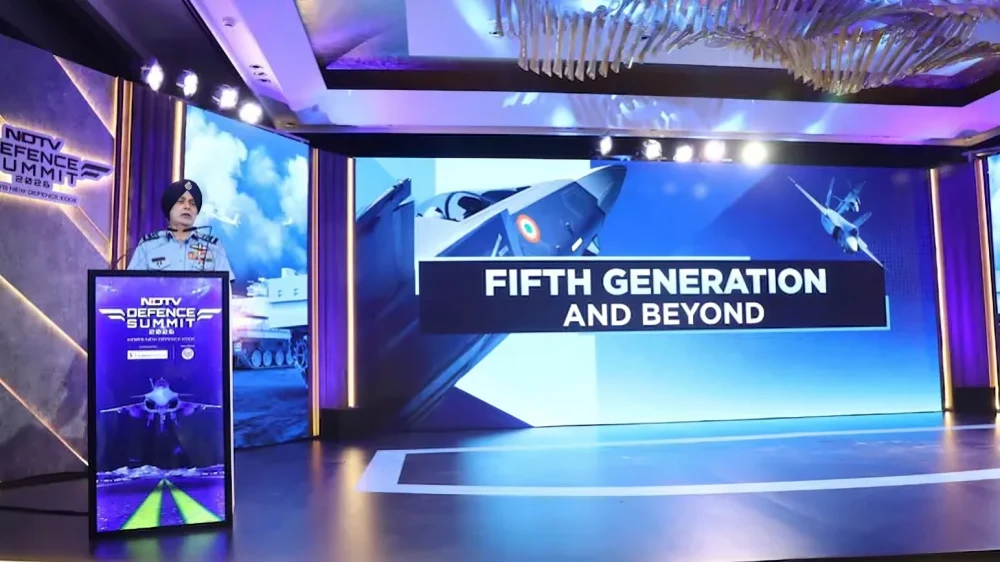
Speaking at the NDTV Defence Summit 2026 during his special address titled “Fifth Generation and Beyond”, Air Marshal Tejpal Singh said the IAF needs to address immediate operational requirements while simultaneously building the architecture required for fifth-generation and next-generation battlespace capabilities.
He said the immediate task was to understand the capabilities already available, identify what is urgently required and, at the same time, build the architecture for what is going to come next.
“We cannot stop at the capability we have today while we wait for that ideal future to emerge 20 years from now. Our challenges are actually more demanding,” Air Marshal Tejpal Singh said.
He said the approach should involve finding what the force has, detecting what it urgently needs and building the architecture for the future while considering how fifth-generation and beyond capabilities should shape thinking about the battlespace.
According to Air Marshal Tejpal Singh, it may not be possible to move from one generation of aircraft to another generation immediately, but it is possible to attempt a generational change in combat architecture.
“That is what we should aim for,” he said, while highlighting autonomy, distributed sensing, resilient communications and open mission systems as areas that can be developed before the aircraft normally associated with fifth-generation warfare arrive.
He said this approach was important because the future Indian Air Force would inevitably be a fifth-generation force. The emphasis, therefore, should be on building the architecture and capabilities that can support future combat requirements.
Air Marshal Tejpal Singh also stressed that technological uniformity should not be the objective. Instead, he said, the objective should be operational coherence despite technological diversity.
“The objective cannot be technological uniformity. It has to be operational coherence despite technological diversity,” he said.
He added that urgency and transformation should not be treated as competing requirements. According to him, capabilities inducted today should have a path into the combat structure being developed for the future.
Air Marshal Tejpal Singh also said that not every platform needs to be fifth generation. Instead, the force needs to become future compatible, including its personnel, industry and the Air Force.
He said air warriors should not be prepared only for one particular system or aircraft. Personnel would need to understand technology, data, Artificial Intelligence, space, cyber, electronic warfare and joint operations, along with systems thinking.
“That, to my mind, is the real meaning of the 5th generation and beyond for us,” he said.
The Deputy Chief of the Air Staff also highlighted the need for a change in the relationship between operators and users on one side and industry on the other.
He called for operators, designers, software engineers, test establishments and manufacturers to work more closely throughout the entire life cycle of a system.
According to Air Marshal Tejpal Singh, not every experiment needs to become a procurement programme. He said the system should allow an idea to be tested, evaluated, modified if it does not work and tested again.
He described failure as part of the process of developing an adaptive combat system, stressing the need for an approach that allows experimentation and iteration.
The Air Marshal also highlighted the need to shorten the time required to integrate new technologies into operational systems.
“According to the Air Marshal, a new weapon should not become a five- or seven-year integration programme, a software update should not wait for a nine-month upgrade and a new algorithm should be capable of moving from the laboratory to controlled operational experimentation quickly,” the report said.
He also stressed that a successful system should be capable of being manufactured and scaled.
His remarks at the NDTV Defence Summit focused on the transition towards fifth-generation and beyond capabilities while addressing the immediate operational requirements of the Indian Air Force.
The approach outlined by Air Marshal Tejpal Singh places emphasis on building combat architecture capable of bringing together different generations of platforms and technologies. Autonomy, distributed sensing, resilient communications and open mission systems were identified as capabilities that can be developed as part of this transition.
At the same time, he emphasised the need for faster interaction between operators, designers, software engineers, test establishments and manufacturers throughout the life cycle of systems.
The focus on faster experimentation and integration also extends to weapons, software and algorithms. Air Marshal Tejpal Singh stressed that these capabilities should be able to move more quickly from development and laboratory environments into controlled operational experimentation.
The address, titled “Fifth Generation and Beyond”, therefore focused on combining immediate operational requirements with the development of future combat architecture, while preparing personnel and industry for a battlespace increasingly shaped by technology, data, AI, space, cyber and electronic warfare.
Air Marshal Tejpal Singh’s remarks underlined the need for the Indian Air Force to build future compatibility across its platforms, personnel and combat systems while maintaining operational coherence despite technological diversity.