

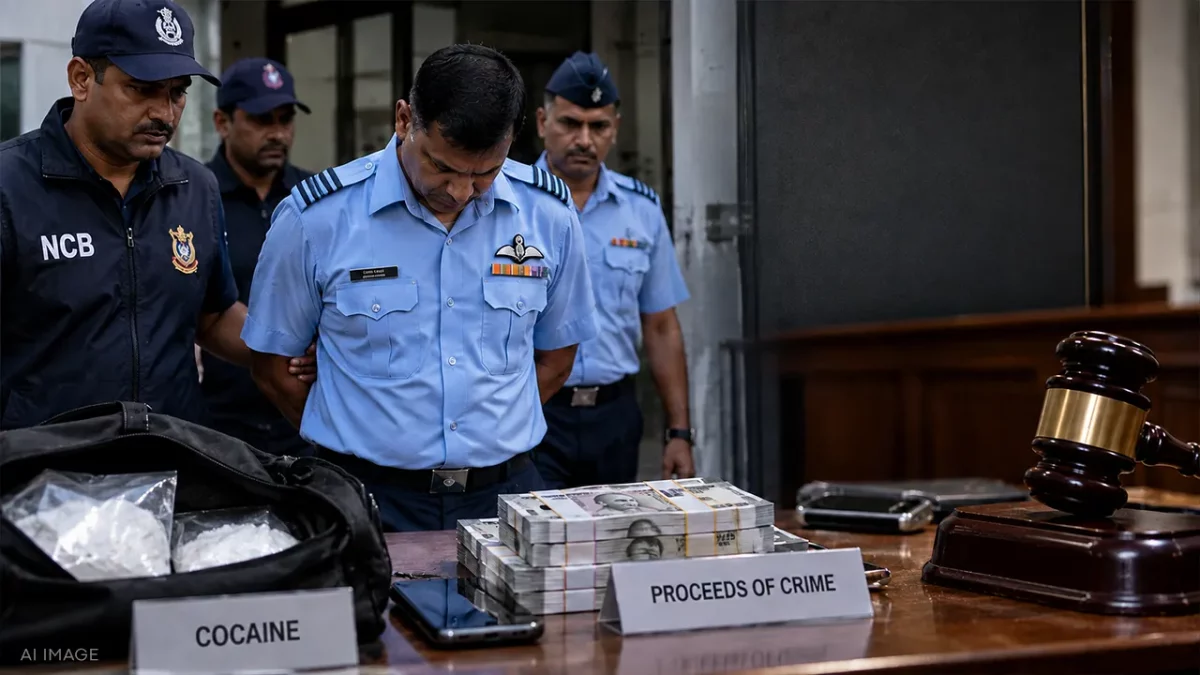
Mohali / Chandigarh, September 4, 2026 — A special court in Punjab’s Mohali has convicted an 80-year-old retired Indian Air Force official and his 77-year-old associate for money laundering linked to a 2008 cocaine seizure, sentencing both to three years of rigorous imprisonment under the Prevention of Money Laundering Act (PMLA).





Special Judge Hardip Singh pronounced the order on September 3. The court also imposed a fine of Rs 5,000 on each convict and directed that the period of detention already undergone be set off against the substantive sentence. The two men had been facing proceedings for about 13 years while on bail in the related police case.
The convicts are Dara Singh, who served in the Indian Air Force for 29 years and retired as a Junior Warrant Officer, and his associate Gurdarshan Singh.
2008 seizure and the scheduled offence
SAS Nagar (Mohali) police booked the two men in August 2008 after recovering 1.23 kilograms of cocaine, then valued at about Rs 50 lakh. Police also seized two bank cheques with a combined value of Rs 10 lakh, which Dara Singh had given to Gurdarshan Singh “to purchase the said contraband.”
A trial court convicted both men in the Narcotic Drugs and Psychotropic Substances (NDPS) Act case in March 2015. Local reports of that earlier judgment state that they were sentenced to 12 years’ imprisonment each. Dara Singh, who was later re-employed by the Punjab Technical Education Board and served there for nine years, challenged the NDPS conviction before the Punjab and Haryana High Court. The High Court suspended his sentence, and the appeal remains pending. The latest order deals only with the separate money-laundering prosecution arising from the same seizure.
ED prosecution and the court’s finding
The Enforcement Directorate registered a PMLA case in October 2019 and filed a chargesheet in October 2022, treating the seized cocaine and the two cheques as proceeds of crime.
The defence argued that the recovered contraband and cheques were not proceeds of crime because “there is no drug money involved in the scheduled offence” and because it had not been shown that any amount was “exchanged or earned” by the accused in that transaction. The ED submitted that “property” under the PMLA includes any property used in the commission of a scheduled offence.
Rejecting the defence, the court held that the cheques were the outcome of the dealings between the two accused and therefore constituted proceeds of crime. The judgment stated:
“These cheques being the outcome of the dealings between both the accused in that case are to be considered as proceeds of crime and the arguments of learned defence counsels are liable to be discarded.”
It further recorded that both accused had committed an offence defined under Section 3 of the PMLA and punishable under Section 4, and convicted them under Section 4.
Plea for leniency
At the hearing on sentence, the accused asked the court to take a lenient view. They submitted that they were the sole breadwinners of their families, suffered from various ailments, and maintained that they were innocent because the original police case had been recorded falsely against them. The court nonetheless imposed three years’ rigorous imprisonment and the statutory fine.
The PMLA conviction stands independently of the pending High Court appeal in the 2015 NDPS case. The two prosecutions arise from the same 2008 seizure but address distinct offences: possession and related narcotics charges on one hand, and the laundering or use of proceeds of that scheduled offence on the other.