
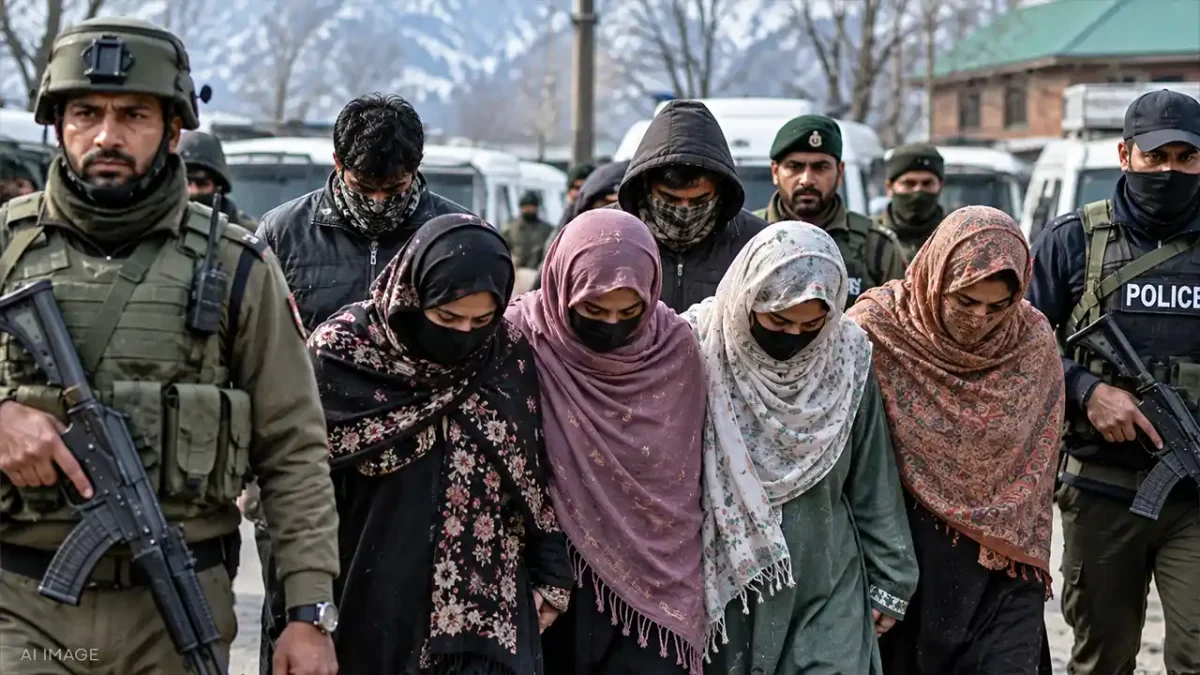
Jammu and Kashmir Police in Bandipora district on Saturday (October 24, 2026) claimed to have dismantled a clandestine module linked to the banned organisation Jammu and Kashmir Ittihad-ul-Muslimeen (JKIM). Six persons, including four women, were arrested in connection with the case. The module is alleged to have operated under the directions of a Pakistan-based handler, engaged in prison-linked networking, covert meetings, ideological mobilisation of women, and receipt of cross-border funds for separatist propaganda activities.

A case, FIR No. 168/2026, has been registered at Police Station Bandipora under Sections 10 and 13 of the Unlawful Activities (Prevention) Act, 1967 (as amended). These sections pertain to membership of an unlawful association and unlawful activities involving the promotion of the ideology of a proscribed organisation and mobilisation of support for its objectives.
Identities of the Accused
The arrested persons have been identified as:
- Waheed Ahmad Bhat (also referred to as Butt), son of Mohd Maqbool Bhat, resident of Bhat Mohallah, Kachloo Qazipora, Handwara, Kupwara district — described as the main accused.
- Mubeena Bano (or Banoo), daughter of Gh Ahmad Dar, resident of Dachigam, Bandipora.
- Kushboo Jan (or Khushboo Jan), daughter of Ab Rashid Sheikh, resident of Check Panzigam, Bandipora.
- Mehak Jan, daughter of Mohd Sultan Sheikh, resident of Check Panzigam, Bandipora.
- Aliya Jan (or Alia/Aaliya Jan), daughter of Ab Rashid Sheikh, resident of Check Panzigam, Bandipora.
- Irfan Ahmed Reshi alias Rayees (or Rais), son of Gh Nabi Reshi, resident of Ananwan, Handwara, Kupwara.
Two of the accused are from Handwara in Kupwara district, while the remaining four are from Bandipora. Police are also examining the alleged role of a religious cleric (preacher/maulvi) and two suspected couriers from Kupwara, who remain at large.
Background of the Module
Investigators stated that the probe initially centred on Waheed Ahmad Bhat. He had earlier been arrested under the UAPA in 2022 in connection with a conference. While lodged in Kupwara Jail, Bhat allegedly re-established contact with a Pakistan-based handler identified as Manzoor Ahmad Shah. With the assistance of another inmate, an alleged network was developed to propagate separatist ideology, organise meetings, and expand support, including by involving women in outreach and mobilisation efforts.
Following Bhat’s release on medical grounds in August 2024, the network reportedly became more active. Police claim that 14 to 15 clandestine meetings were held in Bandipora and adjoining areas. Of these, five to six gatherings allegedly took place at a small hotel located on the Bandipora-Baramulla road. Women were a key target for propaganda-related activities.
Alleged Funding Trail
Investigators have uncovered a financial trail linked to the module. Approximately ₹7–8 lakh was channelled over a period of more than a year. Of this amount, around ₹2.26 lakh was allegedly deposited into the Jammu and Kashmir Bank account of Mubeena Bano of Dachigam, Bandipora. The remaining funds were purportedly delivered through cash couriers. A portion of the money was distributed among associates, while some was utilised for Bhat’s medical treatment and related expenses.
Ban on JKIM
Jammu and Kashmir Ittihad-ul-Muslimeen (JKIM / Ittihadul Muslimeen), headed by Masroor Abbas Ansari and a constituent of the All Parties Hurriyat Conference, was declared an “unlawful association” by the Ministry of Home Affairs on March 11, 2025, under the UAPA for a period of five years. The government cited its alleged involvement in anti-national and subversive activities, supporting terrorism, fuelling secessionist activities, mobilising funds for unlawful purposes, and promoting hatred against the established government. The ban was subsequently upheld by a special tribunal.
Bandipora Police stated that the investigation is continuing to establish the full extent of the network, its operational structure, communication channels, sources of funding, and the specific roles of the arrested individuals and others under scrutiny. Officials emphasised that the module allegedly sought to use women as a means to propagate separatist ideology, possibly under the assessment that they would face less scrutiny.
This development forms part of ongoing security operations in north Kashmir against alleged residual networks linked to banned organisations and cross-border handlers. Further details are expected as the probe progresses.