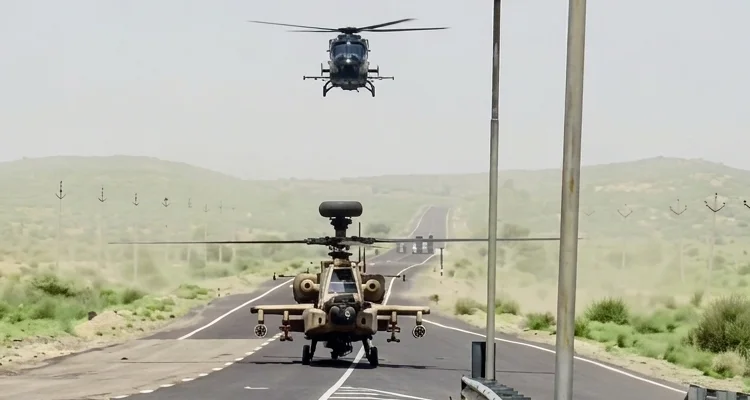
The Indian Army converted a designated stretch of National Highway 911 into a temporary helicopter landing zone on 29 September 2026, conducting landing and take-off drills with Rudra, Dhruv and Chetak helicopters near Dantour in Rajasthan’s Bikaner district, approximately 80 kilometres from the India-Pakistan International Border.





The activity was carried out by Army Aviation units of the Sapta Shakti Command (South Western Command) as part of an operational exercise associated with the Army’s “JAI se Vijay” framework, which emphasises Jointness, Aatmanirbharta and Innovation. The Additional Directorate General of Public Information stated that the helicopters demonstrated operational agility during the exercise near the western border, including landings on national highways, and highlighted rapid response, situational awareness and the utility of dual-use infrastructure for operational readiness.
Pilots practised controlled approaches, landings and departures from the marked highway section, while ground teams managed the temporary operating area and coordinated aircraft movements. The drill lasted approximately 30 minutes. Traffic on the Bharatmala stretch of NH-911 was halted in both directions for the duration, as confirmed by local police officials in the Chhattargarh area. The exercise was conducted in the western desert, where long distances, dust, wind and limited dedicated aviation infrastructure make alternative operating sites relevant to planning.
The three helicopters represent different roles within the Army Aviation fleet. The Dhruv is an indigenous twin-engine Advanced Light Helicopter designed and manufactured by Hindustan Aeronautics Limited (HAL). The Rudra is its armed variant, employed for reconnaissance, escort and fire support. The Chetak, also produced by HAL, is a light utility helicopter built under licence from the French Alouette III design and is used for liaison, observation and support tasks.
The drill tested procedures for operating helicopters from a road when conventional airbases, airfields or helipads are unavailable or restricted. Such rehearsals are intended to preserve mobility for troop movement, logistics, surveillance and support missions in areas where permanent aviation facilities may be limited or inaccessible.
The activity coincided with the tenth anniversary of the surgical strikes conducted by the Army across the Line of Control on the night of 28–29 September 2016, following the terrorist attack on the Uri base that killed 19 soldiers.
By using an existing national highway as a temporary landing zone, the exercise illustrated how suitable sections of the road network can serve as dispersed operating locations, reinforcing the Army’s ability to adapt aviation operations to the conditions of the western desert sector.