
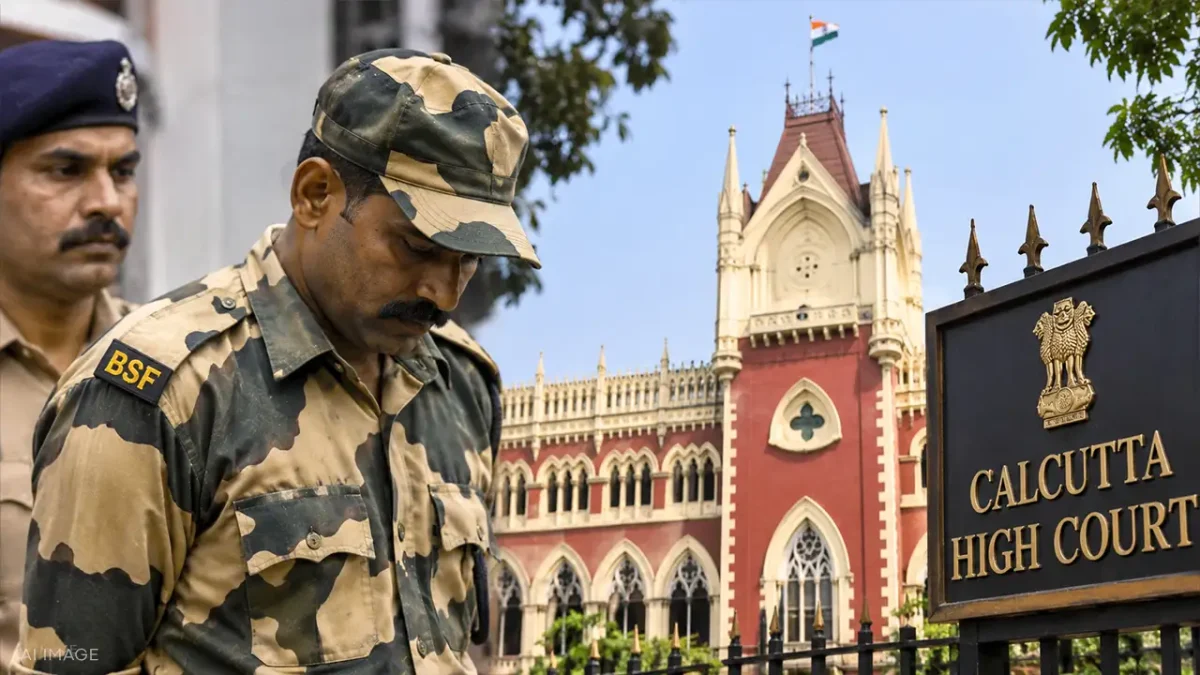
Jalpaiguri, November 13, 2026: A Division Bench of the Calcutta High Court has upheld the conviction and life sentence of a Border Security Force (BSF) constable for the 2018 murder of his colleague in Cooch Behar district, holding that the killing was motivated by jealousy arising from a triangular illicit relationship.





Justices Arijit Banerjee and Chaitali Chatterjee (Das), sitting at the Circuit Bench in Jalpaiguri, dismissed the criminal appeal (CRA/22/2021) filed by Constable C.T. Raghunandan. The court affirmed the trial court’s finding that Raghunandan shot dead Constable Arbind Kumar with the latter’s service INSAS rifle on the night of January 24, 2018, near the Durga Nagar Border Outpost, and thereafter concealed the body.
Incident and Prosecution Case
Arbind Kumar was on duty at Point Alpha-9 under the Durga Nagar BOP. Around 10:00–10:30 pm, another BSF constable stationed nearby heard a sound resembling a bomb explosion. When there was no response on the radio, a search was launched. Arbind’s body was recovered from a jungle (Noloni Barman’s plantation) with his hands and legs tied with a blue nylon rope.
Investigation led to Dasami Modak, a local woman and mother of two children, who was recorded under Section 164 of the CrPC and later examined as the sole eyewitness. She stated that she had been in a physical relationship with both constables. On the night of the incident, she went to meet Arbind after receiving a pre-arranged torchlight signal. While the two were engaged in a physical relationship, Raghunandan arrived and shot Arbind in the chest at point-blank range using Arbind’s own service rifle. Raghunandan then threatened Dasami and her children with death if she disclosed the incident.
The body was later found with urine and semen discharged from the private parts, consistent with the eyewitness account of intimacy immediately before the shooting. Ballistic examination confirmed that the empty cartridge recovered from the scene had been fired from Arbind’s INSAS rifle (body number 16534414). Call detail records of the personal mobile phones used by both constables and Dasami further corroborated the relationship and contacts between the three.
Trial Court Judgment
By judgment dated April 30, 2021, the Additional Sessions Judge, Dinhata, convicted Raghunandan under Sections 302 and 201 of the Indian Penal Code. He was sentenced to imprisonment for the remainder of his natural life for murder and to seven years’ rigorous imprisonment (with a fine of ₹1 lakh) for causing disappearance of evidence. The sentences were ordered to run concurrently. He was acquitted of the Arms Act charges.
High Court Findings
The High Court rejected the appellant’s contention that the Sessions Court lacked jurisdiction under Section 475(1) of the CrPC and that the case ought to have been tried by a Court-Martial. The Bench held that no relevant rules of the Central Government had been produced to mandate trial by Court-Martial, and that the provision is directory and does not oust the jurisdiction of an otherwise competent criminal court.
On the evidence, the court reiterated that a conviction can rest on the testimony of a sole eyewitness if the testimony is reliable and trustworthy. It found Dasami Modak’s evidence consistent with her Section 164 statement, natural, and free from any motive to falsely implicate the appellant. The Bench noted that she had implicated herself by admitting the illicit relationships, observing that it was inconceivable that a mother of two children would expose her own conduct merely to falsely accuse another person.
The court held that her testimony received sufficient corroboration from the ballistic report, inquest report, medical evidence (death caused by a gunshot wound perforating the heart and lungs), forensic reports, and call detail records. The defence of alibi, based on the statements of two junior BSF colleagues who claimed Raghunandan was resting in the barracks, was rejected as unreliable and unsupported by any official duty records.
Justice Banerjee observed:
“The obvious motive for Raghunandan to kill Arbind was to eliminate Arbind from the triangular illicit relationship between Arbind, Raghunandan and Dasami. This was kind of a revenge taken by Raghunandan against Arbind. His murderous act was obviously prompted by jealousy and urge to enjoy exclusive physical relationship with Dasami by annihilating Arbind.”
The Bench further recorded that there was “ample evidence on record to demonstrate that the appellant committed cold-blooded murder of the victim” and found no perversity in the trial court’s appreciation of evidence.
The appeal was accordingly dismissed, and the conviction and life sentence were upheld. The judgment underscores that quality of evidence, rather than its quantity, is decisive, and that credible testimony of a single eyewitness, when corroborated by scientific and circumstantial evidence, is sufficient to sustain a conviction for murder.