
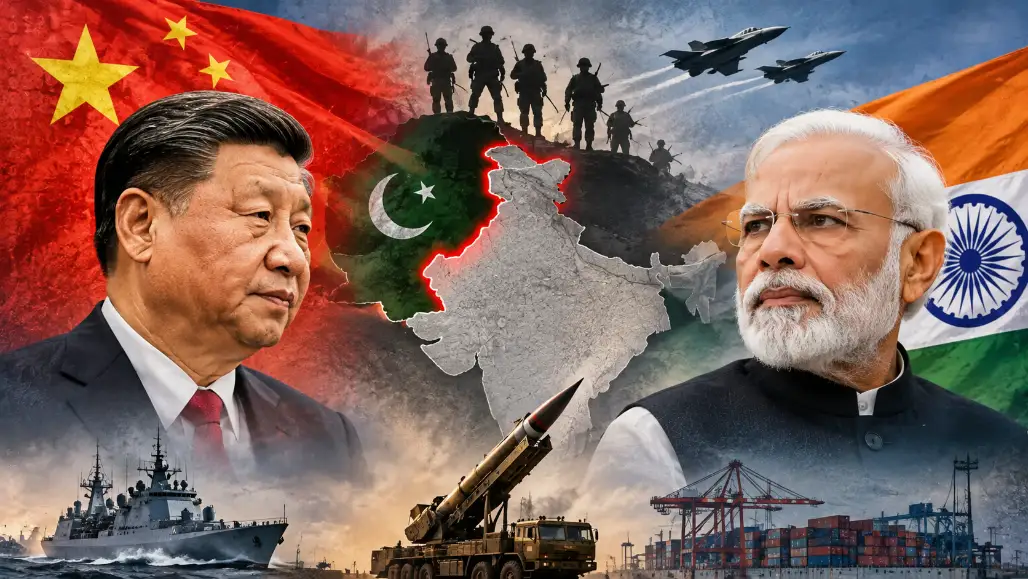
China’s military support to Pakistan during Operation Sindoor in May 2025 was part of a broader strategy to suppress India’s rise as a regional power, according to the latest annual report of the US-China Economic and Security Review Commission, a key panel that reports to the US Congress. The report has highlighted Beijing’s use of military, economic and technological pressure to constrain New Delhi’s strategic and industrial growth.





The commission identified India as an important power in the wider competition between the United States and China, describing it as one of the few countries outside the US alliance system with the scale to influence the long-term balance of power in Asia. It also highlighted India’s potential as an alternative manufacturing and supply-chain partner at a time when Washington is seeking to reduce strategic dependence on China.
“India is one of the few powers outside the US alliance system with the scale to materially affect the long-term competition with China,” the panel said, adding that Beijing was actively working to suppress India’s rise across multiple domains.
China’s Support for Pakistan During Operation Sindoor
The report gave particular attention to the May 2025 hostilities between India and Pakistan following the Pahalgam terror attack. It said the conflict demonstrated how China could strengthen its close strategic partner, Pakistan, during a military crisis without directly entering the fighting.
“China’s evolving military partnership with Pakistan has made a two-front contingency an increasingly critical concern for India,” the commission observed.
The report also referred to disclosures concerning China’s technical assistance to Pakistan during Operation Sindoor. Earlier in 2026, a Chinese engineer, Zhang Heng, told Chinese state broadcaster media that he had been part of a team providing technical support to the Pakistan Air Force during the conflict. He said the team’s objective was to ensure that Pakistani equipment could perform at its full combat potential, referring to the J-10CE fighter aircraft operated by the Pakistan Air Force.
The report’s assessment also comes against the backdrop of remarks by Lieutenant General Rahul Singh, who had stated that China provided real-time inputs to Pakistan regarding India’s military deployments during the hostilities.
According to the US commission, China’s support for Pakistan during the conflict reflected a deeper level of military integration between the two countries. While Beijing has maintained long-standing defence ties with Islamabad and supplied it with military equipment, the involvement of Chinese technical personnel highlighted the extent of cooperation during an active crisis.
“The May 2025 conflict demonstrated how China could strengthen Pakistan during a crisis without Beijing entering the fighting directly, adding to India’s concerns about how a future conflict with Pakistan could develop,” the report said.
Border Pressure and Growing Indian Ocean Presence
Beyond its partnership with Pakistan, the commission flagged China’s continued military expansion and infrastructure development along the disputed border with India. It said Beijing was strengthening its ability to mobilise forces rapidly through the expansion of airfields, railway networks and logistical infrastructure along the Line of Actual Control (LAC).
The report also pointed to China’s military pressure along the border, its expanding naval presence and surveillance activities in the Indian Ocean region. It noted that Beijing understood India’s strategic importance in the Indian Ocean, an area central to regional maritime security and the wider strategic competition in Asia.
Although India and China reached an agreement in 2024 to end the four-year military standoff in eastern Ladakh, the report highlighted continuing tensions along the border, including developments in the Arunachal Pradesh sector. These concerns persist even as bilateral relations have moved towards a cautious recovery following the disengagement process.
The commission’s assessment underlined that China’s military infrastructure and growing operational capabilities along the frontier continue to pose strategic challenges for India.
Economic Pressure and Supply-Chain Dependence
The report identified China’s economic influence as another major instrument through which Beijing could constrain India’s development. It highlighted China’s control over critical industrial inputs, technologies and specialised expertise, arguing that these advantages could be used to protect its manufacturing dominance and slow the growth of competing Indian industries.
The commission alleged that China had restricted exports of key inputs and products to India, recalled engineers and withheld equipment in ways that could affect India’s electronics manufacturing ambitions.
It also flagged China’s pricing strategy as a challenge for Indian manufacturers. The report cited lower prices for certain Chinese pharmaceutical inputs, including chemicals and raw materials used in medicine production, which could make it difficult for new Indian manufacturing units to compete with established Chinese suppliers.
The panel further referred to Chinese export controls on battery technology, warning that such restrictions could affect India’s efforts to develop domestic clean-energy manufacturing capabilities.
Despite these challenges, the commission noted that India was taking steps to reduce strategic vulnerabilities. New Delhi has been modernising its armed forces, expanding domestic manufacturing, restricting Chinese involvement in sensitive sectors and strengthening cooperation with the United States and other international partners.
However, the report cautioned that India’s industrial expansion continues to depend significantly on Chinese machinery and components. Building alternative domestic supplier networks, it said, would require substantial investment, access to technology and considerable time.
US Panel Calls for Deeper Strategic Cooperation with India
In view of China’s expanding military and economic influence, the commission recommended that Washington deepen its engagement with New Delhi. It called for stronger cooperation in defence technology, intelligence sharing, maritime security and manufacturing supply chains.
The report’s recommendations reflect the panel’s assessment that India has an important role in maintaining a favourable balance of power in the Indo-Pacific and in providing alternatives to China-dominated manufacturing networks.
For India, the findings highlight the interconnected nature of its security and economic challenges. China’s military partnership with Pakistan, its infrastructure expansion along the LAC, its growing presence in the Indian Ocean and its influence over critical industrial supply chains represent different dimensions of the same broader strategic competition.
The commission’s report argues that closer US-India cooperation across defence, technology and industrial sectors could help address these challenges while strengthening India’s position in the regional balance of power.