
The Indian Navy marked the Golden Jubilee of its Long-Range Maritime Reconnaissance (LRMR) operations on November 18, 2026, commemorating five decades of airborne surveillance and maritime security operations across the Indian Ocean Region and beyond. The milestone coincides with the 50th anniversary of the commissioning of Indian Naval Air Squadron (INAS) 312, popularly known as the ‘Albatross’.



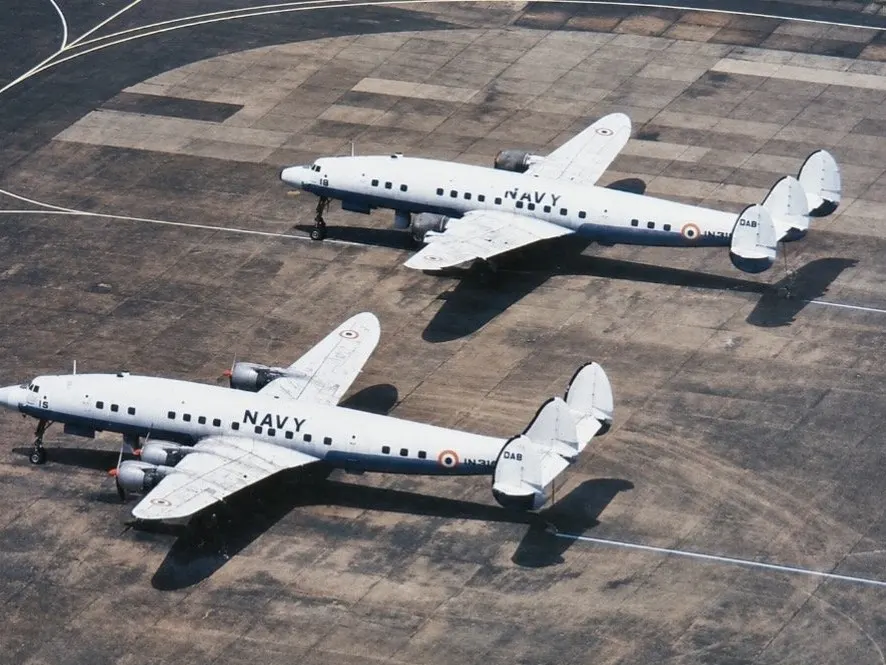
The occasion marks five decades of the Indian Navy’s sustained efforts to strengthen its long-range maritime surveillance capabilities and maintain an effective aerial watch over India’s maritime interests. From the induction of the Lockheed Super Constellation aircraft in 1976 to the deployment of the advanced Boeing P-8I, the Navy’s LRMR capability has undergone a significant technological and operational transformation.
The requirement for dedicated shore-based maritime patrol aircraft emerged following the 1971 war. Recognising the need for aircraft capable of operating alongside naval ships and helicopters, the Indian Navy assumed responsibility for long-range maritime reconnaissance. Consequently, on November 18, 1976, INAS 312 was commissioned at INS Hansa, Goa, with five Lockheed Super Constellation aircraft transferred from the Indian Air Force.
The induction of the Ilyushin Il-38 in 1977 marked another important development in the Navy’s maritime reconnaissance and anti-submarine warfare capabilities. The aircraft strengthened the Navy’s ability to monitor maritime activity and support operations over extended distances.
A further expansion came in 1988 with the induction of the Tupolev Tu-142M into INAS 312. The long-range aircraft significantly extended the Navy’s patrol reach across the Indian Ocean Region, strengthening its ability to conduct maritime surveillance and undertake anti-submarine warfare missions.
The induction of the Boeing P-8I at INS Rajali, Arakkonam, in 2013 marked a major advancement in India’s long-range maritime reconnaissance capability. Equipped with advanced systems, the P-8I brought enhanced capabilities in wide-area intelligence, surveillance and reconnaissance, anti-submarine warfare and maritime strike. Its induction represented an important transition towards a more technologically advanced and integrated maritime surveillance framework.
Over the past five decades, the Navy’s LRMR aircraft have played an important role in several military operations and maritime security missions. Their contributions include support to Operations Cactus, Vijay, Parakram and Sindoor, besides participation in anti-piracy operations and search and rescue missions.
Today, the Indian Navy’s long-range maritime reconnaissance capability is sustained by P-8I aircraft operating from two key naval air stations. INAS 312 at INS Rajali, Arakkonam, and INAS 316 at INS Hansa, Goa, continue to maintain surveillance over the Indian Ocean and beyond, supporting the protection of India’s maritime interests.
The evolution of LRMR operations reflects the Indian Navy’s continued focus on strengthening maritime domain awareness and maintaining the ability to monitor developments across strategically important maritime areas. The transition from the Super Constellation to the P-8I also highlights the technological progress achieved in naval aviation over the last five decades.
The Golden Jubilee also honours the generations of naval aviators, mission crews, maintainers and support personnel who have contributed to building and sustaining the capability. Their dedication and professionalism have remained central to the operational effectiveness of the Navy’s long-range maritime reconnaissance fleet.
As the Indian Navy marks 50 years of LRMR operations, the milestone celebrates the legacy of INAS 312 and the evolution of a capability that continues to play a significant role in India’s maritime security architecture.