


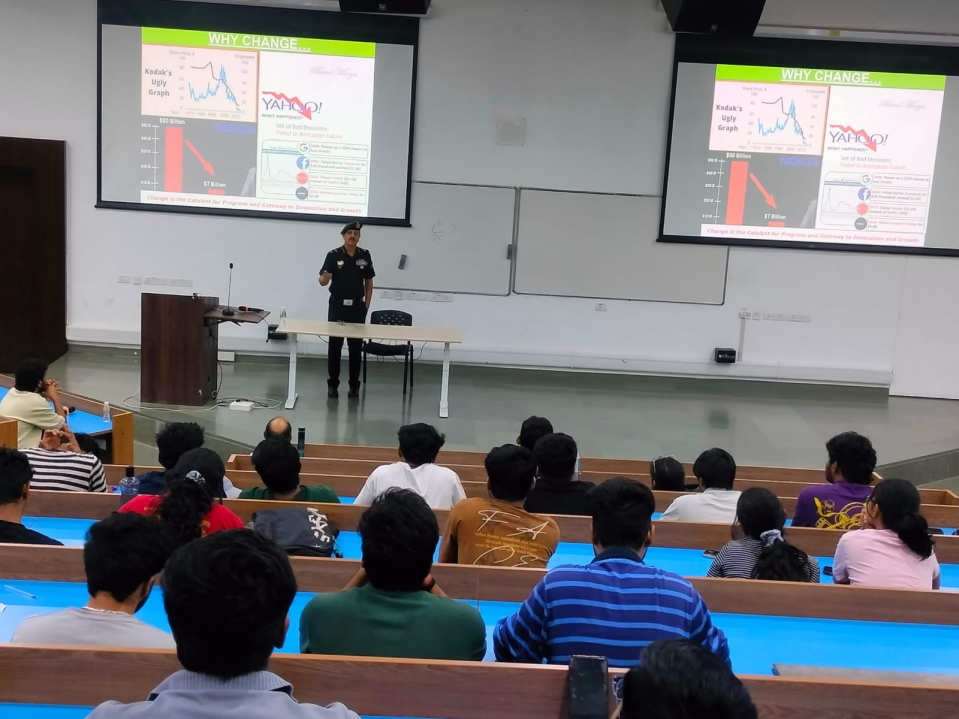
Major General Bimal Monga, SM, VSM, Additional Director General (ADG) of the National Cadet Corps (NCC) Directorate Gujarat, delivered an insightful lecture on “Engineering the Future of Defence” at the Indian Institute of Technology (IIT) Gandhinagar on November 11, 2026. The interaction brought together B.Tech and postgraduate students along with faculty members, focusing on rapid technological advancements, evolving defence requirements and the importance of continuous learning in an increasingly dynamic professional environment.





Addressing the gathering, Maj Gen Bimal Monga highlighted the rapidly shrinking “half-life” of technology and its significant implications for modern equipment, engineering practices and defence systems. He explained how technological innovations are emerging at an unprecedented pace, reducing the period during which existing technologies remain relevant and effective.
The senior Army officer emphasised that the accelerated evolution of technology is transforming the nature of modern warfare and creating new challenges for defence organisations, engineers and technology professionals. As advanced systems become increasingly sophisticated, the ability to anticipate technological changes and adapt to emerging developments has become essential for maintaining professional competence and operational effectiveness.
Maj Gen Monga urged students and faculty members to develop a mindset that embraces change rather than resists it. He stressed that professionals must continuously adapt, evolve and upgrade their knowledge to remain relevant in their respective fields. His remarks highlighted the importance of flexibility, innovation and lifelong learning in an era where technological advancements can rapidly transform established practices.
A major focus of his address was the importance of upskilling to keep pace with emerging technologies. He encouraged aspiring engineers and researchers to continuously strengthen their technical capabilities, acquire new competencies and remain informed about developments that could influence future defence systems and industrial applications.
The ADG NCC Gujarat also emphasised that technical expertise alone is insufficient to achieve professional excellence. He underlined the equally important role of soft skills, particularly critical thinking, problem-solving, teamwork and effective communication, in building successful careers and contributing meaningfully to organisations.
According to the message conveyed during his lecture, these abilities are indispensable for navigating complex professional challenges, making informed decisions and working effectively in multidisciplinary environments. He described the combination of technological competence and strong interpersonal abilities as essential for both professional excellence and personal success.
The interaction was particularly relevant for engineering students, as the defence sector is witnessing significant technological transformation through advancements in artificial intelligence, autonomous systems, robotics, cybersecurity, advanced materials, aerospace engineering and next-generation communication technologies. These developments are creating opportunities for young engineers and researchers to contribute to indigenous defence innovation and technological self-reliance.
The concept of the shrinking technological half-life also carries important implications for military equipment and defence planning. Technologies that remain effective today may require substantial upgrades or replacement as new capabilities emerge. This makes continuous research, development, modernisation and technological adaptability important considerations for maintaining the effectiveness of defence systems.
Maj Gen Monga’s address encouraged students to look beyond conventional academic learning and recognise the importance of developing practical skills, analytical abilities and an innovative approach to problem-solving. His message reinforced the need for educational institutions and aspiring professionals to remain closely connected with evolving technological and industrial requirements.
The lecture also highlighted the growing relationship between academic institutions and India’s defence ecosystem. Premier institutions such as IIT Gandhinagar play an important role in developing engineering talent, advancing scientific research and fostering innovation that can contribute to national technological capabilities.
Engagements between senior military leaders and students provide opportunities to exchange perspectives on emerging challenges and encourage young professionals to explore careers in defence technology, research, engineering and related fields. Such interactions can also help students better understand the practical applications of their academic knowledge in addressing complex national security and technological challenges.
As the Additional Director General of NCC Directorate Gujarat, Maj Gen Bimal Monga’s interaction with the academic community also reflected the broader importance of leadership development, discipline, adaptability and professional excellence among young Indians. These qualities remain central to preparing future generations for responsibilities in technology-driven and rapidly changing environments.
The lecture at IIT Gandhinagar reinforced the message that future success will depend not only on acquiring technical qualifications but also on maintaining the willingness to learn, unlearn and relearn throughout one’s career. By emphasising continuous upskilling alongside critical thinking, teamwork, communication and problem-solving, Maj Gen Monga encouraged students to prepare themselves for the demands of an evolving technological landscape.
His address on “Engineering the Future of Defence” underscored the importance of combining technical knowledge, adaptability and leadership skills to meet future challenges. The interaction served as a motivational engagement for students and faculty members, highlighting the role of innovation, continuous professional development and multidisciplinary capabilities in shaping the future of defence engineering and technological progress in India.