

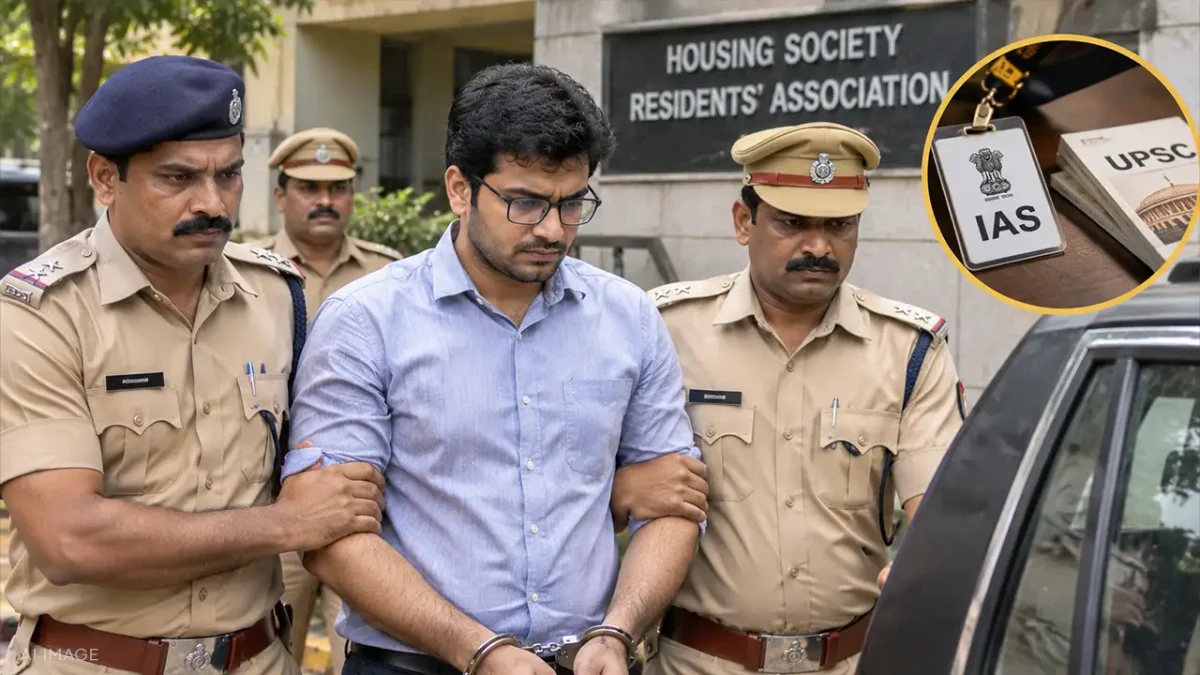
Pune police have arrested a 21-year-old man for allegedly posing as an Indian Administrative Service (IAS) officer, becoming chairman of a housing society in the Baner-Balewadi area, and cheating its members of approximately ₹35 lakh over about 11 months.





The accused, identified as Hitesh Pramod Kulkarni, is a resident of Inclusive Cooperative Housing Society (also referred to as 51B Inclusive Co-operative Housing Society), Flat 604, D Wing, near Balewadi High Street. Baner police arrested him on November 17, 2026, following a complaint lodged by society treasurer Dattatray Vaijnath Nagarjoje (31). The case has been registered under Sections 204, 314, 316(2), 319(2), 318(4), 336(2), 336(3) and 340(2) of the Bharatiya Nyaya Sanhita (BNS).
How the fraud unfolded
According to police, Kulkarni began claiming in 2025, while residing in Chikhali in Pune district, that he had cleared the UPSC Civil Services Examination and become an IAS officer. His father is said to have introduced him as such to neighbours, and he reportedly displayed photographs of felicitation ceremonies (including one linked to a Lions Club event) along with newspaper reports to support the claim. He later moved into the MHADA-developed society near Balewadi High Street with his family in January 2026. The society has around 25 flats.
Claiming to be posted at the divisional commissioner’s office in Pune and working as a central government bureaucrat, he gained the confidence of residents. He was elected chairman after reportedly assisting with the society’s conveyance deed. Once in the post, he allegedly forged signatures of members—including the secretary, treasurer, complainant Nagarjoje, and another member Pooja Jadhav—to activate online banking facilities and take control of the society’s accounts.
The society had placed roughly ₹37 lakh (collected as one-time maintenance charges) in fixed deposits at a public-sector bank’s Pimple Saudagar branch, with a linked savings account at the Paud Phata branch. Police allege that Kulkarni took an unauthorised ₹10 lakh loan against the deposits, withdrew ₹5 lakh by cheque, and transferred another ₹5 lakh to his personal account. He later prematurely encashed the fixed deposits and diverted the remaining amount (approximately ₹27 lakh after loan adjustment) along with a ₹3 lakh balance from the savings account into his own account. The total loss to the society has been estimated at around ₹35 lakh.
In parallel, Kulkarni allegedly promised to allot unsold flats and shops in the society through a lottery system at attractive prices. He collected money from residents and acquaintances (amounts ranging from ₹3–5 lakh in some cases, including from relatives), issued fake no-dues certificates, and prepared forged allotment letters on the society’s letterhead. One report states he used ChatGPT to generate the fake allotment letters and created a fake email address in the name of a builder’s employee. Some payments were partially returned, but the scheme largely collapsed when a complainant approached the society after receiving only partial repayment and no flat.
Police findings
Baner police station Sub-Inspector Raju Jadhav told PTI that Kulkarni had never cleared the IAS examination and had studied only up to Class 12. Senior Inspector Chandrashekar Sawant confirmed to The Times of India that Kulkarni was a UPSC aspirant who had appeared for the examination but failed to clear it; he began posing as an IAS officer after moving into the society and fabricated details about his posting. His father is an electrician. Police are investigating the impersonation, forgery, unauthorised banking transactions, and the bogus flat-allotment promises. Further probe is underway.
The case highlights risks associated with unverified claims of official status in residential societies and the need for due diligence on banking authorisations and property-related promises.