

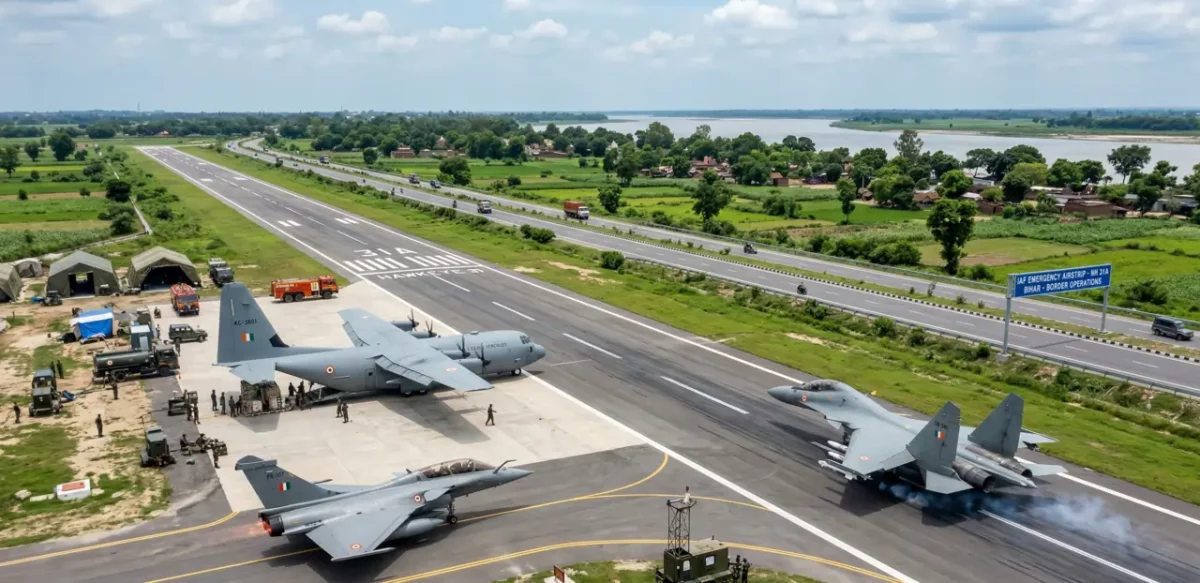
In a major boost to India’s defence preparedness, Bihar is set to develop three highway-based Emergency Landing Facilities (ELFs) capable of handling fighter jets like the Dassault Rafale, Sukhoi Su-30MKI and transport aircraft such as the Lockheed Martin C-130J Super Hercules.





Strategic Locations Near International Border
The proposed airstrips will be developed along key corridors in North Bihar, particularly near the Nepal border, enhancing rapid military response capabilities.
Key projects include:
- Patna–Purnia Expressway (245 km):
- Bihar’s first expressway with an integrated airstrip
- Reinforced, divider-free stretch for fighter jet landings
- Gorakhpur–Siliguri Expressway (417 km):
- Strategic runway segment in Bihar
- Enhances surveillance and response along northern frontier
- Ramjanaki Marg (Ayodhya–Janakpur corridor):
- 40 km airstrip stretch in Sitamarhi district
- Strengthens border-area infrastructure
Military and Strategic Significance
These ELFs are designed to:
- Enable aircraft operations if conventional airbases are targeted
- Support rapid troop and equipment deployment
- Strengthen air defence along sensitive border regions
The move aligns with evolving warfare trends where airbases are considered high-value targets.
Engineering and Operational Features
- Specially reinforced surfaces (up to 3x stronger than normal roads)
- Length of 3.5–5 km for aircraft operations
- Obstruction-free zones (no poles, trees, or wires)
- Provision for mobile air traffic control and refuelling
- Advanced traffic management systems for quick clearance
Civil and Disaster Management Benefits
Beyond defence, the airstrips will:
- Act as lifelines during floods in North Bihar
- Enable rapid delivery of relief materials
- Improve emergency response during disasters
Part of a National Trend
India has already demonstrated such capabilities in Uttar Pradesh with successful fighter landings on expressways like Purvanchal and Agra-Lucknow.
Conclusion
The development of highway airstrips in Bihar marks a significant step in dual-use infrastructure, enhancing both national security and disaster resilience, while also contributing to regional development and connectivity.