

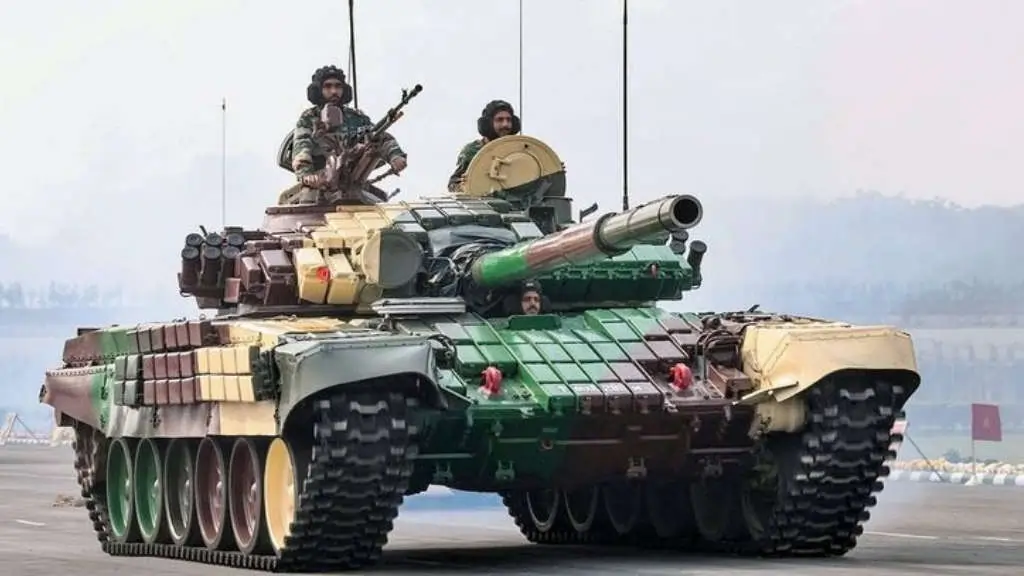
The Indian Army is planning a major battlefield upgrade for its ageing fleet of T-72 main battle tanks as part of efforts to enhance operational readiness against evolving threats from China and Pakistan.





First inducted into the Indian Army in 1978, the T-72 was regarded at the time as one of the world’s most advanced armoured fighting vehicles. Equipped with a powerful 125 mm gun, advanced fire-control systems, low battlefield silhouette, and high mobility, the tank gave India a significant advantage over regional adversaries during its early years of service.
Over time, however, advancements in modern armoured warfare and the emergence of more technologically advanced Western battle tanks exposed limitations in the T-72 platform, particularly in night-fighting capability, thermal imaging, and fire-control systems.
The Indian Army later inducted the more advanced T-90 tanks beginning in 2001, with the first batch procured from Russia. Recently, Armoured Vehicles Nigam Limited (AVNL) delivered the 1,000th T-90 tank to the Army from its Avadi facility in Tamil Nadu.
To extend the operational life of the T-72 fleet beyond 2030, the Army launched an ambitious modernisation initiative known as Project Rhino.
Under the programme, the tanks are expected to receive upgraded engines, advanced fire-control systems, improved protection packages, and modern battlefield technologies aimed at enhancing survivability and combat effectiveness.
Officials stated that future plans may also include conversion of some T-72 platforms into unmanned combat systems under the Aditi 4.0 Challenge initiative, reflecting the Army’s increasing focus on automation and next-generation warfare technologies.
The modernisation programme is intended to bridge capability gaps until the induction of India’s planned Future Ready Combat Vehicle (FRCV), which is expected to eventually replace the ageing T-72 fleet.
Defence experts note that the upgrade effort comes amid increasing emphasis on armoured warfare preparedness along both the western and northern frontiers, where evolving battlefield environments demand enhanced mobility, protection, night-fighting capability, and network-centric combat systems.