New Delhi, May 29, 2026 — In a significant ruling reinforcing military discipline, the Delhi High Court has upheld the removal from service of former Corporal Sachin Kumar Solanki of the Indian Air Force (IAF) for recording and uploading a video on Facebook while in uniform, in which he publicly criticised alleged disparities in service conditions between officers and airmen (jawans).





A Division Bench comprising Justices Anil Kshetarpal and Amit Mahajan, in its order dated May 19, 2026, dismissed the writ petition filed by the petitioner (W.P.(C) 6952/2026, titled CPL Sachin Kumar Solanki (Retd) v. Union of India & Ors.), thereby affirming the decision of the Armed Forces Tribunal (AFT) that had earlier upheld his dismissal.
Background of the Petitioner
Corporal Sachin Kumar Solanki was enrolled in the Indian Air Force in 2011 as an Airman-Communication Technician. He served at various establishments before the incident that led to his removal. The petitioner, now referred to as Ex-Corporal (Retd), had challenged his dismissal through the available legal channels.
The Viral Video and Specific Allegations
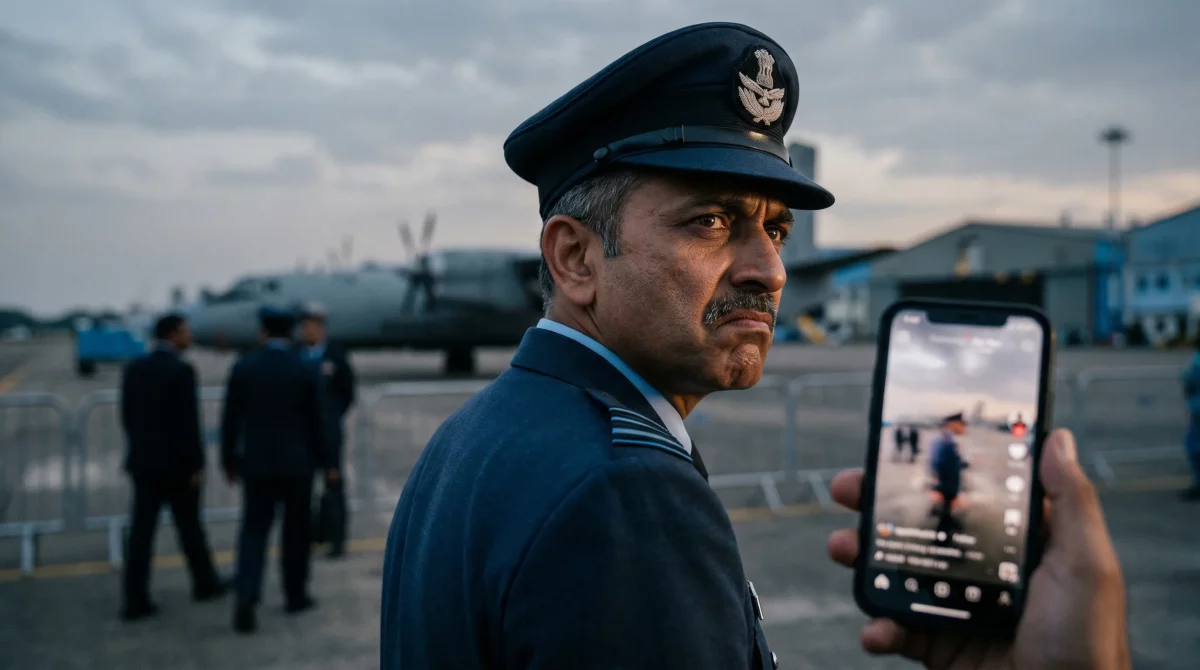
On January 22, 2017, while in uniform, the petitioner recorded and uploaded a video on his Facebook account, which had more than 2,000 followers. The video was subsequently circulated widely on social media platforms. In the video, he made the following specific allegations of unequal treatment:
- Officers receive full free rations, whereas jawans receive only ₹3,000 to ₹3,500 per month, an amount insufficient to purchase essentials such as milk and water.
- Officers are provided stitched uniforms delivered to their residences by logistics personnel, whereas jawans do not receive similar facilities; the petitioner stated he had not been issued shoes for the preceding two years.
- Although officers are more educated and receive higher pay, there exists a disparity in Military Service Pay (MSP) under the 7th Pay Commission — officers receive ₹15,000 while jawans receive ₹6,000.
- On temporary duty (T/D), officers travel in their own cars, claim allowances, and stay in hotels, whereas jawans travel without reservations and are often seated near toilets.
- At official parties or functions, officers’ families are addressed as “Ma’am,” while jawans’ families are ignored, causing the petitioner to feel ashamed to bring his wife before officers’ wives.
- The government pays for the job performed by all personnel; therefore, such wide differences between officers and jawans require examination.
The petitioner admitted to recording and uploading the video while in uniform.
IAF Proceedings and Dismissal
Following the video’s upload, the IAF constituted a Court of Inquiry. On August 29, 2017, a Show Cause Notice was issued to the petitioner. After considering his reply, the competent authority passed a speaking order on December 2, 2017, removing him from service under Section 20(3) of the Air Force Act, 1950, read with Rule 18 of the Air Force Rules, 1969. The order cited the conduct as bringing disrepute to the force, involving unsubstantiated public allegations, bypassing internal grievance mechanisms, and being prejudicial to service discipline, norms, and ethos. It further stated that the petitioner’s retention in service was undesirable.
The petitioner had not utilised the established internal redressal mechanisms available within the IAF before resorting to public dissemination of grievances.
Legal Challenge and Tribunal Decision
The petitioner challenged the removal before the Principal Bench of the Armed Forces Tribunal in New Delhi (OA No. 331/2018). The AFT dismissed the original application on October 17, 2025, holding that the administrative action was lawful, that there was no violation of principles of natural justice, and that the punishment was not arbitrary or shockingly disproportionate.
Delhi High Court’s Reasoning and Observations
In dismissing the writ petition, the Delhi High Court emphasised the limited scope of judicial review in matters concerning military discipline. The Court observed that the Armed Forces operate under unique requirements of command, hierarchy, operational efficiency, and discipline, and that courts intervene only in exceptional circumstances involving patent illegality, mala fides, procedural impropriety, perversity, denial of natural justice causing prejudice, or punishment so outrageously disproportionate as to shock the conscience of the Court.
The Bench held that public dissemination of service grievances by uniformed personnel through social media platforms carries consequences beyond the individual and has the potential to affect discipline, hierarchy, morale, and the institutional image of the force. It noted that the petitioner’s actions violated Air Force Order 17/2015 (which mandates caution in social media interactions) and Paragraph 11 of Chapter VIII of IAP 3903 (which requires extreme caution and restrains dissemination of service-related information).
Key observations from the judgment include:
“Public dissemination of service grievances while being in uniform, particularly through social media platforms, carries consequences extending beyond the individual concerned and has the potential to affect discipline, hierarchy, morale and institutional image.”
The Court further stated:
“Despite the existence of established internal mechanisms for redressal of grievances, the Petitioner chose not to avail such channels and instead resorted to public dissemination through social media. Thus, the punishment cannot be said to be so outrageously disproportionate as to shock the conscience of this Court.”
The Court rejected arguments regarding alleged violation of natural justice, the petitioner’s mental state or family circumstances, the reference to him as a “Technical Officer” in the Tribunal order, and the absence of Court Martial proceedings, holding that the administrative action following a Court of Inquiry, Show Cause Notice, and consideration of the reply was valid and independent.
Outcome
The Delhi High Court dismissed the writ petition and disposed of all pending applications. The removal from service stands upheld.
This ruling underscores the strict standards of conduct expected of members of the armed forces and the impermissibility of public airing of internal grievances through social media while in uniform, particularly when internal channels for redressal remain available. The judgment reaffirms judicial deference to the expertise of military authorities in maintaining discipline and institutional integrity within the Indian Air Force.