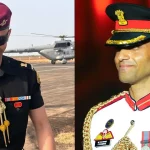

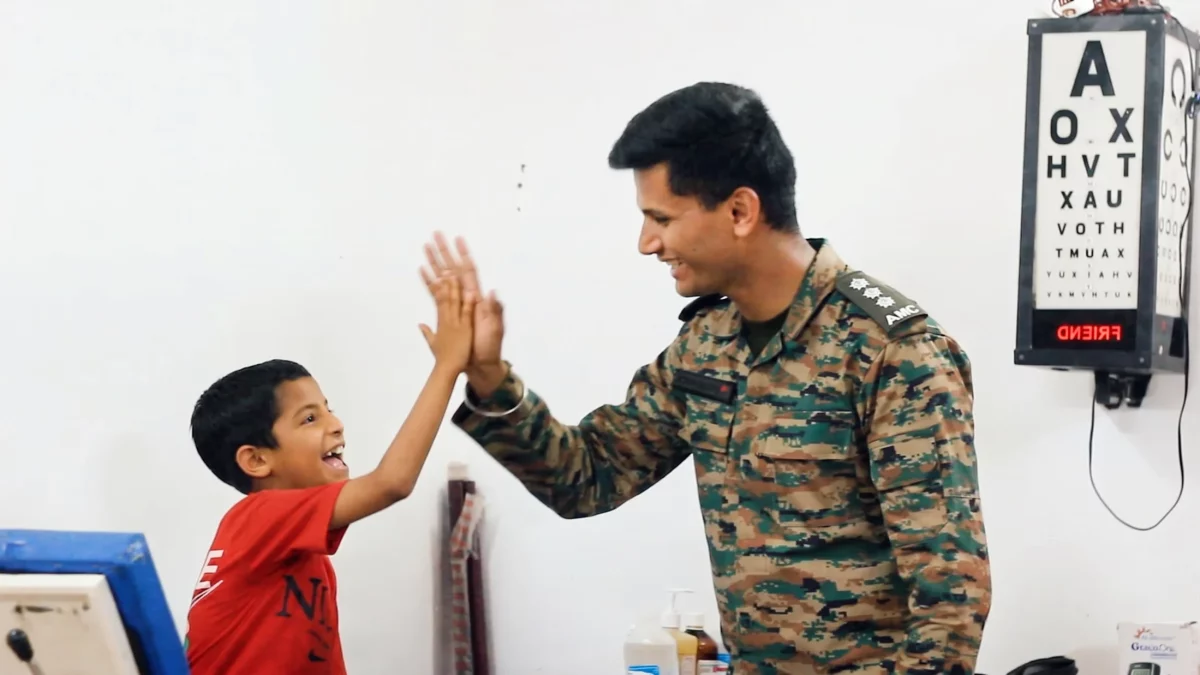
In a remote village of Jammu and Kashmir, an eight-year-old boy who had never spoken properly finally found his voice. The remarkable transformation of Akshay Sharma, a Class 3 student from Duggan village in Kathua district, became possible because of the compassion, patience, and determined efforts of Captain Saurabh Salunkhe, an officer of the Indian Army Medical Corps.




Captain Salunkhe, serving as the Regimental Medical Officer of 7 Sikh Light Infantry, went far beyond his routine medical responsibilities to help the young boy overcome years of silence. His initiative not only changed Akshay’s life but also highlighted the humane face of the Indian Army in remote border areas where access to specialised healthcare remains limited.
A Childhood Without Speech
Akshay Sharma was born with a cleft lip and palate, a congenital condition in which the lip or roof of the mouth does not develop properly before birth. When he was around three to three-and-a-half years old, he underwent corrective surgery at Pathankot Civil Hospital.
The surgery repaired the structural defect, but it did not solve the speech-related challenges that often remain after such procedures. For proper speech development, children with cleft lip and palate usually require consistent post-operative speech therapy. Unfortunately, Akshay’s family had no access to such specialised care.
His father, Kulwant Sharma, a labourer and civilian worker associated with the Indian Army, could not afford expensive therapy in faraway cities. Living in the remote Duggan area, the family had very limited medical options. As years passed, Akshay remained unable to speak, even though he was otherwise healthy and capable.
For the family, the silence became painful. They hoped that Akshay would begin speaking naturally with time, but that did not happen. By the age of eight, he had still not experienced the simple joy of calling out to his parents.
Captain Salunkhe Meets Akshay
The turning point came in mid-June 2025 during an Army medical camp in Duggan village. As part of the Indian Army’s outreach in remote areas, Captain Saurabh Salunkhe was providing medical support to local civilians.
During the camp, Akshay was brought for examination. Captain Salunkhe carefully assessed the boy’s condition and realised that his inability to speak was not irreversible. With proper training, exercises, and structured speech therapy, Akshay could potentially learn to speak.
However, there was one major challenge: there was no speech therapist available nearby.
For many, this would have meant simply referring the family to a distant facility and moving on. But Captain Salunkhe chose a different path. He decided to take personal responsibility for Akshay’s therapy.
Learning, Planning and Teaching
Although Captain Salunkhe had received basic exposure to speech therapy during his medical training, he was not a practising speech therapist. Still, he refused to let that become a limitation.
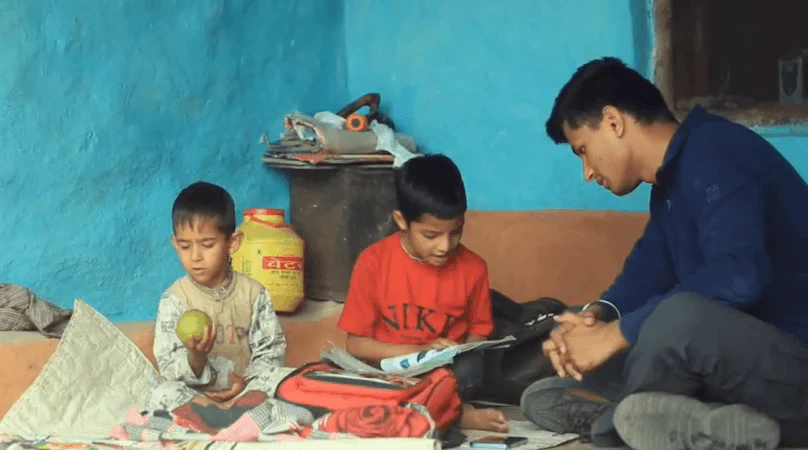
He began studying speech therapy methods through available resources, including online material, and designed a simple but structured plan suited to Akshay’s condition. The therapy did not depend on expensive equipment. It required patience, consistency, observation, and daily practice.
For nearly eight weeks, Captain Salunkhe reportedly spent two to three hours every day with Akshay. The sessions began with the basics and gradually moved towards more complex speech formation.
In the initial phase, Akshay was made to practise gargling exercises to stimulate his vocal tract and improve oral awareness. Captain Salunkhe then introduced controlled tongue and jaw movements to help the boy learn how to use his mouth and palate correctly.
As Akshay progressed, the training moved to different categories of sounds. He was taught to differentiate between nasal and oral sounds. Later, he practised labial sounds, palatal sounds, throat sounds, alphabets, syllables, words, and eventually short sentences.
The process was slow and demanding. It required discipline from the doctor, trust from the child, and hope from the family.
The First Words
After weeks of dedicated effort, the breakthrough finally came.
Akshay began forming words. Gradually, those words turned into short sentences. For the first time, he was able to speak with growing confidence.
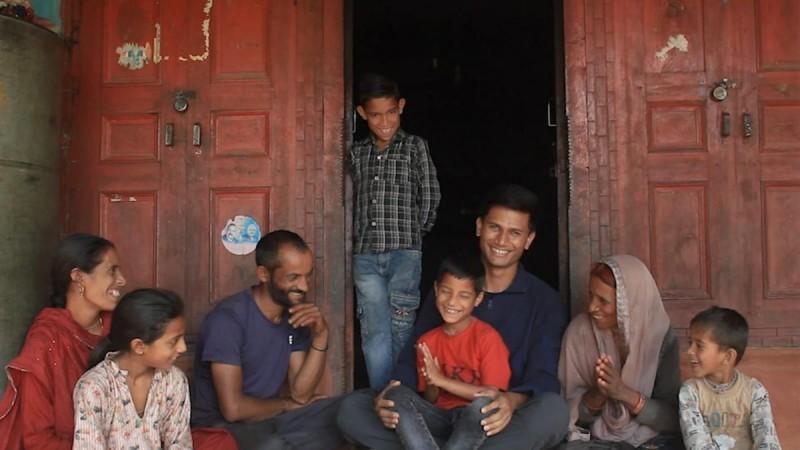
The most emotional moment came when Akshay called out to his parents. For a family that had waited years to hear his voice, it was an unforgettable experience. What had once seemed impossible had become a reality through consistent therapy and the extraordinary dedication of an Army doctor.
For Akshay’s parents, it was nothing less than a miracle. Their child, who had lived in silence for years, was finally able to communicate.
More Than a Medical Case
The story of Captain Saurabh Salunkhe and Akshay Sharma is much more than a medical success. It is a powerful reminder of how crucial follow-up care is after corrective surgeries for cleft lip and palate.
Surgery can repair the physical structure, but speech often requires proper training. Without speech therapy, many children may continue to face communication difficulties even after successful operations. In remote areas, this gap becomes even more serious because families often do not have access to specialists.
Captain Salunkhe’s intervention bridged that gap for Akshay. His work showed that even in resource-limited environments, a committed medical professional can create life-changing results through knowledge, effort, and empathy.
The Indian Army’s Humanitarian Role
The Indian Army is often seen through the lens of combat, security, and national defence. But in remote and border regions, Army personnel also play a vital humanitarian role. Medical camps, emergency assistance, education support, and community outreach often become lifelines for local populations.
In areas like Duggan, where civilian healthcare infrastructure may be limited, Army doctors frequently become the first point of medical support for villagers. Captain Salunkhe’s work is a shining example of this service ethos.
He did not restrict himself to routine duties. As an RMO, his primary responsibility was to care for soldiers and ensure the medical readiness of his unit. Yet he chose to invest his time and energy in a civilian child who needed help.
That decision changed a young boy’s life forever.
A Voice Restored, A Life Changed
By helping Akshay speak, Captain Saurabh Salunkhe gave him far more than words. He gave him confidence, dignity, and the ability to express himself. He opened the door for better learning, social interaction, and emotional connection with his family and friends.
For Akshay, the ability to speak is not just a medical achievement. It is the beginning of a new life.
For the Indian Army Medical Corps, the story reflects its proud tradition of service, compassion, and healing. For the nation, it is a reminder that heroism is not always found only on the battlefield. Sometimes, it is found in quiet rooms, in patient teaching, in daily effort, and in the smile of a child who speaks for the first time.
Captain Saurabh Salunkhe’s dedication stands as an inspiring example of service beyond duty. His actions prove that one committed individual can make a life-changing difference, even in the most remote corners of the country.