

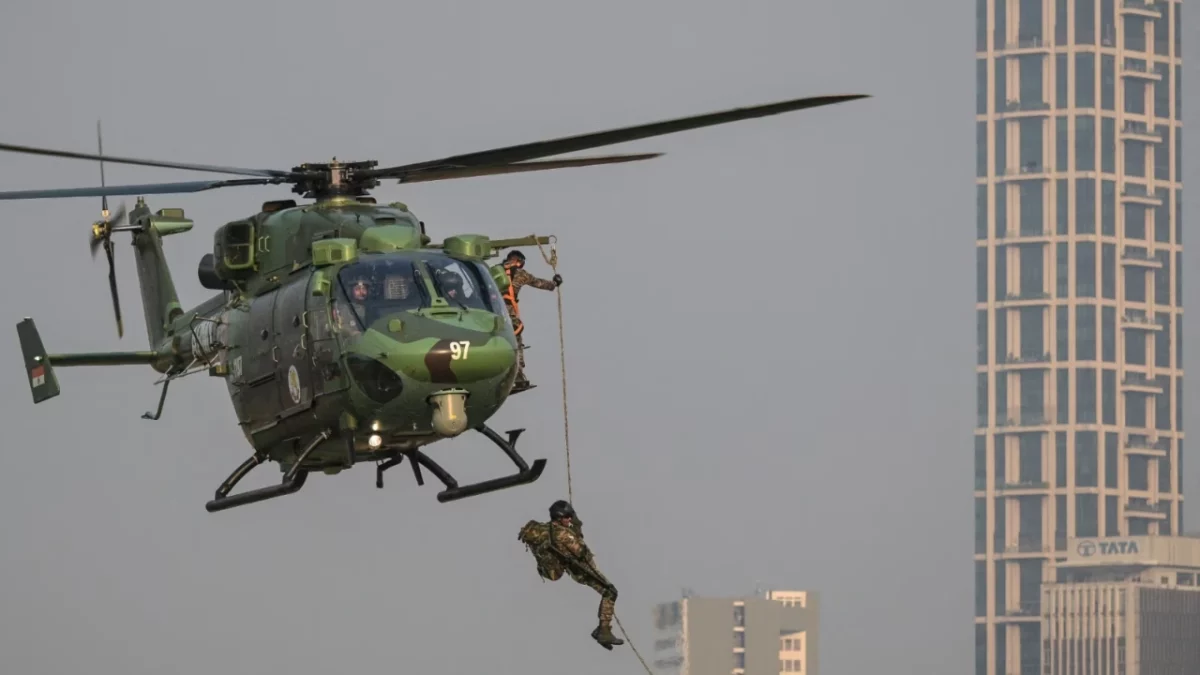
The Indian Air Force (IAF) is planning a major enhancement of its counter-drone capabilities by equipping its attack helicopters with specialised micro-missiles, artificial intelligence (AI)-enabled target identification systems and advanced electronic warfare equipment. The initiative forms part of the IAF’s broader effort to strengthen its air defence architecture in response to the rapidly evolving nature of modern warfare, where drones have emerged as a significant battlefield threat.





The proposal was outlined during the IAF-SIDM Seminar SANKALP 2026 in New Delhi, where the Air Force released its latest Problem Statements Handbook, inviting indigenous industry to develop advanced technological solutions for future operational requirements.
The proposed system envisages helicopters equipped with micro-missiles specifically designed to engage slow-moving, low-flying unmanned aerial systems (UAS), including loitering munitions and suicide drones. These precision weapons would complement forward-mounted 20 mm cannons, providing helicopters with multiple engagement options against aerial threats.
A key feature of the proposed capability is the integration of AI-driven target identification systems, enabling helicopters to rapidly detect, classify and track hostile drones while reducing operator workload. The system would be supported by lightweight airborne radio-frequency (RF) and GPS jammers, allowing helicopters to disrupt enemy drone communications and navigation signals before or during an engagement.
The IAF has also proposed the development of proximity-fused and time-delay fragmentation warheads for the micro-missiles. Unlike conventional direct-hit missiles, these warheads are designed to detonate near the target, dispersing high-velocity fragments over an estimated 25-metre lethal radius, significantly improving the probability of destroying small and highly manoeuvrable drones.
Although the Air Force has not officially identified the platforms that will receive these systems, the capability is expected to be integrated primarily on the AH-64E Apache attack helicopter and the indigenous Light Combat Helicopter (LCH) Prachand. Both platforms possess the agility, sensor suite and weapon integration capability required for dedicated anti-drone missions. The ageing Mi-25 and Mi-35 Hind attack helicopters, which are gradually being phased out of service, are unlikely to receive the new systems.
The initiative represents a significant shift in the IAF’s approach to countering unmanned aerial threats. Traditionally, anti-drone operations have relied predominantly on ground-based air defence systems, radars and electronic warfare assets. However, recent conflicts have demonstrated that terrain-masking tactics, low-altitude flight profiles and swarming drone attacks can reduce the effectiveness of static ground-based defences.
By employing helicopters as airborne counter-drone platforms, the Air Force aims to overcome these limitations. Helicopters operating at low and medium altitudes can detect and intercept drones beyond the line-of-sight limitations faced by ground-based systems, while also providing flexible and mobile air defence coverage for critical military installations and forward-deployed forces.
The move comes in the wake of Operation Sindoor, during which drones, loitering munitions and unmanned surveillance platforms played a prominent role in military operations. The experience reinforced the growing importance of developing layered counter-UAS capabilities capable of addressing both reconnaissance drones and armed unmanned systems.
The project also aligns with India’s broader push towards defence indigenisation under the Aatmanirbhar Bharat initiative. By publishing the operational requirements through the SANKALP 2026 problem statements, the IAF is encouraging Indian defence companies, start-ups and research institutions to develop indigenous AI-enabled sensors, electronic warfare systems and specialised micro-missile technologies tailored to future battlefield requirements.
As drone technology continues to evolve rapidly, the Indian Air Force’s plan to integrate AI, precision-guided micro-missiles and airborne electronic warfare systems into its helicopter fleet represents an important step towards building a more agile, technology-driven and future-ready air defence capability capable of countering emerging aerial threats.