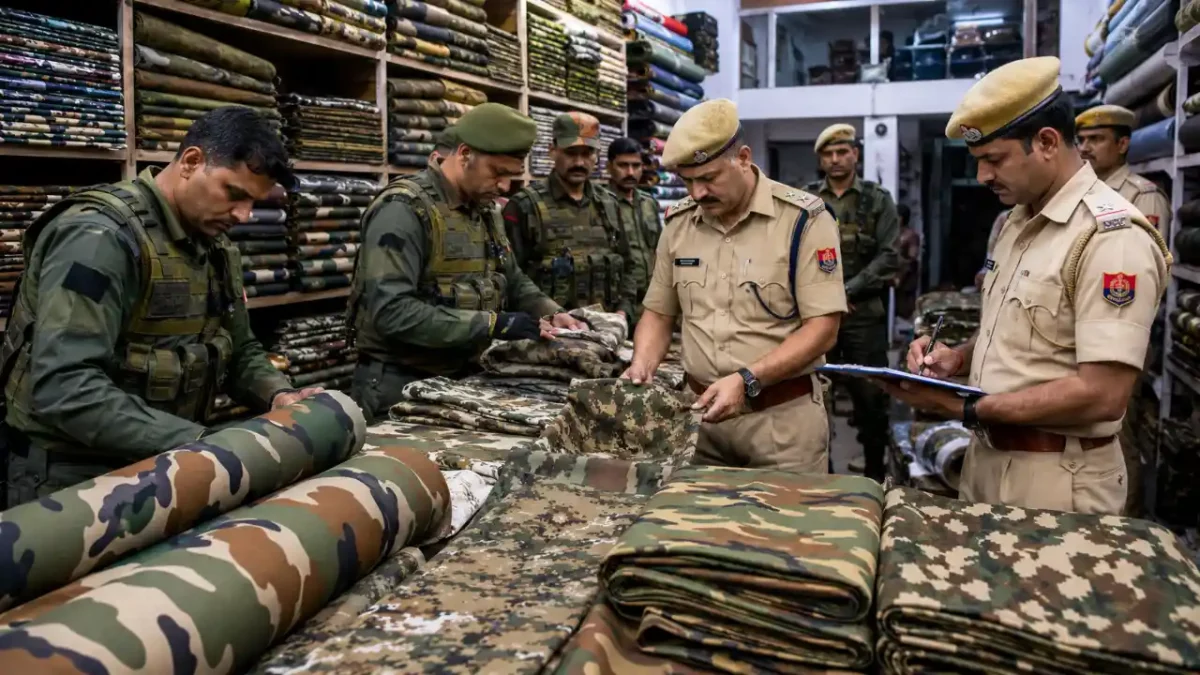
A joint operation conducted by Indian Army intelligence units and Rajasthan Police has led to the seizure of nearly 1,000 metres of unauthorised Army-pattern combat cloth from several shops across Rajasthan’s Sriganganagar district.





The operation has reportedly exposed a wider supply network allegedly involved in manufacturing and distributing counterfeit military uniform material to vendors in the region. The cloth resembled the combat-pattern fabric used for Indian Army uniforms but had not been authorised for commercial production or sale.
The investigation began after authorities recovered similar counterfeit combat cloth during an operation in Bareilly in June 2026. During the follow-up inquiry, the seized material was reportedly traced to a manufacturing source operating from Sriganganagar.
Based on this lead, Indian Army intelligence personnel initiated a discreet investigation in Sriganganagar to identify the individuals and businesses allegedly involved in the production, storage and distribution of the unauthorised fabric.
The investigation reportedly pointed towards a local firm suspected of serving as an important link in the supply chain. The firm was allegedly supplying Army-pattern combat cloth to shops located in Sriganganagar town and nearby areas, including Lalgarh Jattan and Suratgarh.
Following the intelligence inputs, coordinated searches were carried out with the assistance of Rajasthan Police at multiple commercial establishments across the district. During the operation, authorities recovered nearly 1,000 metres of fabric bearing patterns similar to those used in Indian Army combat uniforms.
The seizure has raised concerns over the unauthorised availability of military-pattern clothing in civilian markets. Counterfeit combat uniforms and fabric can potentially be misused by criminals, impersonators or other unauthorised individuals to gain access to sensitive locations or create a false impression of association with the armed forces.
The commercial sale of military-style uniform material also poses security challenges in districts located near international borders. Sriganganagar shares proximity with the India-Pakistan border and hosts several strategically important military establishments, making the unauthorised circulation of Army-pattern clothing a matter of particular concern.
Officials are expected to examine the records of the shops and firms allegedly involved in the supply network to determine the origin of the material, the quantity manufactured and the locations to which it was distributed.
Investigators may also verify whether the counterfeit cloth was supplied to vendors outside Rajasthan and whether the network had connections with manufacturers, wholesalers or retailers operating in other states.
The role of the local firm identified during the investigation remains under examination. Authorities are likely to question those associated with the business and scrutinise invoices, transportation records, financial transactions and communication details to establish the full extent of the alleged supply chain.
The joint operation highlights the importance of coordination between military intelligence units and state police forces in preventing the unauthorised production and sale of military-pattern equipment.
Further action will depend on the findings of the ongoing investigation and the applicable legal provisions. The identity of the firm and the shopkeepers involved has not been officially disclosed in the information available so far.
The seizure in Sriganganagar also indicates that the counterfeit combat cloth recovered in Bareilly may have been part of a broader distribution system rather than an isolated consignment. Authorities are now working to identify all individuals and commercial entities connected with the alleged network.
The investigation is continuing, and additional seizures or legal action may follow as officials trace the movement of the unauthorised Army-pattern fabric across different markets.