

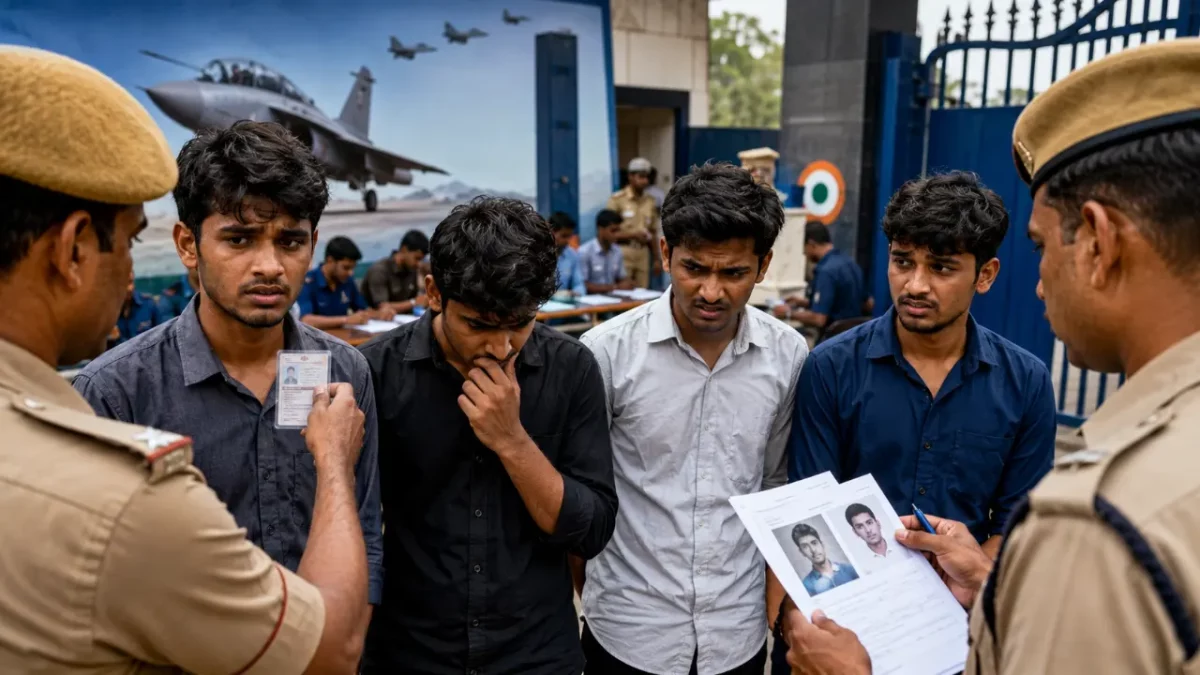
In a significant case of examination malpractice targeting Indian Air Force recruitment, four youths from Haryana were arrested for allegedly impersonating candidates and using sophisticated miniature electronic devices during the Agniveer Vayu written examination held at the Air Force Station in Avadi, Chennai, on Sunday, 2 August 2026.





The examination was conducted for lower division clerk (and in some accounts, civilian mechanical transport driver) posts under the Agniveer scheme. It aimed to fill just four vacancies but drew a large number of aspirants — reports put the figure between around 1,000 and 1,800 candidates from across the country.
How the fraud came to light
The racket was unearthed during routine but layered verification of hall tickets and admit cards. While the accused managed to clear the initial security checks at the entrance, invigilators conducting a second round of checks inside the examination hall noticed a clear mismatch between the photograph on one candidate’s admit card and the person sitting for the test.

The individual was identified as R. Gourav (also referred to as Gaurav), 21, a resident of Thua village in Haryana’s Jind district. He was appearing in place of S. Aman Kumar. Gourav was detained and taken to the room where he and his associates were staying. A search of the premises and subsequent questioning revealed the involvement of three other men from the same district.
Acting on the information, officials quickly identified and detained:
- S. Anil, 27, also from Jind district, who was impersonating H. Sunil (or Sunil Kumar).
- D. Sawan, 25, of Thua village, Jind.
- C. Deepak (Deepak Kumar), 24, of Ramna Patti, Jind district.
Sawan and Deepak were found using highly concealed electronic aids.
Nature of the cheating devices
The two candidates caught with devices had inserted tiny SIM-enabled GSM earpieces, each less than a centimetre in size, deep inside their ears. These wireless devices were designed to receive answers relayed from outside the examination hall. Officials also recovered additional equipment, including a Bluetooth dual SIM GSM box, a Bluetooth earpiece, eight mobile phones and 10 SIM cards.
A signal jammer installed at the examination venue is believed to have rendered the devices ineffective, preventing the cheaters from receiving any assistance during the test.
Money trail and confessions
During interrogation, the accused admitted they had received an advance payment of ₹50,000 each — either for appearing as proxies or for facilitating the electronic cheating. They were promised the balance amount after the original candidates cleared the recruitment process and secured the jobs.
The four men had travelled together to Avadi and were staying in the same accommodation, from where multiple bags containing the prohibited devices and related materials were recovered.
Police action and investigation
IAF officials completed their preliminary inquiry and handed the four accused over to the Muthapudupet police station. A case has been registered. The accused were produced before a magistrate and remanded in judicial custody.
Police are now investigating whether the group is part of a larger interstate examination fraud network. Efforts are on to trace the original candidates who hired the proxies, identify the middlemen who arranged the impersonation and supplied the high-tech devices, and determine the full extent of the racket.
Broader context
This is not an isolated incident at the same centre. In November 2024, a 25-year-old man from Haryana named Praveen Kumar was arrested at Avadi for impersonating a candidate in a similar IAF clerk examination. He had reportedly been promised a much larger sum (around ₹3 lakh) if the candidate cleared the process.
The Avadi case has been described in some reports as a “Vasool Raja”-style operation — a reference to organised, professional proxy and cheating arrangements that have plagued various competitive examinations across India. High-tech tools such as miniature GSM earpieces have become increasingly common in such rackets, posing a growing challenge to the integrity of recruitment tests, including those conducted by the armed forces.
For defence aspirants and the Indian Air Force, the incident underscores the critical importance of multi-layered verification, technological countermeasures (such as signal jammers), and continued vigilance. With only a handful of vacancies and intense competition, any compromise in the selection process not only undermines merit but also risks the entry of unsuitable personnel into a force that demands the highest standards of integrity and capability.
Further investigation is underway. Police sources indicate that the probe will examine links to other recruitment examinations and attempt to dismantle any wider network operating out of Haryana and beyond.