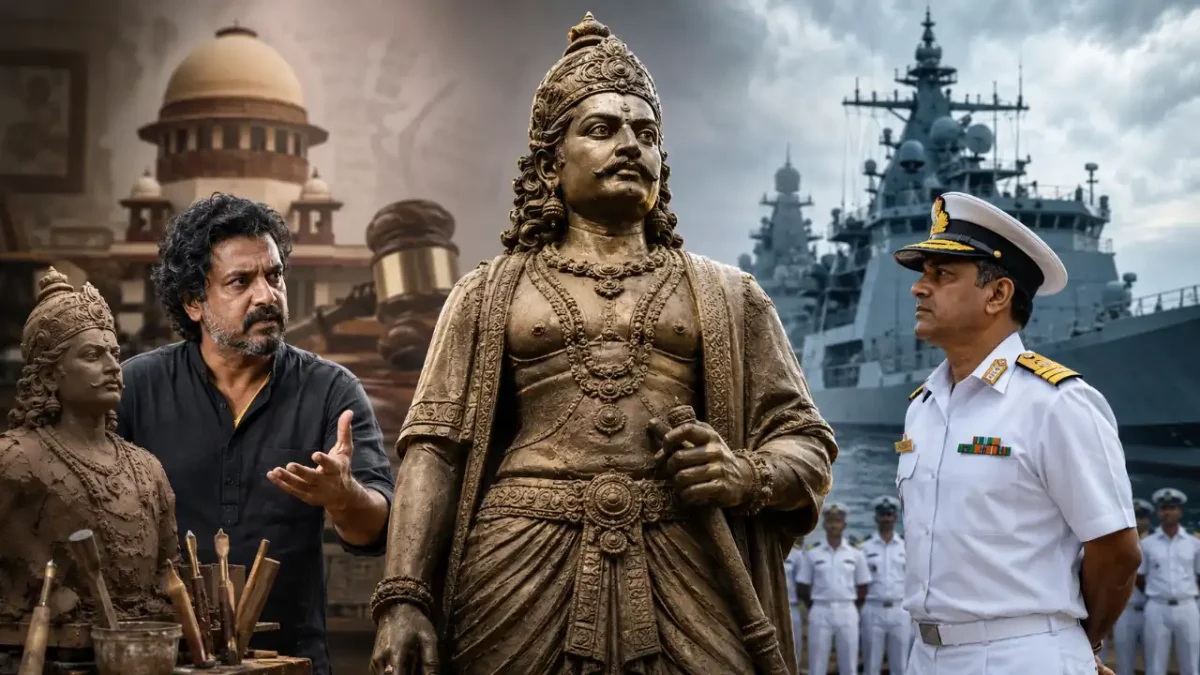
A Chennai-based artist has approached the Madras High Court alleging that the Indian Navy copied his original sculpture of Chola emperor Rajendra Chola I and installed a larger version at its headquarters in the city without his authorisation.





Artist Ashok Balakrishnan has filed a civil suit (Ashok Balakrishnan vs Union of India & Others) claiming copyright infringement, breach of confidence, violation of moral rights, and unjust enrichment. He has sought ₹15 lakh in damages along with other reliefs.
The Allegations
According to Balakrishnan, Navy officials first approached him to create a miniature sculpture of Rajendra Chola I. They later requested proposals for larger versions measuring 10 feet and 20 feet. He submitted an estimate of ₹8.79 lakh for the 10-foot statue and a separate estimate for the 20-foot version.
The artist claims that instead of awarding him the contract, the Navy shared photographs of his miniature sculpture with two other private sculptors. These sculptors then produced the larger 20-foot statue that has now been installed at the Naval Headquarters Office in Chennai.
To support his case, Balakrishnan relied on videos allegedly uploaded by the other sculptors on Facebook and Instagram showing the process of making the statue. His counsel argued that the Navy not only installed a statue based on his work without permission but also encouraged third-party sculptors to create moulds. This, he contended, could allow the production of hundreds of similar statues across the country, rendering his original work “completely insignificant.”
Balakrishnan further claimed that the installed statue does not reflect his artistic vision. He said his design portrayed Rajendra Chola as a majestic figure — historically regarded as one of the earliest naval powers in the region — whereas the installed version, in his view, depicts the emperor in a more submissive posture.
Court’s Interim Orders
Justice Kumaresh Babu of the Madras High Court heard the matter. The court restrained the two private sculptors from making any further reproductions of the disputed sculpture.
However, the court declined to order the removal or covering of the already installed 20-foot statue at the Naval Headquarters. When the artist’s side suggested covering the statue with gunny bags as an interim measure, the court questioned the necessity of such a step and observed that the statue could also be viewed as part of national heritage.
The court has sought responses from the Union government and the other defendants in the case. The plea for compensation remains under consideration, while prayers seeking dismantling of the statue and its delivery to the artist are pending.
Reliefs Sought
In addition to damages, Balakrishnan has prayed for:
- A permanent injunction restraining further duplication, copying, adaptation or modification of his work
- An order directing the dismantling of the monument installed at the Naval Headquarters and its delivery to him
Significance of Rajendra Chola
Rajendra Chola I (reigned c. 1014–1044 CE) is celebrated for expanding the Chola empire’s influence across the Bay of Bengal through naval expeditions, including campaigns against the Srivijaya kingdom. The Indian Navy has in recent years highlighted the Chola naval legacy as part of its historical and cultural outreach.
The case raises questions about the protection of an artist’s copyright and moral rights when government institutions commission and adapt artistic works, particularly those involving historical and cultural figures.
The matter remains pending before the Madras High Court.