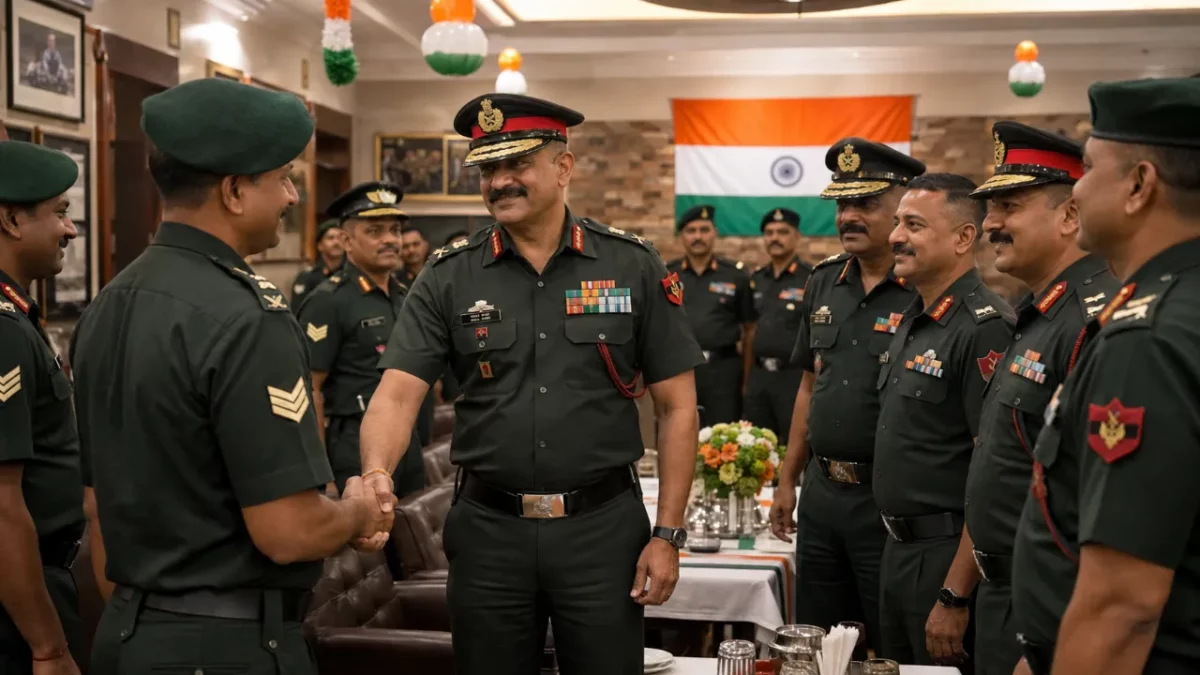
On Independence Day, 15 August, Junior Commissioned Officers (JCOs) of the Indian Army formally invite commissioned officers of their unit to the JCO Mess for lunch, high tea, or a shared meal and informal interaction. Officers reciprocate on Republic Day, 26 January, by hosting JCOs in the Officers’ Mess. This reciprocal custom is observed across units and regiments of the Indian Army. It is not a casual social event but a deliberate tradition that temporarily softens rank barriers, reinforces mutual respect, and strengthens unit cohesion.





Historical Origins
The practice has layered roots that combine a spontaneous post-Independence gesture, institutional formalisation, and older military cultural patterns.
On 15 August 1947, the first Independence Day, JCOs—who were Indian soldiers risen through the ranks—invited officers to their mess to celebrate the nation’s freedom together. At the time, a significant number of officers were still British, as Indianisation of the officer cadre was gradual. The invitation was a grassroots, voluntary act rather than an order from above. It expressed national ownership of the Army, confidence among Indian soldiers, and a desire to reduce colonial-era social distance. JCOs asserted that the institution now belonged to free India and that celebration of freedom should cut across ranks.
General K.M. Cariappa, the first Indian Commander-in-Chief (later Chief of Army Staff), recognised the value of this gesture. He institutionalised reciprocity: officers would invite JCOs to the Officers’ Mess on Republic Day. This created a balanced, two-way tradition rather than a one-sided courtesy. Sources describe it as combining spontaneous patriotism with structured institutional design. Some accounts place the formal reciprocal arrangement around the early years of the Republic (linked to 1950), while the 15 August invitation by JCOs is tied to the events of 1947 itself.
Older accounts note deeper continuity. The custom has been linked to British Indian Army practices and, in different forms, to princely state forces. Warrior leaders such as Shivaji, Maharana Pratap, and Maharaja Ranjit Singh were remembered for sharing the hazards, joys, and food of their soldiers. The Indian Army’s mess culture retained formal separation of ranks for discipline and professionalism while creating controlled occasions for cross-rank interaction. Post-Independence, the national days provided natural, high-symbolism moments for this.
Slight variations exist in emphasis across sources—some stress the 1947 JCO initiative as the primary spark for the Independence Day event, others highlight Cariappa’s formalisation of the reciprocal cycle, and earlier reports (including a 2006 Hindustan Times piece) note British-era and princely-state antecedents. The core practice itself is consistent and widely observed.
How the Tradition Is Practised
On 15 August, JCOs host officers in the JCO Mess (sometimes called the JCO Club). The atmosphere is deliberately more relaxed than routine military interactions. Rank formality is reduced; officers and JCOs converse freely, share views, and celebrate the day. Dress is typically regimental mufti—ties, cravats, and other “fauji” attire rather than full ceremonial uniform. The gathering often centres on lunch, high tea, or drinks and snacks. It remains disciplined and purposeful; it is not an abandonment of hierarchy but a temporary, controlled opening of social space.
The reverse occurs on 26 January in the Officers’ Mess, often with a banquet or cocktail-style interaction lasting a defined period. Both events are held unit-wide. They sit alongside other Army customs such as Bada Khana (shared community meals) that reinforce collective identity.
Timing adds further weight. Around Independence Day the President of India announces gallantry awards and honorary commissions (Honorary Lieutenant or Captain) for deserving JCOs. The unit-level mess invitation thus complements national recognition, linking formal honour with informal, face-to-face respect.
Why It Matters: Symbolism and Function
JCOs occupy a distinctive position. As Naib Subedars, Subedars, and Subedar Majors, they are gazetted officers commissioned by the President. They are the experienced bridge between commissioned officers and Other Ranks (jawans). They manage troop welfare, training, discipline, and the practical realities of unit life. The mess tradition publicly acknowledges their standing and experience.
The custom serves several practical and cultural purposes:
- Trust and cohesion: Officers and JCOs depend on each other in operations. Shared informal time builds understanding that routine hierarchy alone does not provide.
- Mutual respect without eroding discipline: The events occur only on the two most important national days and remain formal enough to preserve standards. Hierarchy is not abolished; it is humanised.
- National and institutional identity: Independence Day celebrates freedom from colonial rule; Republic Day celebrates constitutional equality and the Republic. Hosting across mess lines on these days reinforces that the Army belongs to the nation and that service transcends rank.
- Continuity of ethos: The Indian Army maintains separate messes (Officers’, JCO, Other Ranks) for good order. Controlled exceptions on national days prevent isolation while protecting professional boundaries—a balance not found in every military.
Retired JCOs and officers have described the gatherings as creating a “family-like” atmosphere in which people who rarely interact informally can exchange views. This contributes to the Army’s distinctive combination of strict discipline and regimental camaraderie.
Contemporary Relevance
The tradition continues in units across the country—from training establishments and hospitals to operational formations. Minor variations exist according to regimental custom or location, but the reciprocal pattern is standard. It remains relevant because modern armies still face the tension between necessary hierarchy and the need for genuine trust. In an era of complex operations, technological change, and diverse recruitment, deliberate occasions that reinforce shared purpose matter.
It also quietly educates younger officers and JCOs about the institution’s post-1947 character. The Army did not simply inherit colonial structures; it adapted them, added Indian leadership values, and created new symbols of unity. The mess exchange is one such living symbol.
In short, officers are invited to the JCO Mess on 15 August because that day marks national freedom, and the invitation began as (and continues as) a statement that the Army’s celebration of freedom and its internal bonds of respect run both ways. JCOs host on Independence Day; officers host on Republic Day. The practice is modest in form yet significant in meaning: it affirms that while ranks differ, the uniform, the mission, and the nation are shared.