

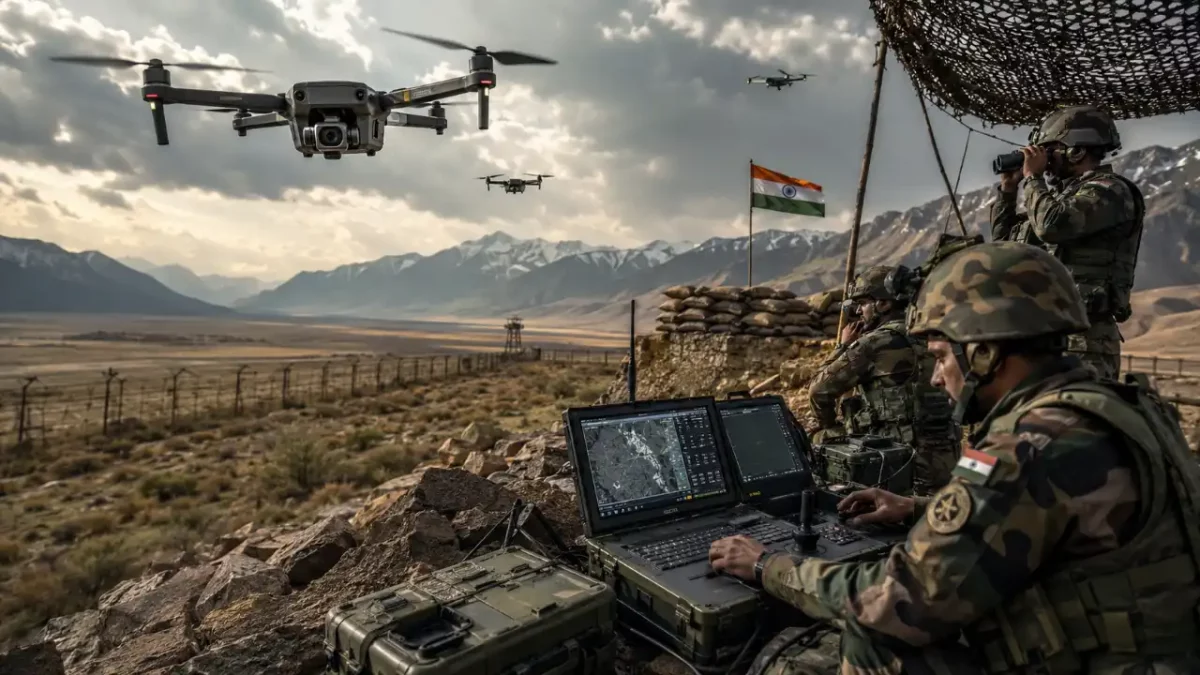
The Indian Army has raised its first dedicated ‘Baaz Battalion’ under the Jalandhar-based 11 Corps (Vajra Corps) to conduct specialised Remotely Piloted Aircraft (RPA) and unmanned systems operations along the western front with Pakistan. The unit, established in Jalandhar, marks a major organisational step in the Army’s post-Operation Sindoor transformation and forms part of a broader effort to create a structured, specialist force for large-scale drone warfare.





Named “Baaz” (Hindi for hawk), the battalion draws on the bird of prey’s associations with sharp vision, long-range tracking, and precision targeting. Its mottoes include “New Wings. New Capability. Decisive Edge” and “Eyes in the Sky. Edge on the Battlefield.” During the raising, the General Officer Commanding of Vajra Corps and all ranks extended best wishes to the battalion’s personnel, with the GOC underscoring the integration of technology, innovation, and operational excellence.
Strategic Context and Drivers
The initiative was first publicly outlined in late June 2026 by then Chief of the Army Staff General Upendra Dwivedi as one of the key measures under the Army’s “Decade of Transformation.” It builds directly on the existing Remotely Piloted Aircraft Flights and creates a specialist pool of trained personnel responsible for the full lifecycle of RPA operations deployment, maintenance, data exploitation, software upgrades, training standardisation, and seamless integration with ground forces.
Two sets of operational lessons proved decisive. Prolonged deployments and standoffs along the Line of Actual Control with China highlighted the need for persistent, high-altitude, and deep-area surveillance. More immediately, Operation Sindoor the Indian military response in May 2025 against terror infrastructure in Pakistan and Pakistan-occupied territory demonstrated the decisive role of drones and unmanned systems in intelligence, surveillance, reconnaissance (ISR), target acquisition, Suppression of Enemy Air Defences, and precision effects. Drones and surveillance platforms played an outsized role in building a clearer battlespace picture and shaping decisions under high tempo.
Compounding these lessons is the sheer scale of the Army’s unmanned inventory growth. From a few hundred drones roughly two years earlier, the force now fields more than 50,000 unmanned systems, with projections that the number could double within two to three years. Sustaining such numbers demands specialist manpower, standardised procedures, rapid replenishment cycles, and the ability to process high-density data streams functions that conventional units cannot efficiently absorb.
Layered Drone Architecture: Where Baaz Fits
The Baaz Battalion occupies a distinct operational tier in the Army’s emerging multi-layered unmanned architecture:
- Ashini (or Ashni) drone platoons embedded in infantry battalions handle tactical, short-range, “immediate-vicinity” surveillance and limited offensive tasks, typically with quadcopter-style platforms.
- Divyastra batteries (and planned Shaktiban regiments) within the Artillery focus on longer-range target detection and the employment of loitering munitions (one-way attack drones).
- Shaurya squadrons under experimentation in the Armoured Corps aim to enhance reconnaissance and manoeuvre support with aerial assets.
Baaz Battalions sit above these tactical layers. Placed under the Army Aviation Corps, they function as a centralised “nerve centre” or “brain” for sustained, operational-level ISR, deep-penetration reconnaissance, target designation, data fusion, and coordination across mixed fleets. They are designed to deliver persistent battlefield awareness, compress the sensor-to-shooter cycle, and support both defensive monitoring and offensive shaping along contested borders.
Platforms and Operational Reach
The battalion is configured to operate larger and longer-endurance platforms than the tactical systems assigned to infantry or artillery sub-units. Confirmed and planned systems include:
- Searcher-class UAVs
- Medium-Altitude Long-Endurance (MALE) platforms such as the Israeli Heron and Hermes families
- High-Altitude Long-Endurance systems, notably the MQ-9B (SkyGuardian) being acquired from General Atomics under a major government-to-government deal
- A growing inventory of Indian-made tactical and operational UAVs from firms including IdeaForge, SMPP, and NewSpace Research, with potential integration of DRDO’s Ghatak stealth UCAV and other indigenous armed/strike platforms in future phases
These assets enable prolonged border monitoring, deep-area surveillance inside adversary territory, real-time tracking of enemy order of battle and dispositions, and the generation of actionable intelligence for frontline commanders. The broader ecosystem under Baaz management also encompasses armed UAVs, FPV drones, loitering munitions, and logistics drones. AI-based battlefield decision-support systems are expected to play a central role in prioritising and exploiting the volume of data generated by mixed fleets.
Significance for the Pakistan Front and 11 Corps
11 Corps (Vajra Corps), headquartered in Jalandhar and nicknamed the “Defenders of Punjab,” is responsible for some of the most sensitive stretches of the India-Pakistan international border in northern Punjab terrain that witnessed major fighting in both the 1965 and 1971 wars. Raising the first Baaz Battalion here directly addresses the need for enhanced aerial agility, responsiveness, and reach in this historically and operationally critical sector.
The unit will operate alongside the existing Army Aviation Squadron in Jalandhar that flies Cheetah and Chetak helicopters (including in Humanitarian Assistance and Disaster Relief roles). Together they form an expanded aerial layer for the Corps. Officials describe Baaz as adding a potent new dimension that provides frontline units with advanced surveillance and situational-awareness tools while centralising the technical and logistical demands of high-intensity drone operations.
Broader Transformation and Future Trajectory
No final number of Baaz Battalions has been announced, but the model is expected to be replicated at other field formations over time as the unmanned inventory expands across the western and northern fronts. The raising fits into a wider suite of reforms that include Bhairav Battalions, Rudra all-arms brigades, Unified Control Centres at division level for coordinating UAS and counter-UAS assets, and continued investment in both offensive and defensive unmanned capabilities.
In essence, the Army is moving beyond simply adding drones across existing structures toward building a dedicated organisational and human capital framework around them. The goal is a force capable of continuous sensing, rapid decision-making, precision effects, and adaptation in contested electromagnetic and aerial environments lessons drawn not only from India’s own recent operations but also from global conflicts that have underscored the centrality of unmanned systems.
The first Baaz Battalion under 11 Corps is therefore more than a new unit: it is the initial operational expression of a doctrinal and structural shift that seeks to give Indian ground forces a decisive, persistent edge in the skies over one of the country’s most sensitive frontiers.