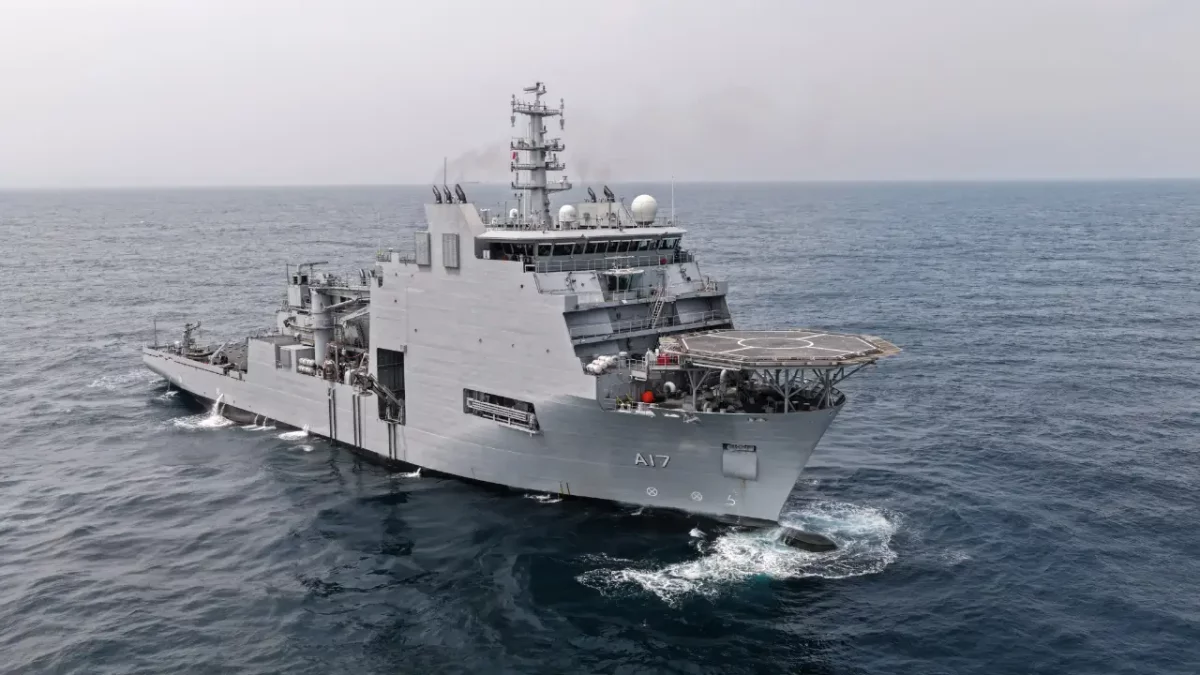
Mumbai / New Delhi: The Indian Navy will commission Nipun, the second Nistar-class Diving Support Vessel (DSV), at the Naval Dockyard in Mumbai on 31 August 2026, completing a two-ship indigenous programme built to give India dedicated, two-coast capability for deep-sea diving, underwater intervention and submarine rescue.





The specialised platform was designed and constructed by Hindustan Shipyard Limited (HSL) at Visakhapatnam and delivered to the Navy on 30 July 2026 after outfitting and trials. Its induction will place a matching DSV on the west coast, alongside sister ship INS Nistar, which was commissioned at Visakhapatnam in July 2025 and is based with the Eastern Naval Command.
The Sanskrit name Nipun means one who is adept, capable and well-versed in a particular discipline — a description the Navy has applied to a ship built for work that few navies can sustain independently.
From leased platforms to a two-ship class
Until the Nistar class entered service, the Navy’s dedicated diving-support and submarine-rescue work often depended on commercially leased vessels such as SCI Sabarmati, used as temporary motherships for Deep Submergence Rescue Vessels (DSRVs). An earlier ship also named Nistar, acquired in the Soviet era, had left service decades ago. The gap mattered as India’s submarine force grew and as accidents such as the 2021 loss of Indonesia’s KRI Nanggala underlined how quickly a rescue window can close.
The contract for two indigenous DSVs was signed with HSL on 20 September 2018, valued at about ₹2,393 crore for the pair. Keels were laid in December 2019 (Nistar) and March 2020 (Nipun). Both hulls were launched together on 22 September 2022. The original delivery calendar slipped, in part because of the Covid-19 disruption; Nistar was handed over on 8 July 2025 and commissioned on 18 July 2025, with Nipun following a year later.
Nistar has already been used operationally. In September 2025 she took part in Exercise Pacific Reach off Singapore, deploying DSRV Tiger X in mating drills with foreign submarines — a public demonstration of the rescue architecture the second ship is now meant to mirror on the western seaboard.
What the ship is built to do
Official statements describe Nipun as a purpose-built platform for a wide spectrum of diving and underwater work, not a general-purpose auxiliary with diving gear added on. Core missions include:
- Saturation diving to about 300 metres, allowing divers to remain at working-depth pressure for extended periods rather than making repeated surface-to-bottom trips.
- Air and mixed-gas diving from a side diving stage, typically cited for operations down to about 75 metres.
- Submarine rescue, as mothership for a DSRV that can mate with a distressed submarine and evacuate personnel.
- Salvage and intervention, using remotely operated vehicles (ROVs) for diver monitoring and work reported down to about 1,000 metres.
- Medical support, including hyperbaric and hospital facilities needed after deep dives or a rescue.
The Ministry of Defence says the ship has modern navigation and platform-management systems and precise station-keeping — essential if divers, a diving bell or a DSRV are working under the hull while the ship must hold position in swell and current. Dynamic positioning of DP-2 class is part of the class design.
Class-wide equipment described across official and technical accounts includes a moon-pool-launched submersible decompression chamber (diving bell), a six-person decompression chamber, a self-propelled hyperbaric lifeboat, observation-class ROVs, side-scan sonar, a roughly 15-tonne-class subsea crane, and a flight deck for helicopter operations. The ships also carry limited self-defence armament, including 30 mm AK-630 close-in weapons.
Satulation diving is the capability that most clearly separates a true DSV from a diving tender. Divers live in pressurised chambers on board, transfer under pressure to the work site, and decompress only at the end of a multi-day job. That is how pipelines, wrecks, hull fittings and seabed infrastructure are worked at depths where bounce diving is inefficient or unsafe.
Size, endurance and the numbers that vary
Official Navy language on the lead ship describes a vessel about 118 metres long with a displacement of nearly 10,000 tonnes. Other briefings on Nipun have used “over 8,560 tonnes.” Independent technical summaries commonly list about 118.4 metres length, 22.8–23 metres beam, diesel propulsion, a cruise speed near 14 knots, endurance of about 60 days, and accommodation on the order of 25 officers and 225 sailors. Displacement figures should be treated as approximate until the Navy publishes a single official table for Nipun.
What is consistent is scale: the ship is large enough to carry saturation systems, a DSRV, ROVs, medical spaces and stores for long deployments without becoming a floating workshop that cannot stay on station.
Mother ship for submarine rescue
The operational centrepiece is the DSRV role. India acquired two deep-submergence rescue systems so that a response can be mounted from either coast. A DSRV is a small, pressure-resistant craft that is launched from a surface mothership, locates a disabled submarine, mates with its rescue hatch, and transfers crew to safety. Without a dedicated mothership that can hold position, handle the vehicle, treat survivors and support saturation or hyperbaric care, the DSRV is only half a system.
Nistar covers the east, where much of the nuclear submarine infrastructure is concentrated. Commissioning Nipun at Mumbai is intended to give the Western Naval Command a comparable host. Together, the two ships reduce the risk that a single hull in refit, or a crisis on the opposite coast, would leave the Navy without a ready rescue platform.
The same hull can support salvage, wreck survey, harbour-clearance diving and non-combatant or search-and-rescue tasks. Those secondary roles matter in peacetime more often than a full submarine disaster, but the design driver remains the rescue mission.
Indigenous content and HSL’s role
The Navy and the Ministry of Defence put indigenous content at nearly 75 per cent on Nipun; some industry accounts on the class use a figure above 80 per cent. The ships were designed and built to Indian Register of Shipping classification rules. HSL, a Miniratna defence PSU with a long history that includes submarine work, used a wide vendor base — reports around the delivery cited about 120 micro, small and medium enterprises. Acceptance documents at delivery were signed by Rear Admiral Arvind Rawal, Chief Staff Officer (Technical), Western Naval Command, and Rear Admiral Chandrasekharan Raghuram (Retd.), Chairman and Managing Director of HSL.
Officials have framed the programme as part of Aatmanirbhar Bharat and Make in India: not only hull steel and outfit, but the harder task of integrating saturation systems, dynamic positioning, medical hyperbaric plant and DSRV handling on an Indian-built warship. That does not mean every subsystem is Indian-origin; specialised diving and rescue plant is a thin global market. The policy claim is that the platform as a whole is no longer a foreign lease or a one-off import.
The class is separate from the smaller Diving Support Craft programme (catamaran hulls built by Titagarh Rail Systems for coastal diving). Those boats complement, rather than replace, the two large DSVs.
Why the timing matters
India’s submarine inventory — conventional boats on both coasts and nuclear boats centred on the east — is expanding as new Kalvari-class boats and indigenous nuclear programmes mature. Every additional hull increases the statistical and operational need for rescue cover. A DSV is also a tool of maritime diplomacy: Nistar’s Pacific Reach deployment showed that India can offer a rescue asset in a multinational setting, not only for its own fleet.
There is a quieter industrial point. Complex auxiliaries are often harder to design than they look. A destroyer’s combat system is demanding; a DSV’s combination of station-keeping, life-support under pressure, and subsea handling is demanding in a different way. Delivering a second ship a year after the first suggests HSL has moved from a prototype learning curve toward a repeatable build — even if the original 36-month contractual clock was missed.
What commissioning will and will not finish
On 31 August, Nipun will shift from builder’s and acceptance trials into commissioned service. That is not the same as full operational certification of every diving regime. Saturation systems, DSRV mating and medical pathways typically continue under naval diving and submarine-rescue units after the commissioning pennant is hoisted. The Navy’s language is that the ship will “augment” rescue capability and strengthen specialised missions “across India’s maritime areas of interest.”
Once both Nistar-class ships are in commission, India will, for the first time, own two purpose-built indigenous motherships rather than depending on a single new hull plus leased commercial tonnage. That is the practical meaning of this week’s ceremony in Mumbai: not a glamorous capital ship, but a second specialist platform in a niche that decides whether a submarine accident remains a rescue or becomes a recovery.