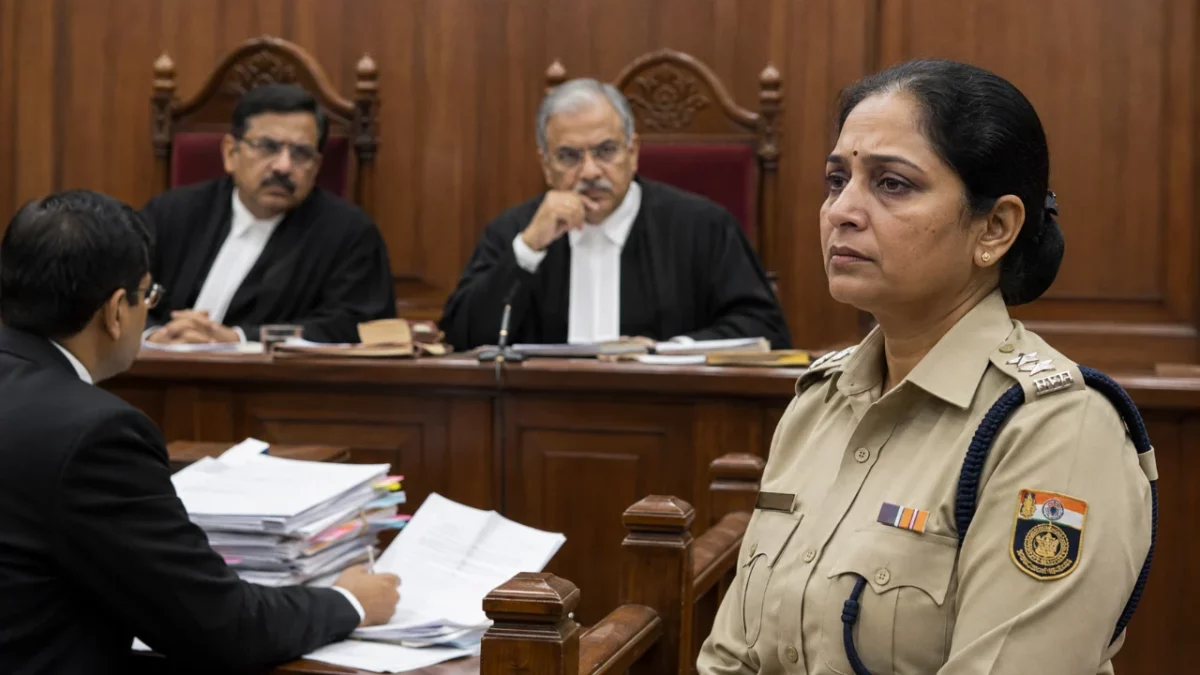
Ahmedabad, September 1, 2026 — The Gujarat High Court on Monday warned the Union government and senior officers of the Central Reserve Police Force (CRPF) of contempt proceedings if they fail to amend service rules that discriminate against HIV-positive personnel within a court-fixed deadline.





A division bench of Chief Justice Sunita Agarwal and Justice D.N. Ray rejected an affidavit filed by the Union Home Ministry and observed that the force had still not aligned its medical and recruitment rules with the Human Immunodeficiency Virus and Acquired Immune Deficiency Syndrome (Prevention and Control) Act, 2017. The statute prohibits discrimination against persons living with HIV in employment and occupation.
“It is not about combat forces… it is about people who are there in your institution… This stigma has to go… The Act does not permit you to discriminate… if one catches HIV virus during service,” the bench remarked orally.
The warning arose in the long-running case of a woman officer, a now-retired woman CRPF officer in the ministerial cadre who was repeatedly denied promotion solely because she is HIV-positive.
How the dispute began
She joined the CRPF as Assistant Sub-Inspector (Ministerial) on June 5, 1991. She was diagnosed HIV-positive around 2013. Medical records over the following years showed fluctuating SHAPE categories — the force’s fitness grading system — even when her CD4 counts remained well above clinical thresholds associated with severe illness.
SHAPE-1 denotes that a serving member is fully fit across five parameters: Psychological (S), Hearing (H), Appendages (A), Physical Capacity (P) and Eyesight (E). Clause 4.13 of Standing Order No. 04/2008, issued on November 18, 2008, and Rule 5 of the CRPF Assistant Commandant (Ministerial) Recruitment Rules, 2011, treated SHAPE-1 as a prerequisite for promotion across ranks, including purely desk-based ministerial posts.
She was denied promotion to Inspector (Ministerial) in Departmental Promotion Committees for 2016-17, 2017-18 and 2018-19 on the strength of a 2015 medical report placing her in SHAPE-III. She was later promoted to Inspector in 2019, but without the retrospective seniority and financial benefits her juniors received. In 2024 she was again excluded from consideration for Assistant Commandant (Ministerial) after a temporary SHAPE-II classification, despite a CD4 count of 562.
She approached the High Court in 2025 through advocate Swapneshwar Goutam, challenging the rules as contrary to the 2017 Act and Articles 14, 16 and 21 of the Constitution.
The August 2025 judgment
On August 4, 2025, the same bench declared Clause 4.13 of the 2008 Standing Order and Rule 5 of the 2011 Recruitment Rules ultra vires the Constitution and the 2017 Act insofar as they applied to HIV-positive personnel. Other clauses of the Standing Order (4.15 to 4.17) were also directed to be amended so that no benefit, opportunity or advantage could be withheld from HIV-positive employees, whether directly or by effect.
The court called the Centre’s failure to update the rules after the 2017 Act a “sorry state of affairs” and held that the authorities had “perpetuated discrimination.” It directed that She be given promotion to Inspector (Ministerial) from the date her juniors were promoted, with consequential financial benefits, and that a special Departmental Promotion Committee consider her for Assistant Commandant (Ministerial) after placing her in the gradation list with her batch. The entire exercise was to be completed within two months.
The bench emphasised that ministerial posts do not involve the physical demands of combat or field deployment. Even under the Standing Order’s own tables, personnel in certain lower SHAPE categories remain fit for duties that do not require severe physical stress, particularly when antiretroviral therapy is available.
A year of non-compliance
Implementation lagged. The CRPF later assigned an effective promotion date of August 2019 rather than the earlier date on which juniors had moved up. The court found “no confusion” in its original order and issued a show-cause notice for willful non-compliance. In December 2025 the petitioner returned to court seeking clarification. Subsequent affidavits were found inadequate.
In July 2026, counsel for the Centre pointed to an internal proposal sent to medical authorities of the Central Armed Police Forces and onward to the Ministry of Home Affairs. The bench noted that the amendment remained pending and that no proper compliance affidavit had been filed. It then directed that a responsible officer from the Home Secretary’s office file an affidavit by August 31, 2026, warning of an adverse order if the deadline was missed. On Monday that affidavit was rejected.
Why the 2017 Act matters
Section 3 of the HIV and AIDS (Prevention and Control) Act, 2017, bars discrimination against a “protected person” in employment or occupation. The Act treats HIV status as a protected characteristic and requires reasonable accommodation rather than blanket exclusion. The High Court held that treating HIV-positive personnel as if they suffer from a permanent, career-ending illness — even when they are clinically stable and working in non-combat roles — is arbitrary and unconstitutional.
The case is not isolated. Courts in other jurisdictions have similarly struck down or read down medical-category bars that automatically exclude HIV-positive personnel from promotion. The Gujarat bench observed that earlier High Court rulings on the same issue had been ignored while the 2008 Standing Order continued to be applied.
Broader implications
The ruling and the contempt warning reach beyond one officer. They apply to HIV-positive personnel across the CRPF and, by implication, other Central Armed Police Forces that use similar SHAPE-based promotion filters. Ministerial and other sedentary cadres are the clearest case: there is no operational justification for denying career progression on the basis of a treatable chronic condition when the employee remains fit for the actual duties of the post.
The court has made clear that stigma cannot substitute for individual medical assessment. If the Centre and CRPF do not now amend the Standing Order and recruitment rules, they risk formal contempt proceedings against senior officers, including those in the Ministry of Home Affairs.
The matter remains pending for compliance. The bench has left little room for further delay.