
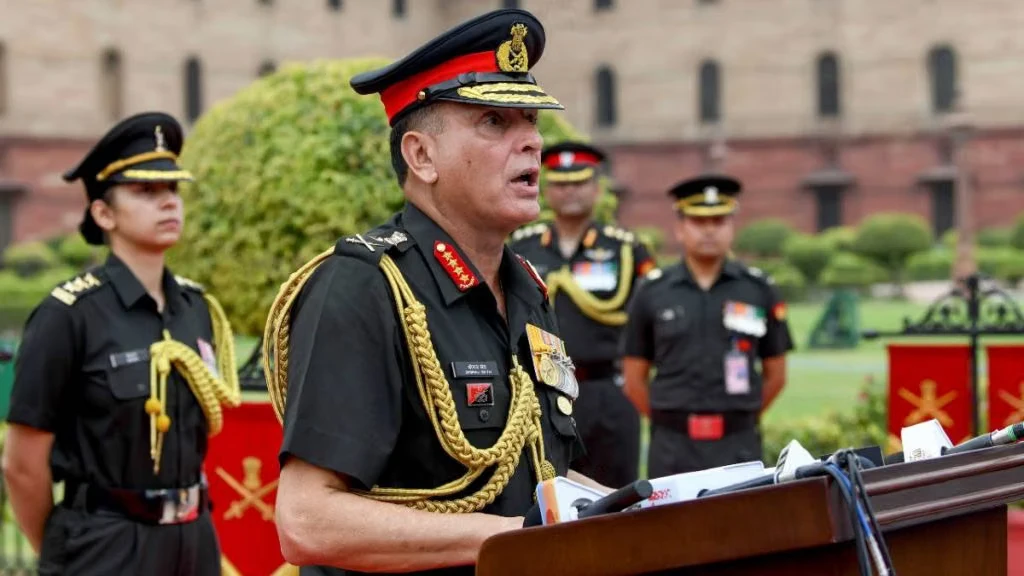
Chief of the Army Staff General Dhiraj Seth is set to travel to Russia on Wednesday for an official visit, with discussions expected to cover the sustainment of India’s extensive Russian-origin military inventory as well as potential acquisition and cooperation on new defence platforms.
According to a report cited by Firstpost, General Seth is expected to meet his Russian counterpart, Colonel General Andrei Mordvichev, along with other senior Russian military officials. The visit would mark the first visit by a serving Indian Army chief to Russia in nearly six years, with General Bipin Rawat being the last Army chief to visit Moscow in October 2018.
The visit comes at an important juncture in India’s defence relationship with Russia. While New Delhi has been steadily diversifying its defence procurement and placing greater emphasis on indigenous production, Russian-origin systems continue to constitute a substantial part of the Indian Army’s combat inventory.
Russian and Soviet-origin platforms remain particularly significant across the Army’s armoured, mechanised infantry and air-defence elements. This makes the continued availability of spares, maintenance support, ammunition, upgrades and technical assistance an important component of India’s operational preparedness.
One of the likely priorities during General Seth’s discussions will therefore be the supply of spare parts and other requirements for Russian-origin equipment already in service. Sustaining these systems remains important as the Army simultaneously transitions towards newer indigenous and diversified platforms.
India’s dependence on Russian equipment has been shaped by decades of military-technical cooperation. Armoured personnel carriers, assault rifles, tanks, rocket systems and air-defence equipment have formed important components of the Army’s inventory, while much of the Armoured Corps and Mechanised Infantry continues to operate Russian-origin platforms.
The Russian side is also reportedly pushing new proposals, potentially giving the Army chief’s visit a broader agenda than the maintenance of legacy equipment. Among the systems that could figure in discussions is the Pantsir-S1M, an upgraded short-range mobile air-defence system.
The Pantsir-S1M could potentially be considered in the context of India’s Carrier Air Defence Tracked (CADET) requirement. Under the reported requirement, the Army plans to acquire at least 90 systems with a minimum of 50 per cent indigenous content. Such systems are intended to provide air-defence protection to mechanised formations operating across different geographical environments, including plains, deserts and high-altitude areas.
Any consideration of a foreign-origin system would have to be viewed against India’s broader push for greater indigenous content and domestic manufacturing. The CADET requirement itself reflects the growing importance of mobile air defence for protecting manoeuvring formations against increasingly diverse aerial threats.
Another potential subject of discussion is the Russian offer of the BMP-3 infantry fighting vehicle as India looks to modernise its mechanised infantry fleet.
The Indian Army has operated the BMP family for decades, with thousands of BMP vehicles produced in India under licence. The platform remains an important element of mechanised infantry formations, even as the Army pursues an indigenous programme to upgrade its existing BMP-2 fleet.
The reported Russian offer could therefore feed into a larger debate over the future of India’s mechanised infantry capability. New Delhi faces the choice of extending the life and capability of existing platforms, developing indigenous replacements or considering newer foreign-origin systems, depending on operational requirements, cost, technology transfer and indigenous-content considerations.
The Army’s search for a new-generation main battle tank could constitute another significant area of discussion. Under the Future Ready Combat Vehicle (FRCV) programme, India is seeking a next-generation tank capability that will eventually replace ageing T-72 and T-90 fleets.
Russia could potentially offer technologies associated with its newer tank designs, including the T-14 Armata, or explore possibilities for joint development and manufacturing tailored to Indian requirements, according to the report cited by Firstpost.
Any such proposal would need to be assessed against India’s long-term objective of developing indigenous armoured fighting vehicle capabilities. The FRCV programme is expected to shape the future of the Army’s armoured formations and could become one of the country’s most consequential land-warfare modernisation programmes.
At the same time, India’s existing relationship with Russian defence equipment continues to involve substantial sustainment and upgrade requirements. In March, India signed a contract worth Rs 445 crore for the upgrade and sustainment of Russian-origin Tunguska air-defence missile systems operated by the Army.
The example illustrates the dual-track nature of India’s current defence modernisation strategy. While the country is increasingly pursuing indigenous platforms and diversifying suppliers, existing Russian-origin systems will remain in service for years and therefore require sustained maintenance, modernisation and life-cycle support.
General Seth’s Moscow visit also follows heightened diplomatic and strategic engagement between the two countries. External Affairs Minister S Jaishankar travelled to Russia in August and met Russian First Deputy Prime Minister Denis Manturov. Russian President Vladimir Putin also invited Prime Minister Narendra Modi to Moscow for the 24th India-Russia Annual Summit on the sidelines of the BRICS Summit.
Against this backdrop, the Army chief’s visit provides an opportunity to reinforce military-to-military engagement while addressing practical defence requirements. Discussions between senior military leadership can help review ongoing cooperation, identify bottlenecks in equipment support and explore possible avenues for future collaboration.
For India, the challenge is to maintain the operational availability of a large legacy inventory while accelerating the transition towards a more diversified and self-reliant defence ecosystem. Russian-origin platforms remain deeply embedded in the Army’s force structure, making a complete shift away from them neither immediate nor operationally practical.
The focus is consequently increasingly moving towards managing the transition—ensuring that existing platforms remain combat-effective while newer indigenous systems progressively enter service. Cooperation with Russia on upgrades, spares and technology could remain relevant within this transition, even as India expands partnerships with other countries and strengthens domestic defence manufacturing.
The reported proposals on air defence, mechanised infantry and future armoured vehicles also demonstrate the breadth of the defence relationship. However, whether any proposal progresses beyond discussions would depend on India’s operational requirements, acquisition procedures, indigenous-content objectives, technology-transfer terms and broader strategic considerations.
General Dhiraj Seth’s Russia visit is therefore significant on multiple levels. It comes at a time when India is seeking greater self-reliance without compromising the readiness of existing combat formations, while Russia remains a major historical source of military technology and equipment for the Indian Army.
The visit is expected to underline India’s continued engagement with Moscow even as New Delhi pursues diversification and domestic production. For the Army, the immediate priority remains clear: ensuring that its existing Russian-origin systems remain operationally available while evaluating technologies and platforms that could contribute to the force structure of the future.