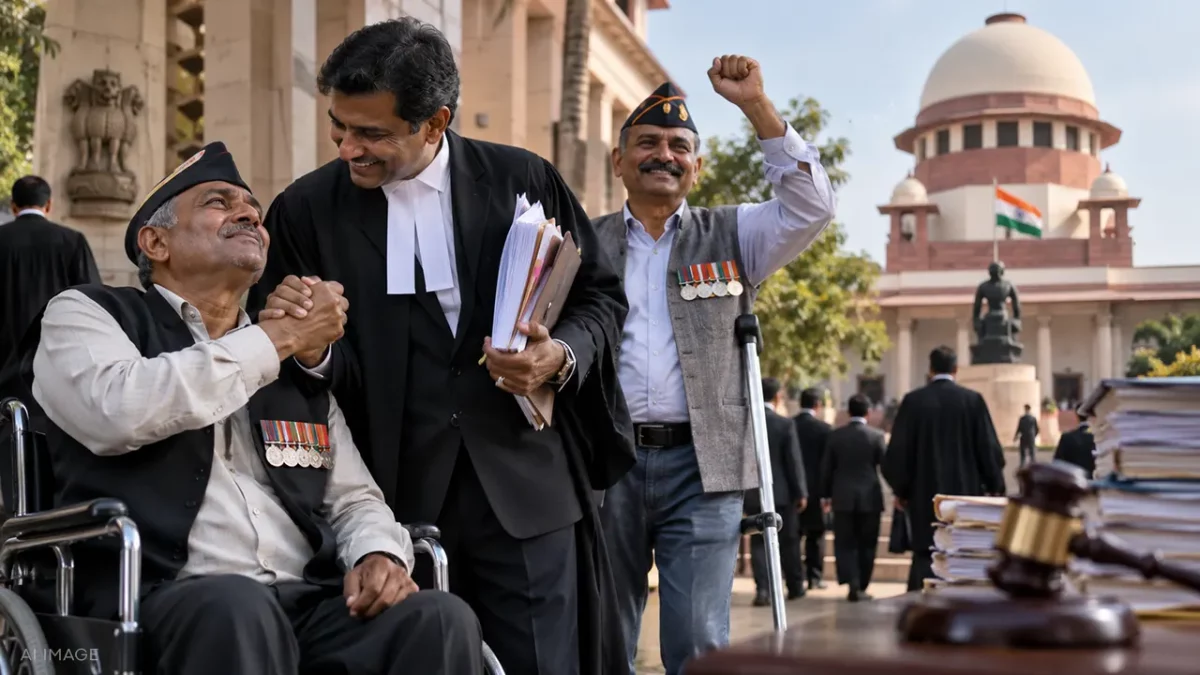
The Supreme Court of India has dismissed a batch of approximately 271 civil appeals and special leave petitions filed by the Union of India challenging orders that granted the disability element of service pension to retired armed forces personnel. The two-judge Bench of Justice P.S. Narasimha and Justice Alok Aradhe delivered the judgment on 15 September 2026 in Union of India and Others v. Col. N.C. Isaac (Retd.) and connected matters (2026 INSC 993).





The Court dismissed the batch both on the ground of delay and on merits. Most of the petitions were barred by limitation. The controversy concerned entitlement to disability pension after Release Medical Boards had classified the disabilities as “neither attributable nor aggravated” (NANA) by military service. The Armed Forces Tribunal and several High Courts had overturned those classifications and granted relief. The Centre then approached the Supreme Court.
The legal dispute: 1982 Rules and 2008 Rules
The Union, represented by Attorney General R. Venkataramani, argued that the Entitlement Rules for Casualty Pensionary Awards, 2008, marked a decisive departure from the 1982 Rules. Under the earlier regime, a member who entered service in sound health and later left with a disability was generally presumed to have suffered that disability on account of service. The 2008 Rules withdrew that automatic presumption and required a causal connection between the disability and military service.
The Court accepted that the 2008 Rules removed the entry-stage presumption and strengthened the requirement of causal nexus. It held, however, that those changes did not dismantle the claimant-protective structure of the earlier scheme. Beneficial provisions on attributability, aggravation, reasonable doubt and the allocation of primary burden remained substantially intact.
The Bench observed:
“The mere addition of a causal requirement and a removal of the presumption that when a member joins service healthy, and, if, he leaves with a disability, it ought to be attributable to the military service, does not, by itself, change the core scheme of the Entitlement Rules 2008 because the other beneficial provisions broadly remain untouched. The onus to prove that the member’s disability is not attributable to service still lies on the employer. The relevant rules regarding attributability and aggravation continue to hold that if the cause of disability is unknown, and presumption of attributability is not rebutted, then the disability is attributable to service.”
Burden of proof and the 15-year rule
For claims preferred within 15 years of discharge, invalidment or release, the primary burden continues to rest on the establishment. If the cause of disability is unknown and the presumption of attributability is not rebutted, the disability is treated as attributable to service.
The one material change introduced by the 2008 Rules is the proviso to Rule 7. Where a claimant approaches the forum more than 15 years after leaving service, the onus shifts to the applicant. The Court explained this as an evidentiary safeguard, given that service records may no longer be available after that period. It also clarified that Dharamvir Singh, decided under the 1982 Rules, cannot be applied mechanically to cases governed by the 2008 Rules.
Weight of Medical Board opinions
The Court accepted the Attorney General’s submission that the opinion of a Medical Board, as an expert body, deserves due weight and ought not to be substituted merely because another view is possible. Tribunals dealing with pending claims must examine the Board’s reasoning in detail. A negative finding discharges the Department’s burden only if it is sound and reasoned. An ex-serviceman may still make out a prima facie case by pointing to infirmities in the Board’s procedure or conclusions.
Criticism of continued litigation
The Bench recorded that the Ministry of Defence’s 2015 Raksha Mantri Report—Review of Service and Pension Matters, Including Potential Disputes, Minimising Litigation and Strengthening Institutional Mechanisms Related to Redressal of Grievances—had recommended the immediate withdrawal of appeals of this nature against disabled soldiers. The Ministry had accepted the recommendation, yet such appeals continued to be filed. The Court described the non-implementation as a matter of regret.
The 2015 report had observed that many disabled soldiers in India were still denied benefits on hyper-technical grounds, and that democracies generally treat disabilities arising in service or during authorised leave as attributable to or aggravated by military service.
The Court also noted the scale of rejection at the departmental appellate stages. Information obtained under the Right to Information Act showed that, of 2,997 appeals before the First Appellate Authority, 2,855 were rejected and only 142 accepted. Before the Second Appellate Authority, 439 of 456 appeals were rejected and only 17 accepted. The Bench described it as “the sad part of this litigation” that most of the 271 matters before it were themselves time-barred.
Outcome
Finding no case for interference, the Supreme Court dismissed the Union’s appeals and petitions on delay as well as on merits. It issued two clarifications for future cases: Medical Board opinions must be given due weight and examined in detail, and claims filed after 15 years attract the proviso to Rule 7, placing the onus on the applicant.
The judgment leaves intact the grants of disability pension already made by the Armed Forces Tribunal and the High Courts in the present batch, while setting a clearer framework for the examination of similar claims under the 2008 Entitlement Rules.