

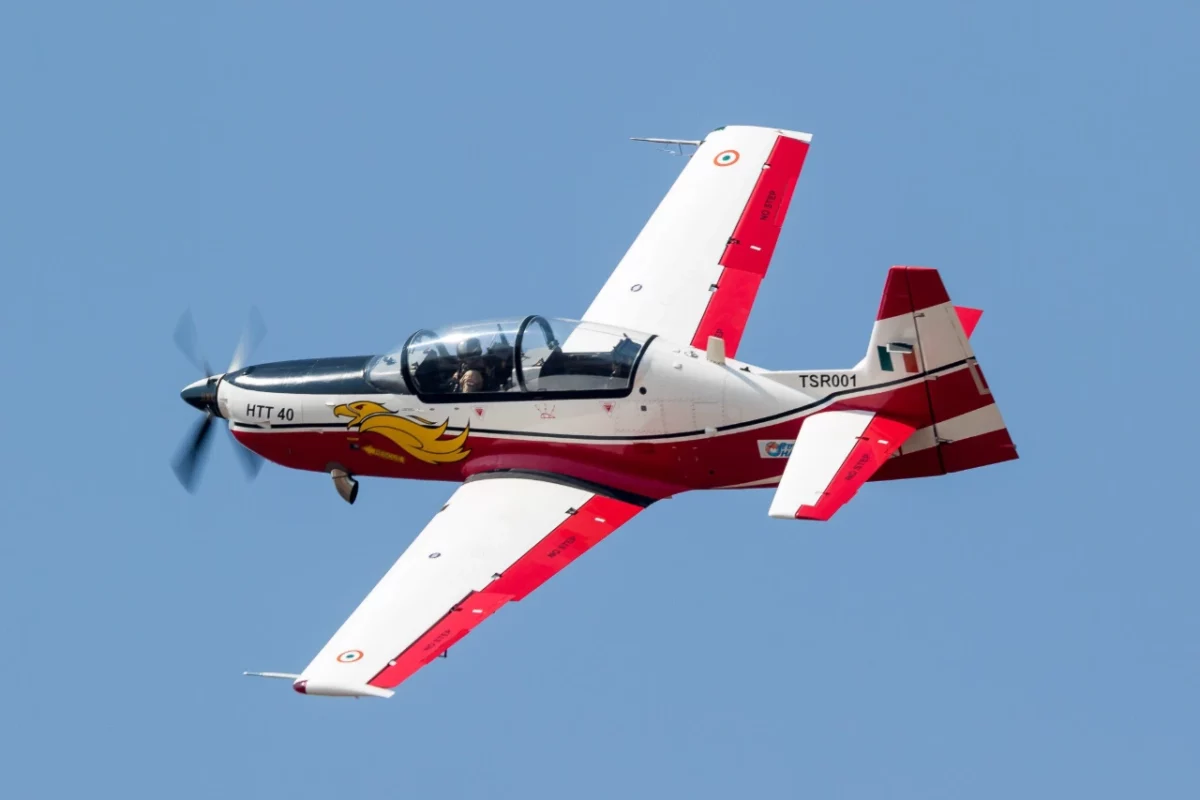
Bengaluru / New Delhi — Hindustan Aeronautics Limited will deliver the last two Light Combat Aircraft Tejas Mk-1 twin-seat trainers and the first batch of three HTT-40 basic trainer aircraft to the Indian Air Force on Friday, 18 September 2026, at its Bengaluru facility. The ceremony will be attended by Defence Minister Rajnath Singh, Civil Aviation Minister K. Rammohan Naidu and Chief of the Air Staff Air Chief Marshal A.P. Singh.



The Ministry of Defence described the handover as a milestone in India’s self-reliance programme, underscoring HAL’s role, together with its industry partners, in designing, developing and manufacturing advanced platforms for both military and civil use.
Completion of the original Tejas Mk-1 contract
The two aircraft being handed over are Final Operational Clearance twin-seat trainers. Their delivery will close the original 40-aircraft LCA Mk-1 order placed in two tranches: 20 aircraft in Initial Operational Clearance configuration in March 2006 and 20 aircraft in FOC configuration in December 2010. Thirty-eight aircraft from that order have already been delivered; the remaining two trainers complete the contract.
The original order comprised 32 single-seat fighters and eight twin-seat trainers. The last two FOC trainers incorporate enhanced radar performance, improved autopilot handling, upgraded fuel systems and avionics software, and software-defined radio for secure communications. They are intended for conversion and operational training of fighter pilots while retaining the flying characteristics of the combat variant.
With the Mk-1 order now complete, HAL’s production focus shifts to the two subsequent Tejas Mk-1A contracts covering 180 aircraft (83 ordered in February 2021 and 97 ordered in September 2025). Deliveries under those contracts have been delayed by the supply of GE F404-IN20 engines.
First HTT-40 trainers after engine-supply delay
The same ceremony will include the first three production HTT-40 aircraft — two built at Bengaluru and one at Nashik. They form the opening batch of a ₹6,838-crore contract signed in March 2023 for 70 basic trainers. HAL had been scheduled to deliver 12 aircraft in financial year 2025-26, but none could be handed over until Honeywell resolved global supply-chain bottlenecks affecting the TPE331-12B turboprop engine. The first three engines reached HAL in mid-2026. Honeywell will supply the initial 16 engines from the United States; HAL will manufacture the remaining units in India under a technology-transfer arrangement.
The HTT-40 is a tandem-seat, fully aerobatic turboprop designed for Stage-I (ab-initio) training of newly inducted IAF pilots. It features an air-conditioned glass cockpit, indigenous avionics, hot-refuelling capability and Martin-Baker zero-zero ejection seats. It is intended to supplement and eventually reduce reliance on the Swiss-origin Pilatus PC-7 Mk II fleet currently used for foundational flying training. HAL now has production lines at both Bengaluru and Nashik with a combined capacity of up to 20 aircraft a year.
Broader indigenous aviation context
In the same event HAL will also hand over four Dhruv Next Generation helicopters to Pawan Hans Limited. Officials attending include Secretary (Defence Production) Sanjeev Kumar, Secretary (Civil Aviation) Samir Kumar Sinha and HAL Chairman and Managing Director Ravi K.
The Government has stated that induction of these platforms is intended to strengthen indigenous design and manufacturing capability and reduce dependence on foreign sources for both combat conversion training and basic pilot training.