
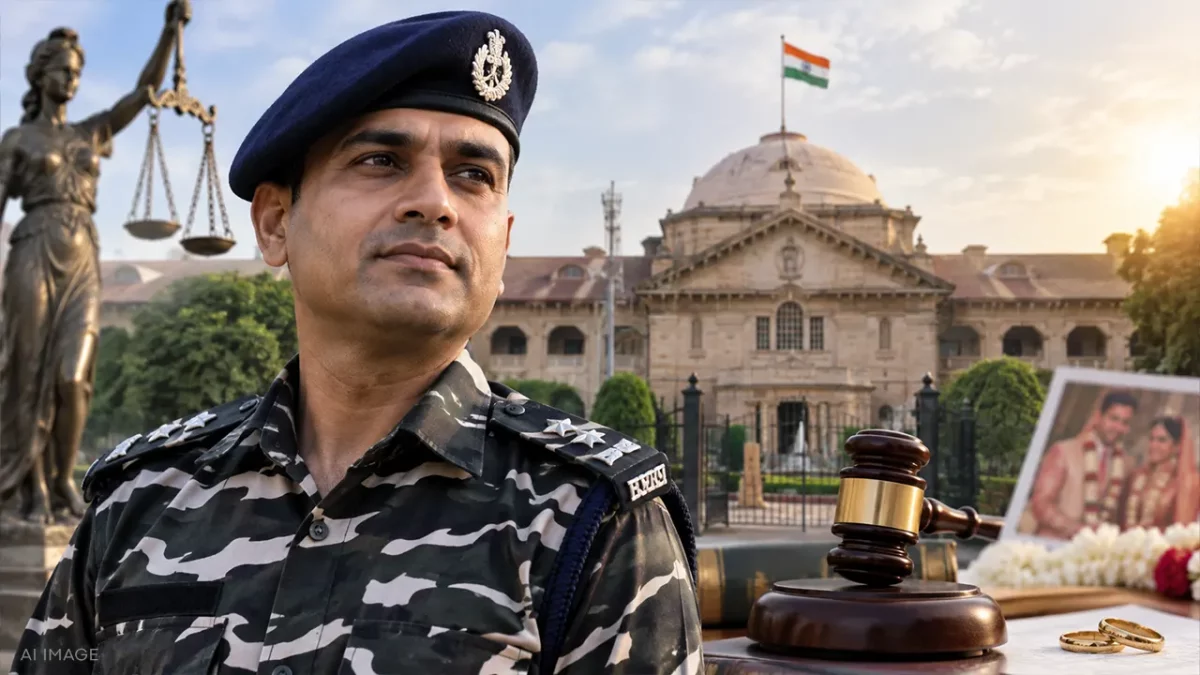
Lucknow, September 22, 2026 — The Lucknow Bench of the Allahabad High Court has quashed the removal of a Sashastra Seema Bal Deputy Commandant who was dismissed after the force concluded that he had concealed a marriage at the time of joining service. The Court held that an Arya Samaj marriage certificate, by itself, does not establish a valid Hindu marriage in the absence of essential ceremonies prescribed under the Hindu Marriage Act.


Justice Rajeev Singh allowed the writ petition filed by Pandey, set aside the removal order dated April 28, 2022, and directed the authorities to permit him to resume duty forthwith. The period from the date of removal until the judgment will be treated as “no work, no pay,” but will not constitute a break in service.
Background of the Case
Pandey was selected as Assistant Commandant (General Duty) in the Sashastra Seema Bal on December 5, 2009, and was promoted to Deputy Commandant on March 22, 2016. At the time of joining, he declared himself unmarried.
The controversy originated from complaints by Suchita, who claimed that she had married him on August 16, 2007, at an Arya Samaj Mandir in Krishnanagar, Prayag, Allahabad. She approached the department, sought entry of her name in his service record and initiated proceedings under Section 125 of the Code of Criminal Procedure. A Court of Inquiry followed. On the basis of her statement, the statement of the priest and notary certificates, the SSB treated the alleged marriage as valid and concluded that the officer’s declaration was false. He was removed from service on April 28, 2022.
The department also relied on a subsequent marriage solemnised by the officer on December 13, 2015, with Sadhana Tiwari, treating it as a second marriage and a further ground of unsuitability. The respondents further alleged that he had answered “No” in the attestation form to a query on prior prosecution despite a pending criminal case.
Officer’s Defence
Pandey contended that a marriage proposal had been placed before his family but was declined, and that the subsequent complaints were intended to pressure him into marriage. He maintained that no marriage had been solemnised in accordance with Hindu rites. He pointed to a police report from the Gadwara outpost in Pratapgarh, which recorded that, according to villagers, no marriage had taken place, even though the complainant’s family had been willing to solemnise one.
His Section 125 CrPC application was dismissed. In Case No. 1548 of 2013, registered under Sections 498-A and 323 of the Indian Penal Code and Section 3/4 of the Dowry Prohibition Act, he was acquitted after the trial court found major contradictions in the complainant’s version. Protection had earlier been granted by a writ court in related proceedings. During the criminal trial, the complainant herself admitted that the alleged marriage had not been performed with Hindu rituals and Saptapadi.
High Court’s Findings
The Court held that a marriage under the Hindu Marriage Act is valid only when essential Hindu ceremonies, including Saptapadi, are performed. Relying on the Supreme Court’s decision in Priya Bala Ghosh v. Suresh Chandra Ghosh (1971), Justice Singh observed that merely placing a certificate of an Arya Samaj Mandir cannot establish that a marriage was solemnised as per the Hindu Marriage Act. The Court also cited Shanti Deb Berma v. Kanchan Prava Devi for the principle that evidence of marriage must be cogent and cannot rest solely on letters or oral claims.
In view of the complainant’s own admission that the essential rites had not been performed, the alleged ceremony of August 16, 2007, could not be treated as a marriage in the eyes of law. Consequently, it could not form the basis for holding the officer unsuitable for service or for his removal. Because the 2007 ceremony was not a valid marriage, the subsequent marriage in December 2015 could not be treated as a second marriage so as to render him unfit for service.
The Bench concluded that the impugned order rested on an unsustainable finding of concealment and allowed the writ petition.
Operative Directions
The Court quashed the order dated April 28, 2022, and directed the Union of India and the Sashastra Seema Bal to allow the petitioner to resume duties immediately. The intervening period will be treated as “no work, no pay,” though without a break in service. The judgment was delivered on September 18, 2026, in Writ-A No. 4741 of 2022.
The ruling reiterates that departmental conclusions on marital status, when used to impose the extreme penalty of removal, must rest on a legally valid marriage and not on a certificate or uncorroborated assertion of a ceremony that does not satisfy the requirements of the Hindu Marriage Act.