
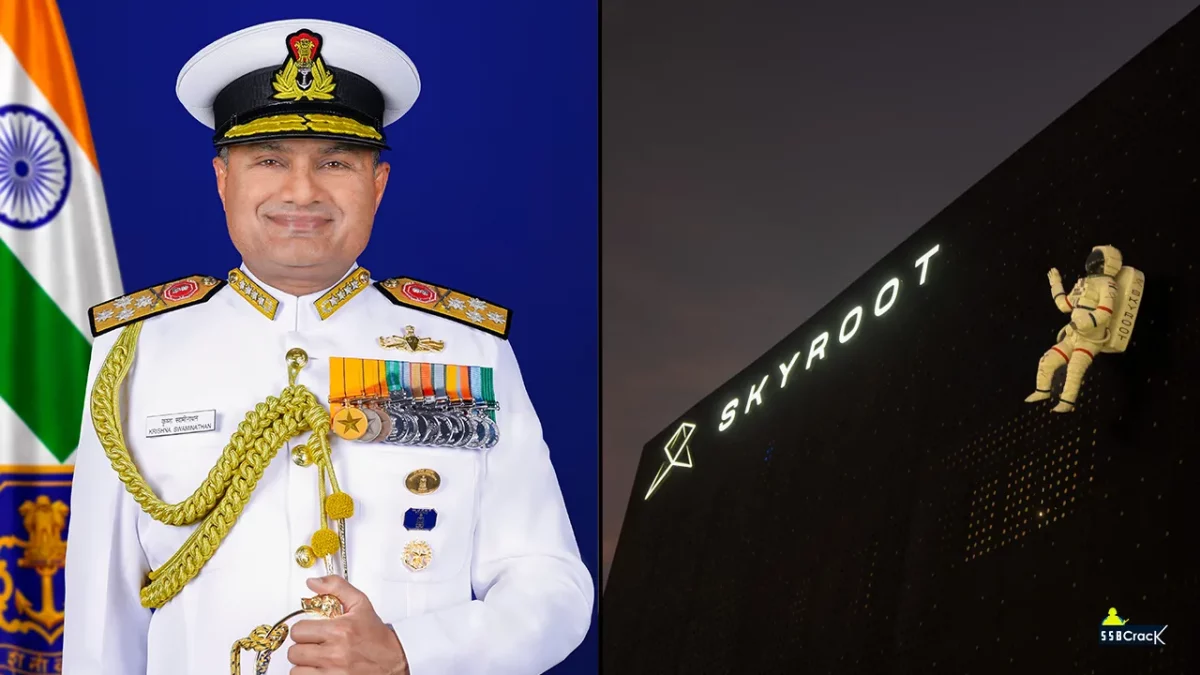
New Delhi, 28 September 2026 — Chief of the Naval Staff Admiral Krishna Swaminathan has invited Hyderabad-based Skyroot Aerospace to work with the Indian armed forces in “mission mode” and help develop sovereign space capabilities over the next two decades.





The invitation was extended at the NDTV Defence Summit 2026 on Sunday, 27 September, during interactions that brought together the Navy Chief and Skyroot co-founder and Chief Executive Officer Pawan Kumar Chandana. Admiral Swaminathan asked the company to understand operational requirements and integrate with the services so that India can become a world-class space power in the defence domain.
“When you are working with the Indian armed forces, you are working for something much bigger than technology or commerce. You are working for national security. We request you to please integrate with us on a mission mode, understand our requirements and make us world beaters in the next 20 or 25 years,” the Navy Chief said.
Admiral Krishna Swaminathan, who assumed charge as the 27th Chief of the Naval Staff on 31 May 2026, underscored the growing dependence of modern naval operations on space-based systems.
He stated that satellites and space technologies already support networked forces, surveillance, targeting and weapon-sensor fusion, and that India must scale up space-based resources, technology and capabilities for the armed forces. Artificial intelligence, quantum technology, space systems and autonomous platforms, he added, are rapidly altering the future character of naval warfare.
The Navy Chief also framed the requirement in maritime-strategic terms. He described India as a maritime nation whose economic, civilisational and geopolitical interests extend far beyond its coastline. More than 60 per cent of national GDP originates in coastal states; nearly 18 per cent of the population lives within 50 kilometres of the coast; and about 90 per cent of trade by volume and more than 70 per cent by value moves by sea. The Indian Ocean region, he noted, has become one of the world’s most militarised maritime spaces, while disruptions at distant chokepoints have direct implications for India’s economy and security.
The call comes two months after Skyroot’s Vikram-1 became India’s first privately developed orbital rocket to reach orbit, on 18 July 2026 from the Satish Dhawan Space Centre, Sriharikota. The successful maiden flight made India only the third country, after the United States and China, with private orbital launch capability. Vikram-1 is an indigenous, largely carbon-composite small-lift vehicle designed to place payloads of up to about 350 kilograms into low Earth orbit.
Chandana, speaking in the session titled “Ignition: India’s Race to Own Space,” described the present period as a civilisational transition. “If steel has built modern civilisation, space is going to be the future civilisation. We are just at the cusp of that transition,” he said. He added that work requiring massive computing capacity is expected to move into space and pointed to orbital data centres, communications satellites and other emerging applications.
He also noted rising sovereign and defence demand. Skyroot receives new launch requirements every month, a substantial share of them from national-security and government programmes, including India’s planned space-based surveillance constellation of about 52 satellites. Chandana said the company is prepared to contribute launch capacity for such missions and to work closely with the armed forces.
Skyroot Aerospace was founded in 2018 by former ISRO scientists Pawan Kumar Chandana and Naga Bharath Daka. The firm has emphasised vertical integration of propulsion, structures and avionics and is targeting a higher launch cadence, with a larger Vikram-2 vehicle planned for 2027. The Navy Chief’s public invitation marks a significant signal that private Indian launch companies are now viewed as partners in building indigenous, defence-oriented space infrastructure rather than solely as commercial service providers.
The remarks align with the wider policy push for Atmanirbharta in defence and space, the opening of the sector to private industry, and the services’ requirement for assured, sovereign access to orbit for maritime domain awareness, communications and sensor fusion. No formal contract was announced at the summit. The invitation, however, places Skyroot among the private firms expected to help close the gap between India’s commercial launch capability and the operational needs of the armed forces.