
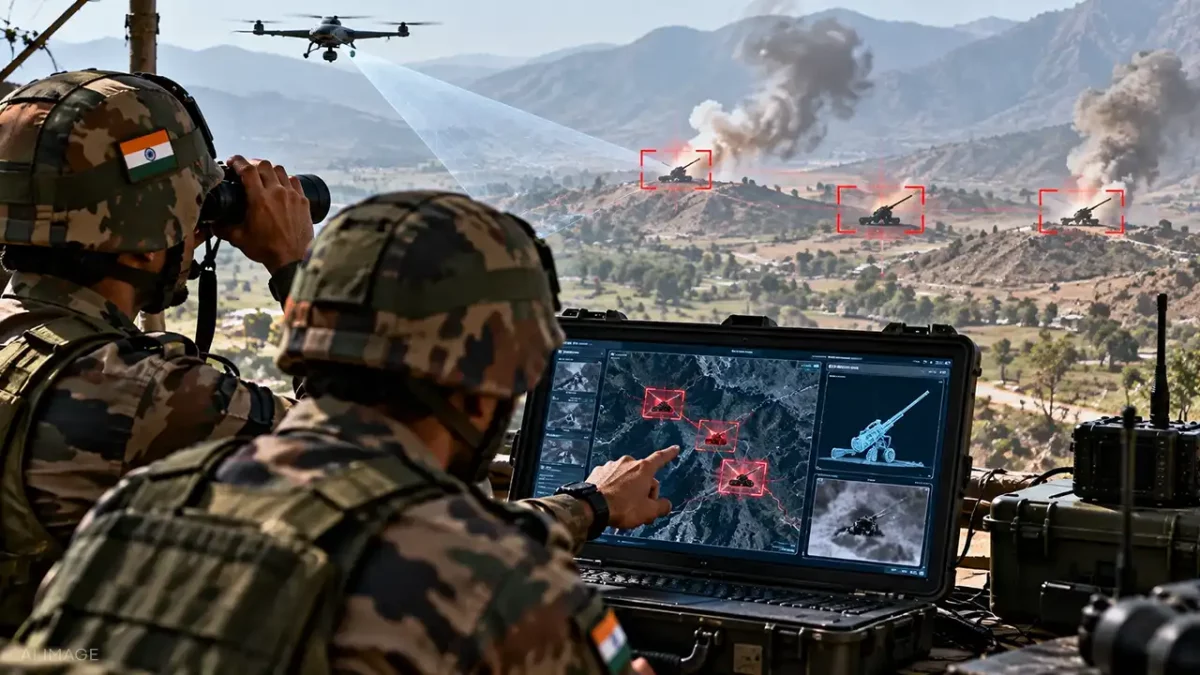
The Indian Army has stated that 23 indigenous artificial intelligence applications, employed during Operation Sindoor in May 2025, achieved approximately 94 per cent accuracy in identifying where Pakistani gun and missile units would be positioned along the border. The assessment, drawn from Army briefings and reported this evening by The Times of India, presents one of the most detailed operational accounts yet of how Indian forces used AI in an actual combat setting rather than in an experimental or training environment.



Operation Sindoor was launched in the early hours of 7 May 2025 in response to the 22 April Pahalgam terrorist attack, which killed 26 civilians. Over four days, Indian forces struck terrorist infrastructure in Pakistan and Pakistan-occupied Kashmir and subsequently engaged Pakistani military assets after Islamabad’s retaliatory drone and missile attacks. A ceasefire understanding was reached on 10 May. Army officers have since described the operation as India’s first cross-border action in which AI was used at scale for intelligence fusion, targeting and battle-damage assessment.
Historical data fused with live sensors
According to the Army, the AI suite combined 26 years of recorded data on Pakistani military movements including radio emissions, frequency signatures, equipment locations and unit affiliations with live feeds from drones, radars, satellites and other sensors. The fused picture was presented to commanders on a single interface. With that modelling and contemporaneous data, the systems were able to predict the likely location of a particular gun, missile unit or similar platform along the border with the stated 94 per cent accuracy.
Lieutenant General Rajiv Kumar Sahni, who served as Director General of Information Systems during the operation and later as Director General of Electronics and Mechanical Engineers, has said the same infrastructure also generated a common battlefield picture and post-strike assessments. The effect, Army officials have argued, was to compress the Observe–Orient–Decide–Act cycle that commanders are trained to shorten under fire. Human operators remained in the loop; AI informed targeting and prioritisation, but did not independently authorise strikes.
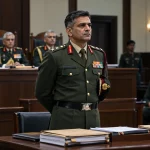
The Army released command-room imagery from 7 May 2025 showing officers monitoring multi-screen feeds during the opening phase of Operation Sindoor.
The applications used
Not all 23 applications have been named publicly. Those identified in official and media accounts include:
- An electronic-intelligence collation and analysis system (ECAS), a homegrown application used across intelligence agencies and modified at short notice during the operation to locate adversary sensors and prioritise threats.
- Trinetra, integrated with Project Sanjay, the Army’s battlefield surveillance system, to produce a common operational and intelligence picture at tactical and operational levels. Project Sanjay also supported edge processing so that data could be analysed forward without exclusive dependence on distant servers.
- Predictive-modelling software trained on the 26-year archive of Pakistani unit movements and emissions.
- An indigenous weather application referred to in some briefings as Anuman 2.0 developed with the India Meteorological Department. It provided usable forecasts, including wind speed and direction, up to 48 hours ahead and out to approximately 200 kilometres into adversary territory, supporting trajectory calculations for extended-range artillery and long-range vectors.
The Army has also noted that heat maps generated at the joint operational control centre helped commanders allocate resources during the four-day exchange.
A networked kill web, not a linear chain
The AI tools did not operate in isolation. They sat inside a wider architecture that linked sensors and shooters across services. Akashteer, the Army’s automated air-defence control and reporting system, the Artillery Combat Command and Control System, and the Indian Air Force’s Integrated Air Command and Control System were all part of that network. The design intent is a “kill web”: information can flow from any sensor to any shooter rather than along a single, brittle chain of command. Officials have presented this as essential for theatre-level operations across long frontiers under electronic attack and drone saturation.
Akashteer, the Army’s automated air-defence control and reporting system, formed part of the sensor-to-shooter network used during and after Operation Sindoor.
Why the disclosure matters
The operational claim is significant because it moves the discussion of Indian military AI beyond modernisation roadmaps and laboratory demonstrations. The Army is asserting that the tools were used in combat to locate enemy artillery and missile units, to build a shared picture for land and air commanders, and to assess the effect of strikes. That is a different category of story from generic digital-transformation coverage.
The same officers have been careful to bound the claim. They describe adoption as phased and responsible, with meaningful human control retained. A military-specific large language model has been described as under development to further integrate operational, intelligence and logistics data. Dedicated AI cells, secure cloud and edge computing, and personnel training in data science are part of the follow-on programme.
Independent verification of the 94 per cent figure is not publicly available; the number originates with Army briefings. What is documented across multiple Indian outlets is the consistent account given by the officer who headed information systems during the operation: historical emissions and movement data, live multi-sensor fusion, weather modelling for long-range fire, and a suite of 23 task-specific applications used together under combat conditions.
For defence professionals and candidates following force modernisation, the relevant point is narrower than a slogan about “AI warfare.” It is that the Indian Army now treats predictive location of adversary fire units, common operational pictures and post-strike assessment as fielded functions already exercised in Operation Sindoor and is building the command-and-control lattice (Akashteer, Sanjay/Trinetra, ACCCS and IACCS) around them.
Based on Army statements reported by The Times of India Defence on 28 September 2026 and earlier briefings by Lt Gen Rajiv Kumar Sahni in October 2025.