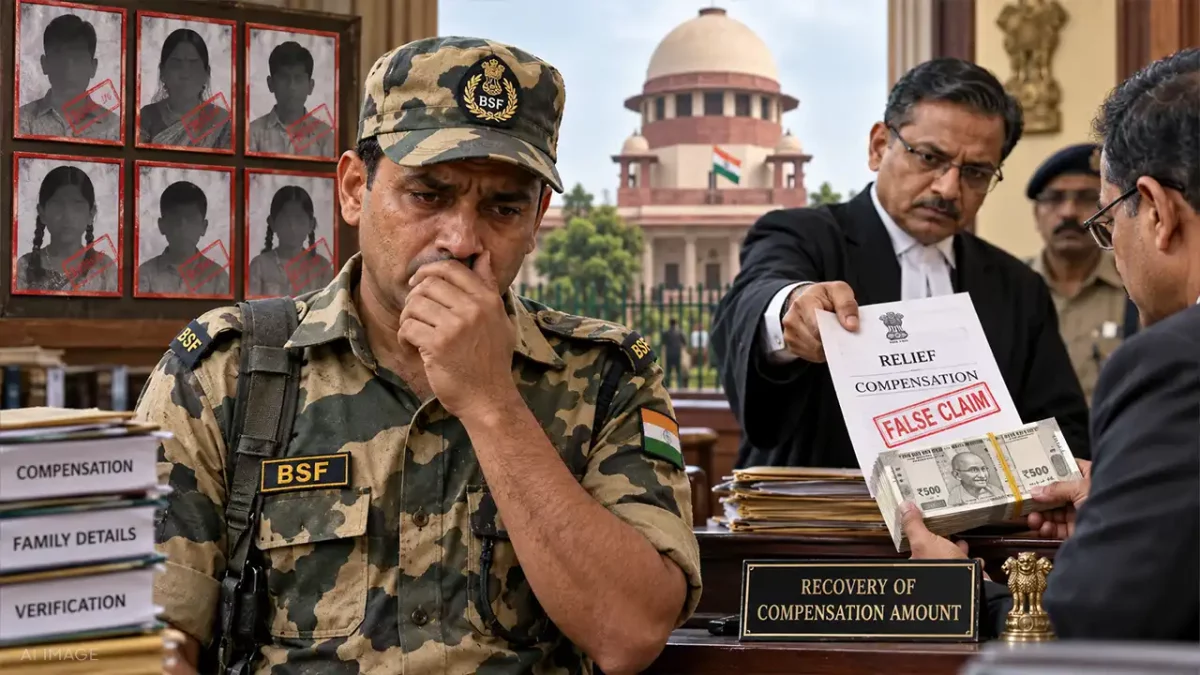
The High Court of Jammu and Kashmir and Ladakh has upheld the recovery of ₹6 lakh from a serving Border Security Force (BSF) jawan who obtained ex-gratia relief by falsely claiming that six members of his family were killed by militants in 1993. Justice Rajnesh Oswal, in an order dated 30 September 2026, dismissed the writ petition and held that the relatives had crossed into Pakistan-occupied Kashmir (PoK) and that retention of the amount would amount to unjust enrichment.





The petitioner, Nazir Ahmad Mir, a resident of Shalla Bathu village near the Line of Control in Kupwara district, claimed that militants torched his house in May 1993 and killed his father, mother, two brothers and two sisters. He approached Police Station Kupwara only in 1997. A Daily Diary entry was made on 8 March 1997, nearly four years after the alleged incident. Death certificates were issued later, and on 15 September 1997 the District Level Screening-cum-Coordination Committee sanctioned ₹1 lakh for each of the six persons. The entire sum of ₹6 lakh was paid to him alone.
The claim came under scrutiny after a May 1999 newspaper report titled “Government gives away relief package for dead families living in PoK.” Inquiries ordered by the Ministry of Home Affairs, the Jammu and Kashmir Home Department and the Divisional Commissioner, Kashmir, found that the relatives had not been killed but had migrated across the LoC with other border residents. An administrative probe by the Additional Deputy Commissioner, Kupwara, concluded that the relief had been obtained through fabricated records in collusion with local police and revenue officials. Recovery was directed in 2022, and the BSF ordered deduction of the amount from Mir’s salary in 30 monthly instalments from 2023.
Before the High Court, counsel for the petitioner argued that the relief had been sanctioned after official verification more than 25 years earlier, that Indian agencies could not verify facts inside PoK, and that the recovery was arbitrary and without a proper hearing. The Union Territory administration and the BSF maintained that the migration to PoK stood established by inquiry and that the jawan had been issued notice and his statement recorded.
Justice Oswal rejected the challenge. The court noted that the police record of a 1993 incident was created only in March 1997, that no body was ever recovered or handed over, and that counsel for the petitioner conceded the bodies were never delivered. The Bench observed that it “strains credulity” that a person whose six family members were said to have died in 1993 would remain silent for four years. It also recorded contradictions in the narrative: one document referred to a 1990 firing incident, while the petition spoke of militant violence in 1993; a report of 5 May 1997, initiated on the petitioner’s own application, stated that all family members except one sister had been killed, yet the record did not explain why compensation was paid only to him and not to the surviving sister.
“The petitioner has utterly failed to prove that six of his family members died in 1993,” the court held, adding that his “lack of candor is clear from his repeatedly shifting claims.” It found that the plea of denial of natural justice failed, as notice had been issued and his statement recorded during the 2001 inquiry by the Additional Deputy Commissioner. Holding that “fraud unravels everything” and that the passage of time cannot validate illicit financial gains, the court ruled that the sanction had been procured in collusion with police and revenue officials and that allowing the amount to be retained would perpetuate unjust enrichment. The petition was dismissed and the recovery left undisturbed.
Advocate Dar Khurshid appeared for the petitioner. Central Government Counsel Faizan Ganai, appearing vice Deputy Solicitor General T. M. Shamsi, represented the Union of India and the BSF. Government Advocate Ilyas Laway appeared for the Union Territory administration.