
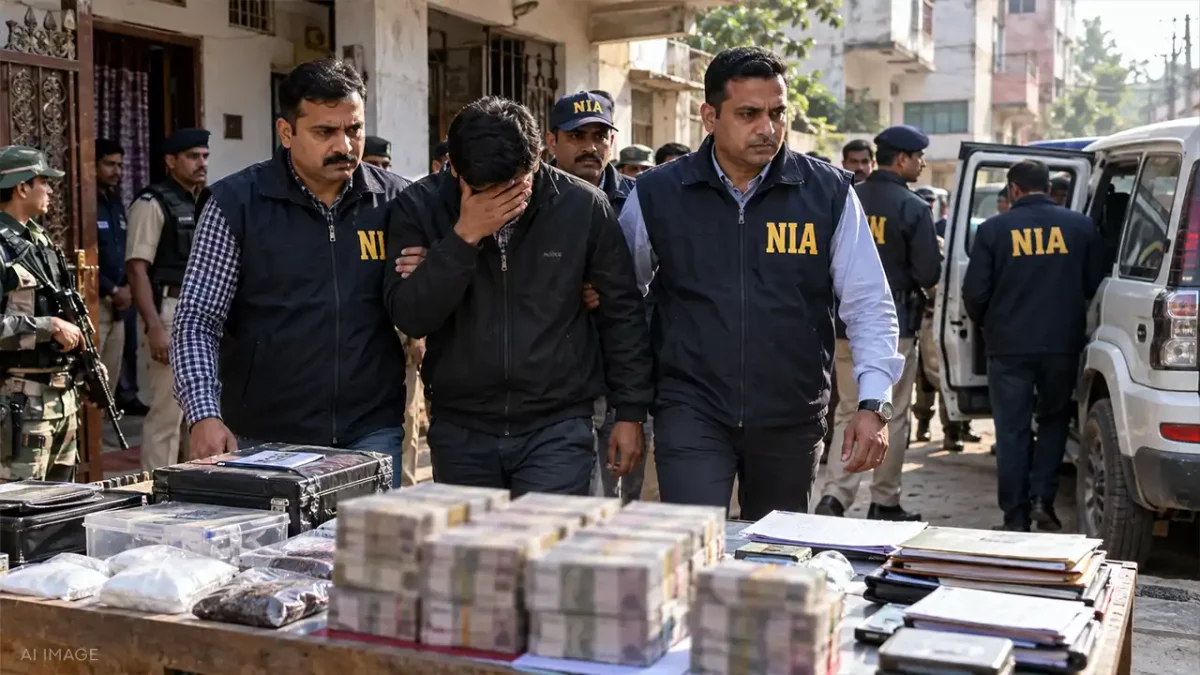
The National Investigation Agency (NIA), along with the Narcotics Control Bureau (NCB), Sashastra Seema Bal (SSB), Bihar Police and local administration, conducted coordinated raids on 11 premises in Madhubani district, Bihar, on Thursday (October 8–9, 2026) as part of an investigation into an alleged cross-border syndicate involved in smuggling Fake Indian Currency Notes (FICN) and narcotics.



The operation targeted locations linked to 60-year-old Hira Mahaseth, popularly known as Chachi (or Hira Devi Mahaseth), and her husband Bharat Mahaseth, primarily in Duhabi Bazar (also referred to as Duhbi Bazaar) near the India-Nepal border under the Basopatti and Jaynagar police station areas. Raids began around 5 a.m. and continued for several hours. Investigators searched residential and commercial properties—including grocery stores, warehouses, a machinery store, a garage and spare-parts outlets—for documents and other evidence. All 11 premises, including the main grocery shop and warehouses, were subsequently sealed pursuant to a court order. Mobile internet services were suspended in the area for security reasons, and a mobile tower-dumping vehicle was deployed.
SSB personnel, including officers such as Deputy Commandant Hari Narayan Jat and Assistant Commandant Paras Rathi (with involvement reported from the 48th Battalion in some accounts), joined the operation alongside NIA teams led by officers including DSP Kislay (or Kishlay) Kumar Sinha and Inspector Vikas Kumar, NCB’s DSP Om Prakash Rai, Bihar Police Rural SP Shivam Dhakad, Jainagar DSP Sadanand Kumar, STF Inspector Amit Kumar and local administrative officials. The SSB provided security and logistical support during the searches near the open border. Some reports noted that SSB personnel deposited mobile phones at a camp beforehand for operational secrecy.
Background of the Case
The probe follows earlier arrests and intensified action over the preceding one-and-a-half months. Bharat Mahaseth and associate Shiv Kumar Raut (alias Mehman) were arrested in early August 2026 (reports cite August 2) after the recovery of counterfeit currency notes with a face value of ₹50,150 in a joint operation involving STF and SSB (or police). Hira Mahaseth was arrested around September 14–15, 2026, on charges related to smuggling FICN, liquor and narcotics (including charas/ganja and other substances). Following her arrest, the case was handed over to the NIA. Multiple FIRs have been registered against her, including under the NDPS Act and for liquor offences.
Police and investigators describe Hira Mahaseth as a key figure in a network with links extending from Madhubani to Kathmandu in Nepal. Associates such as Krishna Thakur and others have also been linked to the syndicate. Some reports indicate surveillance of the family for approximately six months and note suspected financial and operational links across the border, including a shop in Nepal’s Udaypur district (Gaighat) allegedly used as a front. One detailed local account placed assets allegedly accumulated through illegal activities under scrutiny, with figures exceeding ₹250 crore mentioned, though these remain under investigation. No major seizures of currency or narcotics were publicly reported from the latest raids; the focus was on documents and materials, which were seized for analysis in Patna. The NIA has not issued an official statement detailing specific recoveries from the searches.
The operation underscores ongoing efforts by central and border agencies to dismantle transnational smuggling networks along the Indo-Nepal border, which remains vulnerable due to its open nature. Investigations into the wider network, financial trails, associates and cross-border linkages are continuing. Local police, including Madhubani SP Yogendra Kumar in related statements, have noted that many properties of the Mahaseth family along the border have been traced.
This report is based on contemporaneous coverage from Hindustan Times and local Bihar media outlets (including Live Hindustan and others). Slight variations exist across reports regarding the exact number of locations (11 versus 12) and precise arrest dates; the figures above reflect the primary English-language reporting from Hindustan Times supplemented by consistent details from local sources.