
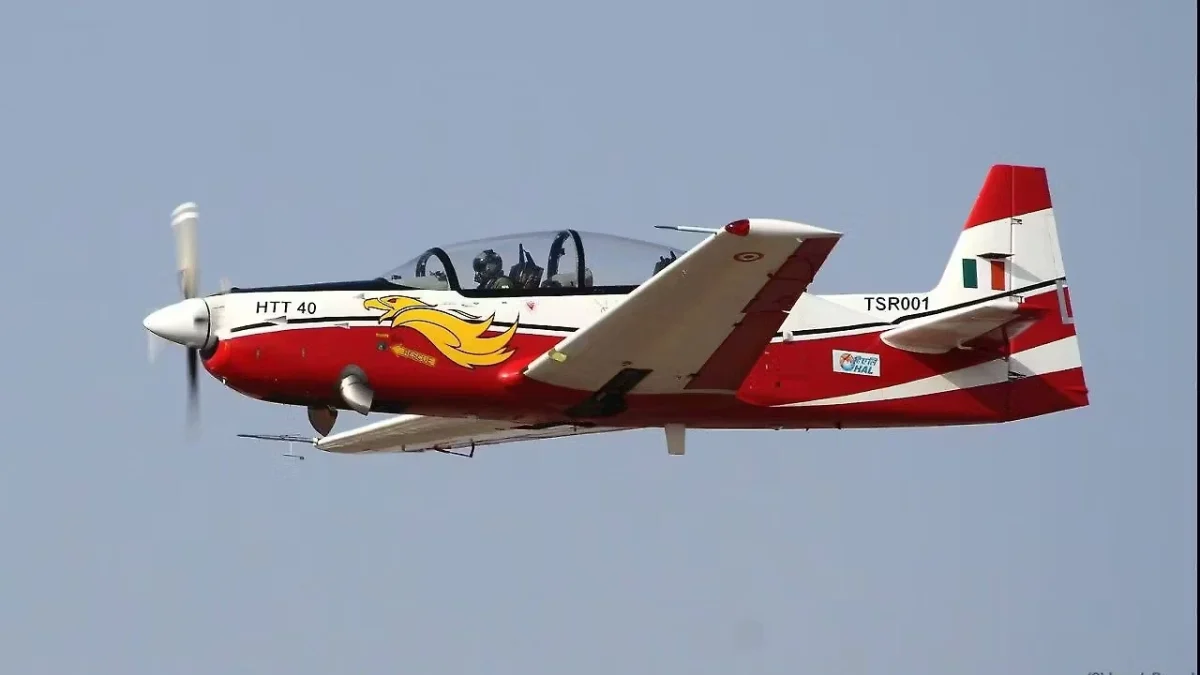
Hindustan Aeronautics Limited (HAL) has handed over the first three indigenous HTT-40 basic trainer aircraft to the Indian Air Force (IAF), marking a significant milestone in restoring homegrown capability for ab-initio pilot training. Full-scale training of rookie pilots on the platform is expected to take up to two years as the service builds a sufficient fleet and prepares a cadre of qualified instructors.

The first aircraft was formally handed over in Bengaluru on 18 September 2026 during a ceremony attended by Defence Minister Rajnath Singh. The HTT-40 has been officially named “Ankur” in IAF service. The initial three aircraft will be stationed at the Flying Instructors’ School in Tambaram, near Chennai.
There, instructors will familiarise themselves with the type, frame standard operating procedures, prepare the training syllabus, and establish proficiency standards for trainee pilots. Only after the IAF accumulates a fleet of approximately 25–30 aircraft and has enough trained instructors will the HTT-40 be introduced for routine Stage-I (ab-initio) training of rookie pilots at the Air Force Academy near Hyderabad.
The IAF ordered 70 HTT-40 aircraft under a contract valued at approximately ₹6,828–6,838 crore, signed around 2023 (with earlier steps at DefExpo 2022 and Cabinet approval in March 2023). Deliveries include associated equipment and training aids, including simulators. Production has faced delays primarily due to supply-chain issues with the Honeywell TPE331-12B turboprop engines.
Under a related agreement, Honeywell is supplying 88 engines and kits, with an initial batch delivered directly and the remainder to be manufactured by HAL under technology transfer. With engine supplies stabilising, HAL expects to produce up to 20 HTT-40s annually at its facilities in Bengaluru and Nashik. The aircraft currently has about 56% indigenous content, which is planned to rise above 60% through further indigenisation of components and subsystems.
The HTT-40 is a fully aerobatic, tandem-seat turboprop trainer designed by HAL’s Aircraft Research and Design Centre. It features an air-conditioned cockpit, modern glass cockpit avionics, hot-refuelling capability, and zero-zero ejection seats.
Key performance figures include a maximum speed of around 450 km/h, a range of approximately 1,000 km, a service ceiling of 6,000 metres, an endurance of about three hours, and load factors of +6/−3g. It is intended for basic flying, aerobatics, general handling, instrument flying, navigation, night flying, and close formation flying. The type first flew on 31 May 2016 and underwent extensive development and certification trials.
The induction of the HTT-40 restores an indigenous option in the basic training segment. The IAF grounded its earlier HAL-built HPT-32 Deepak fleet in 2009 following a series of fatal crashes. Since then, Stage-I training of all rookie pilots has been conducted primarily on Swiss-origin Pilatus PC-7 MkII aircraft (of which 75 were acquired).
After Stage-I, pilots branch into fighter, transport, or helicopter streams, progressing through subsequent stages on aircraft such as the Kiran, Hawk, or relevant transport and helicopter platforms before operational conversion. The HTT-40 is expected to complement, rather than immediately replace, the existing PC-7 fleet while helping address the overall shortage of basic trainers (the IAF’s broader requirement is estimated at around 180 aircraft).
This development strengthens India’s self-reliance in military aviation training infrastructure and supports expanding pilot induction requirements. While the first three aircraft represent the start of deliveries under the 70-aircraft order, the deliberate focus on instructor training, syllabus development, and fleet build-up reflects a methodical approach to ensuring safe and effective integration of the new indigenous platform into the IAF’s pilot training pipeline.