

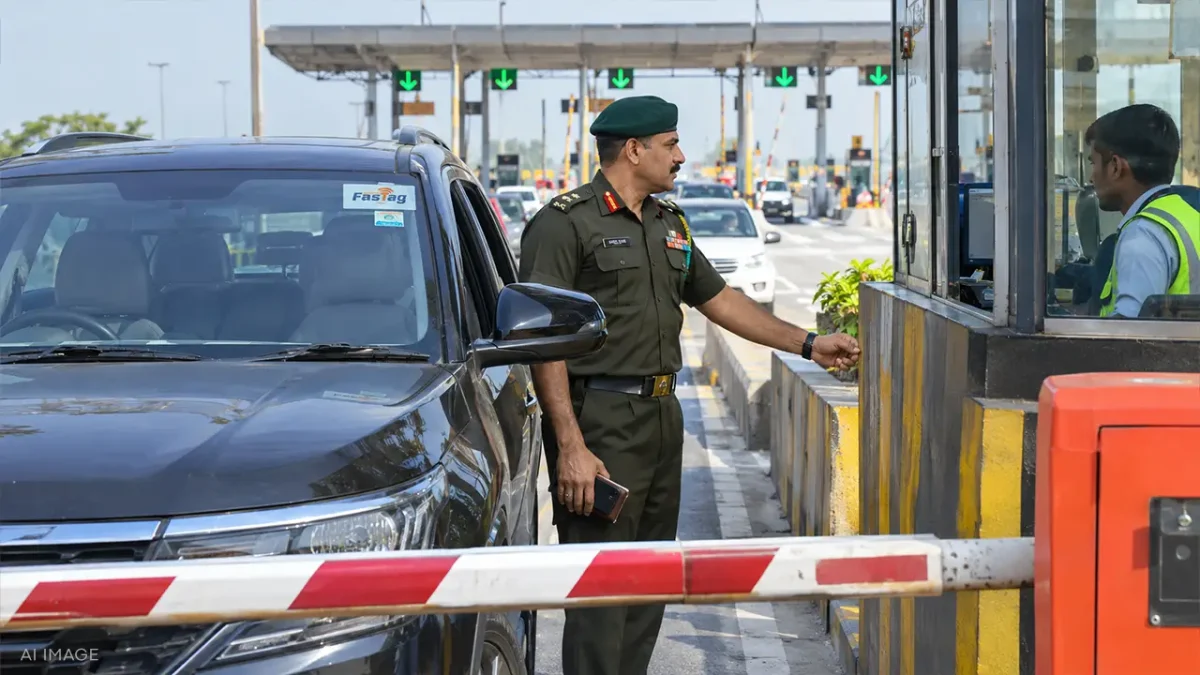
The Centre is planning to extend toll exemptions to the private vehicles of approximately 1.4 million active defence personnel. The initiative aims to resolve operational challenges arising from the nationwide rollout of barrier-less Multi-Lane Free Flow (MLFF) highway tolling systems, under which e-challans are being issued to armed forces personnel using private vehicles.





The Ministry of Road Transport and Highways (MoRTH) has initiated discussions with the Ministry of Defence to develop a mechanism that recognises eligible private vehicles and permits free passage without disrupting traffic flow. One proposal under consideration involves equipping such vehicles with FASTags, with the annual pass cost reimbursed by the defence ministry. Discussions remain inconclusive on which ministry should bear the expense. An alternative option involves a differentiated FASTag that records vehicle movement but does not deduct toll charges.
The move is intended to prevent delays in the MLFF rollout. The system is expected to cover the country’s network of about 1,150 toll plazas by the end of FY28. Currently, fewer than 10 toll plazas operate under MLFF. Bids have been invited for over 100 more, and the ministry expects another 300–400 plazas to be bid out by the end of the current financial year. MoRTH had earlier indicated the possibility of near-complete coverage by the end of this year, but implementation has progressed more gradually.
Under the existing arrangement, private vehicles of armed forces personnel can claim exemption from toll payments by displaying identity cards at toll plazas. MLFF systems eliminate physical barriers and manual verification. They use overhead gantries equipped with automatic number plate recognition (ANPR) cameras and radio-frequency identification (RFID) readers to identify vehicles and process charges automatically while vehicles travel at highway speeds. Vehicles without digitally recognised exemptions risk receiving e-challans for unpaid tolls. The issue has already surfaced on highway stretches where MLFF has been introduced.
A government official, speaking on condition of anonymity, stated that authorities are testing the technology and seeking to resolve such issues before the system becomes available nationally. Queries emailed to MoRTH and the defence ministry remained unanswered.
In May 2026, reports indicated that MoRTH was exploring dedicated FASTags for toll-exempt vehicles, including those used by armed forces personnel, to ensure digital recording of movements without triggering deductions or penalties. Official armed forces vehicles could potentially be recognised through special defence number plates, with movement data deleted subsequently for security reasons. Private vehicles present a more complex challenge, as their ownership and use are not directly linked to government departments.
Former Road Transport and Highways and Defence Secretary Giridhar Aramane noted that the ministry could integrate vehicle details into its database or issue special FASTags with unlimited free movement. An alternative would be to allow regular FASTags, with toll payments reimbursed by the respective departments. He added that MoRTH may authorise the Ministry of Defence to issue a certain number of FASTags as agreed between them, free of cost, for official purposes, to improve system efficiency.
The financial implications could be substantial. India’s armed forces have about 1.4 million active personnel across the Army, Navy, and Air Force, though the exact number of private vehicles eligible for exemption is not publicly available. Extending the existing FASTag annual pass which costs ₹3,075 for 2026-27 and permits up to 200 crossings of national highway and expressway toll plazas in a year to a large number of vehicles could involve costs running into a few hundred crore rupees annually. For instance, the cost for one million vehicles would amount to ₹307.5 crore. The final expense would depend on the number of eligible vehicles and the terms of the framework.
Kuljit Singh, Partner and National Infrastructure Leader at EY India, described the arrangement as important for ensuring smooth movement, particularly in border areas and around major defence office clusters such as the Western Command Headquarters. He added that it would strengthen the overall efficiency of the MLFF system by improving coordination between tolling infrastructure and defence-related exemptions without compromising the objective of barrier-less travel.
Accurate identification, periodic validation, prevention of cloned or misused FASTags, and real-time database synchronisation are viewed as critical to the system’s credibility. Differentiated FASTag identifiers or embedding exemption status at the FASTag or backend account level could eliminate manual verification and support uninterrupted traffic flow while maintaining digital records.
The proposed framework is expected to be finalised before the national expansion of MLFF, balancing the exemptions available to armed forces personnel with the operational integrity of the automated tolling system.