

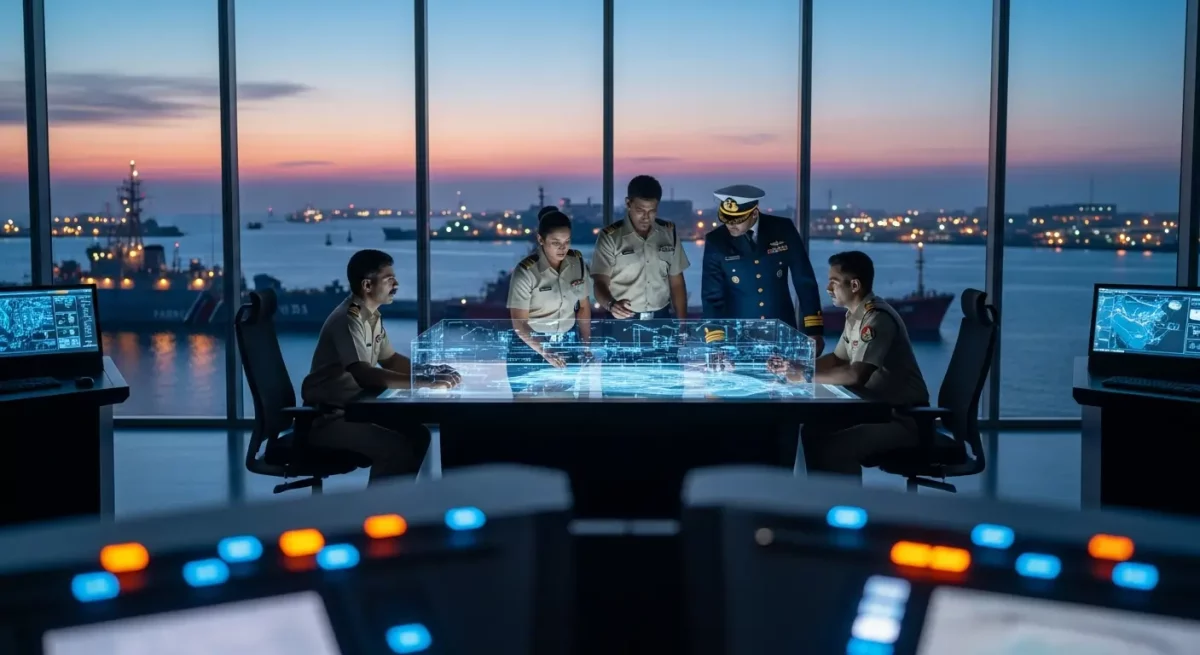
Global maritime border enforcement highlights distinct priorities in early 2026. The U.S. Coast Guard (USCG) faces a massive rise in interdictions of unauthorized vessels off the Southern California coast. Meanwhile, the Indian Coast Guard (ICG) conducts intensive anti-smuggling sweeps across the Arabian Sea and the Bay of Bengal.





In this analysis, we will examine the divergent operational responsibilities of the USCG and the ICG. We will analyze the jurisdictional challenges of maritime interdictions and outline the federal legal processes that follow detainment. The intricacies of federal proceedings following a U.S. border interdiction make consulting an immigration lawyer in San Diego essential.
Analyzing USCG maritime interdictions off the California coast in 2026
The USCG maintains a high operational tempo along the Pacific border to combat maritime smuggling. Operations require shifting military resources as unauthorized crossings adapt to increased enforcement. Over a single weekend, the USCG intercepted six vessels and apprehended 82 suspected migrants near San Clemente Island and Sunset Cliffs within a 90-minute span.
In a separate daytime incident, authorities intercepted a vessel carrying 14 suspected migrants near Point Loma, subsequently transferring them to Ballast Point for Department of Homeland Security (DHS) processing. Beyond illegal crossings, the USCG continues its large-scale counter-narcotics missions in the Pacific. The USCG Cutter Munro recently returned with over 22,000 pounds of seized cocaine following a 119-day deployment.
Navigating the legal aftermath of federal detainment
Following a maritime interdiction, the Coast Guard transfers detainees directly to DHS and Customs and Border Protection (CBP) authorities. These individuals immediately face a complex legal process within the U.S. immigration system. The immigration court in downtown San Diego currently faces a backlog of roughly 5,000 cases, while the Otay Mesa court handles around 800. Furthermore, asylum denial rates vary by up to 57.3 percentage points depending on the specific judge assigned to the case.
Securing an immigration lawyer in San Diego becomes an essential step for detainees facing these federal proceedings. Feldman Feldman & Associates PC operates as a crucial resource for navigating these legal challenges. Their legal team provides comprehensive support for general immigration needs, ranging from deportation defense following maritime interdictions to securing temporary work visas and family-based green cards. This representation ensures fundamental rights remain protected in a complex judicial system.
The Indian Coast Guard and anti-smuggling operations in the Bay of Bengal
The operational focus shifts dramatically when analyzing the Indian Coast Guard (ICG). While U.S. forces prioritize migration and deportation logistics, India heavily targets contraband, narcotics, and regional geopolitical security. ICG units maintain continuous patrols to protect India’s vast exclusive economic zone (EEZ).
Recently, the ICG vessel Apurba Bangla intercepted two suspicious fishing boats near a coral island and arrested 19 individuals. This operation resulted in the seizure of illicit cargo destined for Myanmar. Authorities confiscated 1,140 sacks of cement and over 7,000 cans of energy drinks utilized in regional black-market smuggling.
These rigorous maritime enforcement standards require highly trained personnel to execute dangerous boarding procedures. The physical and operational demands placed on these specialized units parallel the rigorous training and capabilities expected of elite coastal defenders.
Operational priorities compared
| Feature | United States Coast Guard (USCG) | Indian Coast Guard (ICG) |
|---|---|---|
| Primary 2026 Focus | Migrant interdiction, counter-narcotics, deportation logistics | Anti-smuggling, exclusive economic zone (EEZ) protection, piracy |
| Recent Major Operation | Interception of 82 migrants off San Clemente Island | Arrest of 19 smugglers supplying Myanmar |
| Post-Detainment Transfer | Department of Homeland Security (DHS) / CBP | Local coastal police and customs authorities |
| Current Institutional Challenges | Resource strain due to reallocation for deportation flights | Vast maritime borders requiring constant localized patrols |
Jurisdictional challenges and the mechanics of multi-agency coordination
A standard maritime boarding requires precise protocols and extensive coordination among multiple federal agencies to maintain border security. The USCG regularly partners with DHS aircraft and U.S. Navy assets to track and interdict panga-style (open, outboard-powered) cuddy cabin boats. During recent multi-vessel interdictions, the littoral combat ship USS Augusta provided critical surface support.
These coordinated enforcement efforts require advanced tactical execution and seamless multi-agency integration. However, this extensive coordination faces significant internal friction in 2026. Tensions have escalated regarding the reallocation of USCG aviation resources, specifically C-130 aircraft, from primary search-and-rescue missions to immigrant deportation flights. This operational shift reflects rapidly changing federal priorities and strains existing aviation resources.
The protocol of a maritime interdiction
- Detection and tracking: Partner agency aircraft or Navy assets identify suspicious northbound vessels departing foreign waters.
- Pursuit and boarding: Coast Guard pursuit boats launch to intercept the vessel, utilizing non-lethal disabling tactics if the vessel refuses to comply.
- On-site detainment and processing: Individuals are secured, nationalities are verified, and vessels are searched for contraband.
- Transfer to federal authorities: Detainees are transported to land bases (such as Ballast Point or Imperial Beach Border Patrol station) for formal DHS processing and investigation.
- Initiation of legal proceedings: Individuals are processed through the backlogged immigration court system, triggering the need for prompt legal representation.
Navigating the future of global maritime security
The global landscape of maritime enforcement continues to diverge based on regional security needs. The USCG currently directs its primary resources toward migration and deportation logistics, while the ICG concentrates heavily on regional black-market smuggling. As geopolitical tensions and economic disparities persist throughout 2026, nations will increasingly rely on naval and coast guard assets.
The intersection of maritime enforcement and federal law remains an enduring global challenge. Securing coastlines requires an evolving balance of tactical intercept capabilities, inter-agency cooperation, and robust judicial processes.
Disclaimer: The provided text is intended for informational and educational use and should not be interpreted as professional, legal, or financial advice. Neither the author nor this publication acts as a legal counselor. Neither the author nor this outlet serves as a legal representative. Any decisions involving federal litigation or immigration matters should be made with the guidance of a licensed attorney, as prior legal successes do not guarantee similar results in future proceedings.