
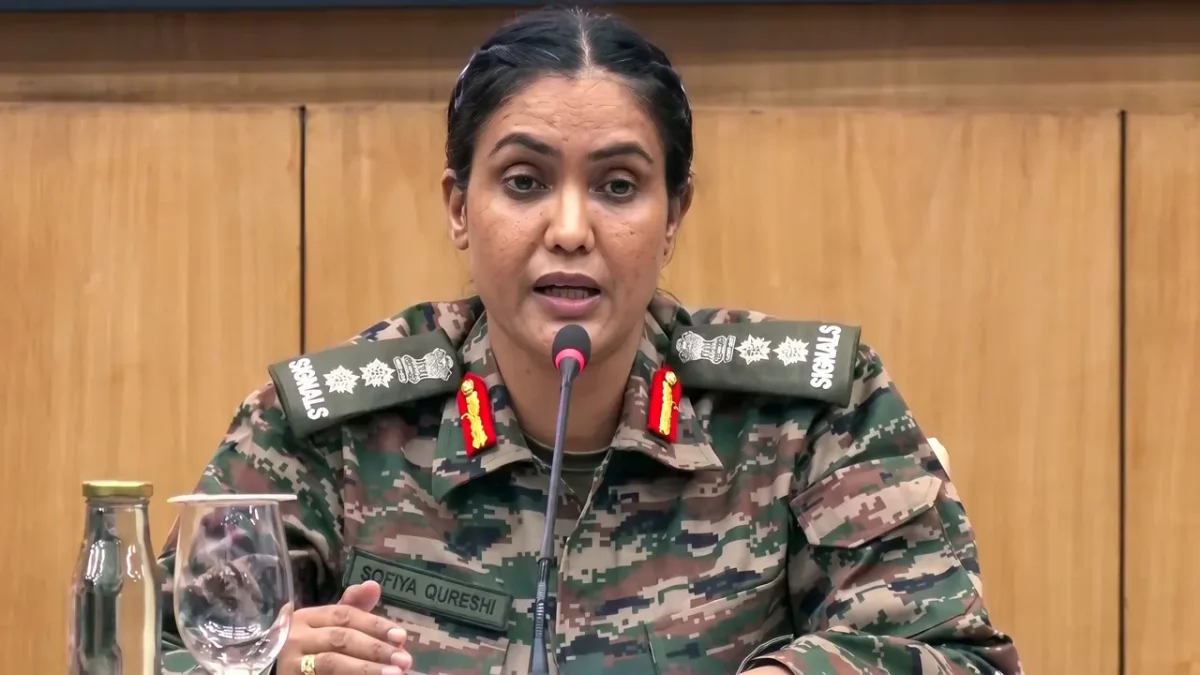
The Supreme Court of India on Friday strongly criticised the Madhya Pradesh government for its prolonged delay in deciding on the grant of sanction to prosecute state minister Kunwar Vijay Shah over his controversial remarks against Colonel Sofiya Qureshi, a decorated Army officer who gained prominence for her media briefings during Operation Sindoor.





A bench comprising Chief Justice of India Surya Kant and Justice Joymalya Bagchi expressed clear displeasure, observing that the state government had failed to comply with its earlier direction issued on January 19, 2026, and remarked, “Enough is enough.” The court directed the Madhya Pradesh government to take a final decision on the sanction within four weeks and report compliance. The matter has been listed for further hearing after the summer vacation.
Background of the Controversy
The controversy stems from remarks made by Minister Kunwar Vijay Shah on May 12, 2025, at a public event in Mau. Shah stated that India had taught a lesson to those responsible for the Pahalgam terror attack by using “their own sister.” While he did not explicitly name any individual, the comments were widely interpreted as a derogatory and communal reference to Colonel Sofiya Qureshi, who, along with other officers, had briefed the media on India’s military response — Operation Sindoor — following the Pahalgam attack.
The remarks triggered widespread outrage across the country, with critics highlighting their alleged misogynistic and communal undertones targeting a serving woman officer of the Indian Army. Colonel Qureshi had emerged as one of the prominent faces of the Operation Sindoor briefings.
The Madhya Pradesh High Court took suo motu cognisance of the matter shortly thereafter. It described the minister’s language as “scurrilous” and “language of the gutters” and directed the registration of a First Information Report (FIR) against him on charges including those related to promoting enmity and hatred between groups.
Supreme Court’s Earlier Interventions
The Supreme Court had earlier intervened in the matter. It granted interim protection from arrest to the minister and, on May 19, 2025, constituted a three-member Special Investigation Team (SIT) headed by senior police officers to conduct a thorough probe. The SIT completed its investigation and submitted a sealed cover report to the court. The report sought the state government’s sanction to prosecute Shah under Section 196 of the Bharatiya Nyaya Sanhita, which pertains to offences promoting communal hatred and ill-will. The SIT’s findings reportedly noted that the minister was “in the habit of making such statements.”
On January 19, 2026, the Supreme Court, after perusing the SIT report, directed the Madhya Pradesh government to take an appropriate decision on the grant of sanction within two weeks. However, no decision had been taken by the state government even months later, prompting the latest hearing.
Friday’s Hearing and Court’s Observations
During the hearing on Friday, Solicitor General Tushar Mehta, appearing in the matter, submitted that the minister had apologised on television with folded hands and suggested, in his personal capacity, that Shah had possibly intended to praise Colonel Qureshi but had failed to articulate his thoughts properly.
The bench firmly rejected these submissions. Chief Justice Surya Kant observed that the remarks were “most unfortunate” and that the minister showed “no sense of repentance.” The court noted that political personalities are expected to be articulate and that a genuine slip of the tongue would have warranted an immediate and unconditional apology.
The bench further remarked that the apology, if any, appeared to have been tendered only after the court had taken cognisance of the matter. “Writing a letter is not an apology. It is only creating a fake defence… The first thing he should have done was say, ‘I have committed a mistake. I tender an unconditional apology for it,’” the Chief Justice stated. The court added that the minister appeared to behave “as if you are above the law.”
Justice Bagchi observed that the state should examine the “totality of the circumstances” before taking a decision on sanction. The bench refused to entertain further submissions on behalf of the minister and the state government, directing strict compliance with its earlier order within four weeks.
Significance of the Order
The Supreme Court’s strong stance underscores the importance of timely executive action in cases involving alleged offences against the dignity of the armed forces and the promotion of communal harmony. The directive comes against the backdrop of heightened national attention on respect for women in uniform and accountability of public representatives.
The case continues to highlight broader questions of political rhetoric, institutional accountability, and the rule of law. The Madhya Pradesh government is now required to decide on the SIT’s request for prosecution sanction and apprise the Supreme Court of its decision within the stipulated timeframe.
The matter remains pending before the apex court.