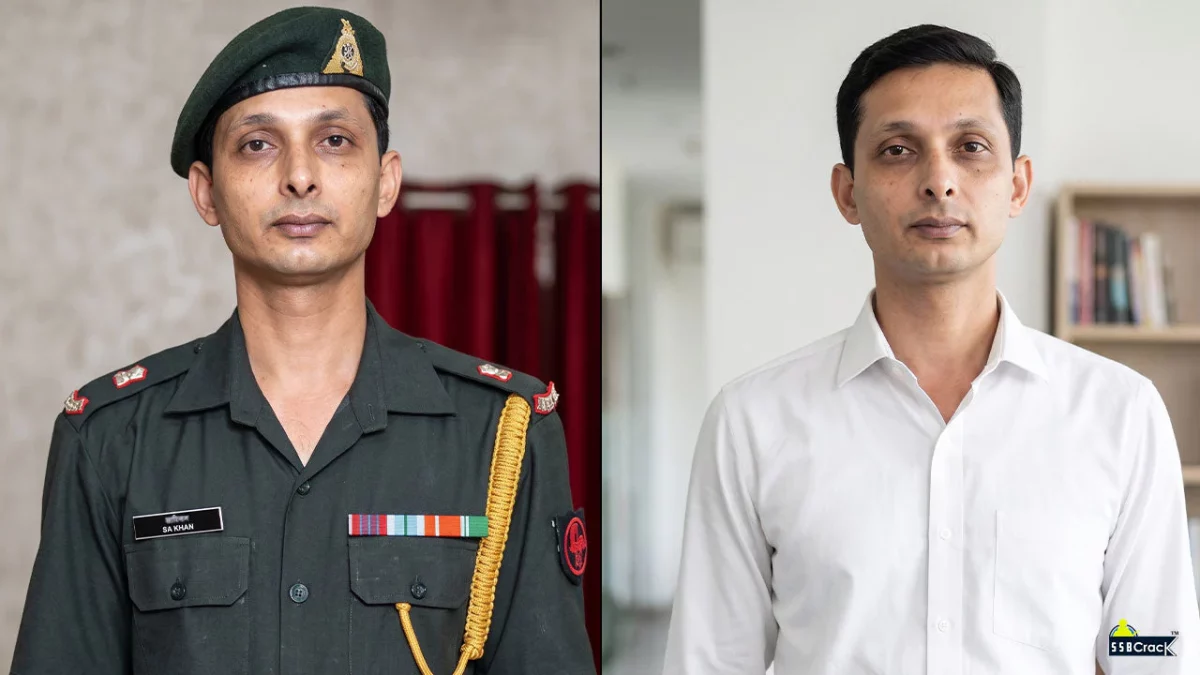
Major Salman Ahmad Khan remains one of the finest examples of courage, leadership and supreme sacrifice in the Indian Army. A young officer from Kanpur, Uttar Pradesh, he laid down his life during a fierce counter-insurgency operation in Kupwara, Jammu and Kashmir, at the age of just 26. Even after being grievously injured by enemy fire, he refused to withdraw from the battlefield and continued to lead his men until the terrorist threat was completely neutralised.





For his extraordinary bravery, indomitable fighting spirit and devotion to duty, Major Salman Ahmad Khan was posthumously awarded the Shaurya Chakra, one of India’s highest peacetime gallantry awards. His story continues to inspire generations of Indians, especially young defence aspirants who dream of serving the nation in uniform.
Major Salman Ahmad Khan was born on 22 October 1978 in Kanpur district of Uttar Pradesh to Shri Mushtaq Ahmed Khan and Smt Rashida. From his early years, he displayed discipline, confidence and a strong sense of patriotism. His upbringing shaped in him the values of duty, humility and courage, which later became the defining traits of his military career.
He received his early education at Sainik School, Lucknow, an institution known for producing disciplined and motivated young men for the armed forces. His years at Sainik School strengthened his desire to join the Army and prepared him for the demanding path ahead. With determination and hard work, he went on to join the National Defence Academy, followed by training at the Indian Military Academy in Dehradun.
These premier military institutions moulded him into a confident and capable officer. The training he received at NDA and IMA instilled in him the principles of leadership, physical toughness, mental resilience and selfless service. These qualities would later be tested in the most difficult circumstances on the battlefield.
In June 1999, Salman Ahmad Khan was commissioned into the 4 Sikh Battalion of the Sikh Regiment, one of the most respected and battle-hardened infantry regiments of the Indian Army. His service number was IC-58686X. Commissioned at the young age of 20, he quickly earned the respect of his seniors and comrades through his professionalism, sincerity and sense of responsibility.
Over the next few years, he proved himself as a dedicated officer with a strong sense of duty. His leadership qualities, discipline and operational commitment helped him rise in the Army, and by 2005, he had attained the rank of Major. Among his fellow soldiers and friends, he was affectionately known as “Sallu,” a name that reflected the warmth and camaraderie he shared with those around him.
Major Khan was remembered not only as a brave officer but also as a humble and approachable human being. He was deeply connected with his men and always led from the front. He was also known for his interest in sports and his energetic personality, which made him a beloved figure within his unit.
After serving with distinction in his parent battalion, Major Salman Ahmad Khan was deputed to 6 Rashtriya Rifles, a specialised counter-insurgency force deployed in Jammu and Kashmir. He was posted in the sensitive Rajwar sector of Kupwara district, an area that had witnessed repeated terrorist activity and required constant vigilance.
In this challenging environment, Major Khan displayed a rare combination of firmness and compassion. While he was determined in operations against terrorists, he also worked to build trust with the local population. In Kakroosa village, he established a strong bond with residents through his respectful conduct and genuine concern for their safety and welfare.
His people-centric approach reflected the true spirit of counter-insurgency operations, where winning the trust of the local population is as important as neutralising hostile elements. For many villagers, Major Khan became a symbol of security, confidence and hope.
The defining chapter of his life came in May 2005 during a counter-insurgency operation in Kupwara. On 5 May 2005, his unit received credible intelligence about the presence of heavily armed terrorists near Trehgam. Acting swiftly on the information, Major Khan led his team to set up an ambush near Bangargund at around 8 pm.
The ambush was executed with precision. During the engagement, Major Khan personally eliminated one terrorist. While searching the body, he recovered important documents that revealed militant routes and hideouts. This intelligence proved crucial for further operations in the area.
The operation continued the next day. On 6 May 2005, fresh information indicated that one terrorist who had escaped from the earlier encounter was hiding in Pazipora village. Without hesitation, Major Khan led a cordon-and-search operation to locate and eliminate the remaining threat. Around 5:30 pm, his team surrounded the suspected house and began the search.
As the operation progressed, the troops came under heavy and accurate fire from automatic weapons and under-barrel grenade launchers. In the intense exchange of fire, Major Khan was hit by bullets in his leg and abdomen. The injuries were serious and life-threatening, but he refused to leave the operation midway.
Bleeding heavily and in severe pain, Major Khan continued to lead his men from the front. Instead of seeking immediate evacuation, he charged towards the terrorist position and engaged the militant at close range. His fearless action severely injured the terrorist, who then tried to escape into a nearby outhouse.
Even in a critically wounded condition, Major Khan kept his composure. Understanding the danger posed by the terrorist, he lobbed two grenades into the structure and successfully neutralised the final threat. His action ensured the complete elimination of the terrorist group and saved the lives of his comrades.
Only after the mission was accomplished did Major Khan collapse due to his grievous injuries. He was evacuated to a military hospital, but his wounds were too severe. On 7 May 2005, Major Salman Ahmad Khan succumbed to his injuries and attained martyrdom at the age of 26.
His courage during the two-day operation remains a shining example of leadership under fire. Despite being mortally wounded, he placed the mission and the safety of his men above his own life. His actions led to the elimination of dangerous terrorists and prevented further harm to soldiers and civilians in the area.
For his exceptional bravery and supreme sacrifice, Major Salman Ahmad Khan was posthumously awarded the Shaurya Chakra. The award recognised his outstanding gallantry, calmness under extreme danger, and unwavering devotion to duty in the highest traditions of the Indian Army.
His name is also inscribed on the National War Memorial in New Delhi, where the nation remembers its brave soldiers who made the ultimate sacrifice. Major Khan’s name stands there as a permanent reminder of the courage of a young officer who chose duty over life.
Major Salman Ahmad Khan’s legacy lives on not only in military records but also in the hearts of his family, comrades and countless citizens. His younger brother, Shri Ikram Ahmad Khan, paid a deeply emotional tribute to him by naming his son Salman, ensuring that the memory of the brave officer continues within the family.
Every year, his sacrifice is remembered with respect and pride. Veterans, serving soldiers, defence aspirants and ordinary citizens pay tribute to the officer who fought till his last breath. His life is a powerful reminder that true heroism is not measured by age but by courage, character and commitment to the nation.
Major Salman Ahmad Khan’s story continues to inspire young Indians to serve with honour and dedication. He was only 26 when he made the supreme sacrifice, but his legacy is timeless. He remains a symbol of fearless leadership, brotherhood, patriotism and selfless service.
In the proud history of the Indian Army, Major Salman Ahmad Khan will always be remembered as a braveheart who refused to step back even in the face of death. He fought for his men, for his mission and for his motherland until his last breath. His sacrifice will continue to shine as an example for generations to come.