
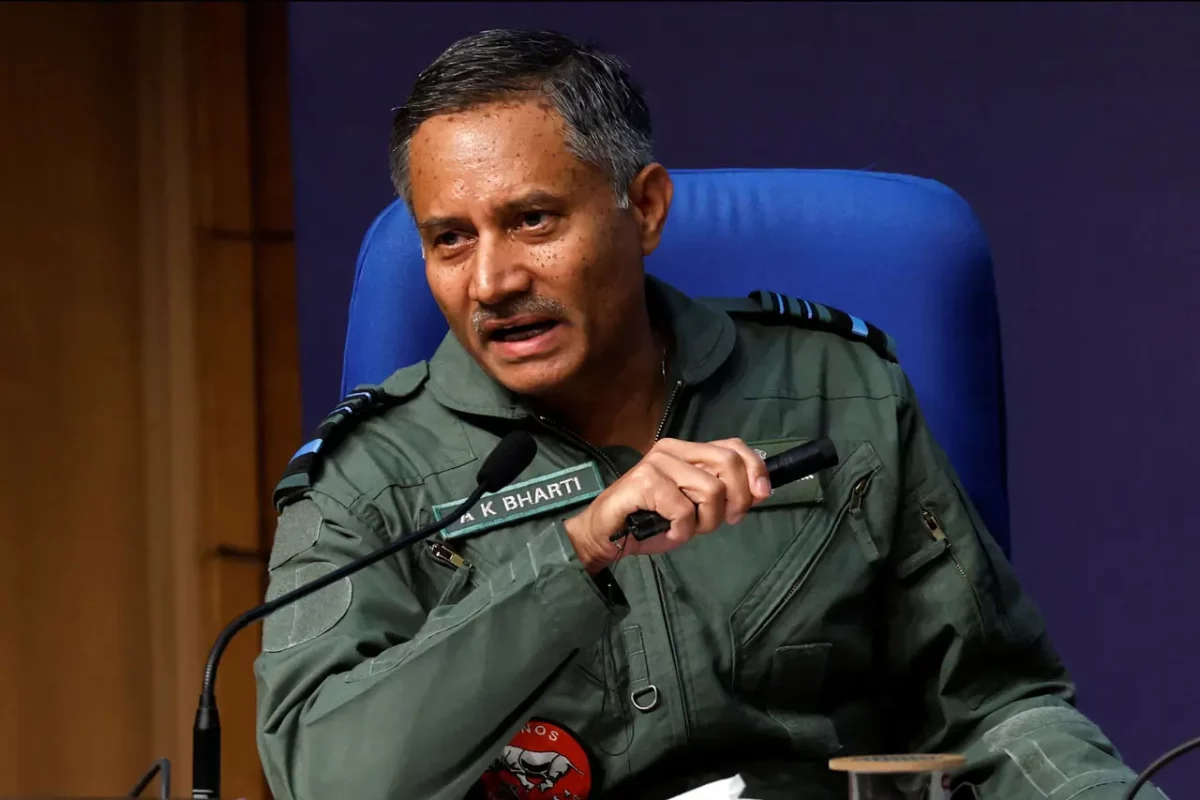
New Delhi, May 12, 2025 — In a detailed joint press briefing by senior Indian military commanders, Air Marshal Awadhesh Kumar Bharti, Director General of Air Operations, stated that the Indian Air Force destroyed 13 Pakistani aircraft — either on the ground or in the air — and struck 11 Pakistani airfields during Operation Sindoor. The operation was launched in response to the April 22, 2025, Pahalgam terror attack that killed 26 civilians.




Air Marshal Bharti, who played a central role in planning and executing the air component of the operation, provided a comprehensive account of the Indian Armed Forces’ actions. “We struck and decimated their nine terrorist camps on 7th May. The proof is there for everybody to see. We struck 11 of their airfields. We destroyed 13 of their aircraft either on the ground or in the air, including one high-value airborne asset at a record distance of 300 kilometres plus,” he said.
The briefing, attended by Air Marshal Bharti along with Lt Gen Rajiv Ghai and Vice Admiral AN Pramod, marked one of the most detailed official disclosures on the multi-domain military response codenamed Operation Sindoor.
Background: The Pahalgam Massacre
On April 22, 2025, terrorists attacked a group of tourists near Pahalgam in Jammu and Kashmir’s Anantnag district. The assailants, identified as members of The Resistance Front (TRF) — widely regarded as a front for the Pakistan-based Lashkar-e-Taiba — segregated victims by religion before opening fire with automatic weapons. Twenty-six civilians, predominantly Hindu tourists, were killed, and approximately 20 others were injured. The attack shocked the nation and prompted a decisive response from the Government of India.
Launch and Execution of Operation Sindoor
Operation Sindoor commenced on the night of May 7–8, 2025, with precision strikes targeting terrorist infrastructure in Pakistan and Pakistan-occupied Kashmir (PoK). The initial phase focused exclusively on nine high-value terror camps associated with Jaish-e-Mohammed (JeM) and Lashkar-e-Taiba (LeT). These included the JeM headquarters at Bahawalpur, the LeT’s Markaz-e-Taiba facility at Muridke, and additional camps in areas such as Kotli, Bhimber, Muzaffarabad, Sialkot, and Sawai Nala.
Air Marshal Bharti emphasised that the strikes were “precise, calculated, and calibrated,” with the explicit objective of neutralising terrorist infrastructure while ensuring zero collateral damage to civilians. “Our fight was with the terrorists and their support infrastructure. And that is what we hit, ensuring no collateral damage,” he stated.
Following Pakistan’s retaliatory actions, including attempts to target Indian positions and military assets, the operation expanded to include strikes on Pakistani air defence and aviation infrastructure. Indian forces successfully engaged and neutralised 11 Pakistani airfields and air bases. The Indian Air Force conducted deep strikes using a combination of air-launched and surface-to-surface precision munitions, including SCALP cruise missiles, BrahMos supersonic cruise missiles, and Crystal Maze ballistic missiles.
Aircraft Losses and Aerial Engagements
Air Marshal Bharti confirmed that the Indian Air Force achieved significant success in both ground and aerial domains. “We destroyed 13 of their aircraft either on the ground or in the air, including one high-value airborne asset at a record distance of 300 kilometres plus,” he said. The high-value asset is understood to refer to a Pakistani AWACS (Airborne Warning and Control System) aircraft damaged at Bholari airbase.
The aerial campaign involved large-scale beyond-visual-range engagements, with the Indian Air Force establishing temporary air superiority over key sectors. All Indian pilots who participated in the operation returned safely. Pakistan’s claims of downing multiple Indian aircraft, including Rafale fighters, were categorically addressed in subsequent briefings, with Indian officials maintaining that no major damage was inflicted on Indian military infrastructure or civilian areas.
Broader Military Assessment
Lt Gen Rajiv Ghai noted that Pakistani forces suffered more than 100 personnel casualties during ground exchanges along the Line of Control following the initial strikes. He highlighted the effectiveness of indigenous defence systems, stating that Operation Sindoor demonstrated that “Atmanirbhar is not just a slogan, it is indeed a force multiplier,” with over 65 per cent of India’s defence equipment now indigenously manufactured.
The operation involved seamless coordination across the Army, Navy, and Air Force, supported by the Integrated Air Command and Control System (IACCS) and advanced air defence networks, including the S-400 Triumf system.
Strategic Message and Cessation
Air Marshal Bharti underscored India’s approach to the conflict: “We stepped back, but we didn’t blink. We had delivered the message, and the message was very clear — misadventure will not go unanswered, and acts of terror will carry consequences.” He added that the armed forces had been granted full operational freedom, with all decisions jointly calibrated at the highest levels.
India halted further offensive operations once its core military objectives — the destruction of terrorist infrastructure and the imposition of costs on Pakistan’s military support apparatus — had been achieved. Pakistan subsequently requested a cessation of hostilities.
Implications and Legacy
Operation Sindoor represented one of the most significant Indian military responses to cross-border terrorism in recent decades. It combined precision deep strikes, robust air defence, and multi-service coordination while adhering to a policy of calibrated escalation and avoidance of civilian harm.
The revelations by Air Marshal Bharti and his counterparts provided rare transparency into the operational successes of the Indian Armed Forces. They reinforced India’s doctrinal shift towards holding state sponsors of terrorism accountable through decisive, technology-enabled military action.
As the nation observed the first anniversary of Operation Sindoor in May 2026, the operation continued to be cited as a benchmark for India’s resolve: peace is the preferred path, but aggression and terrorism will be met with a proportionate and unmistakable response.