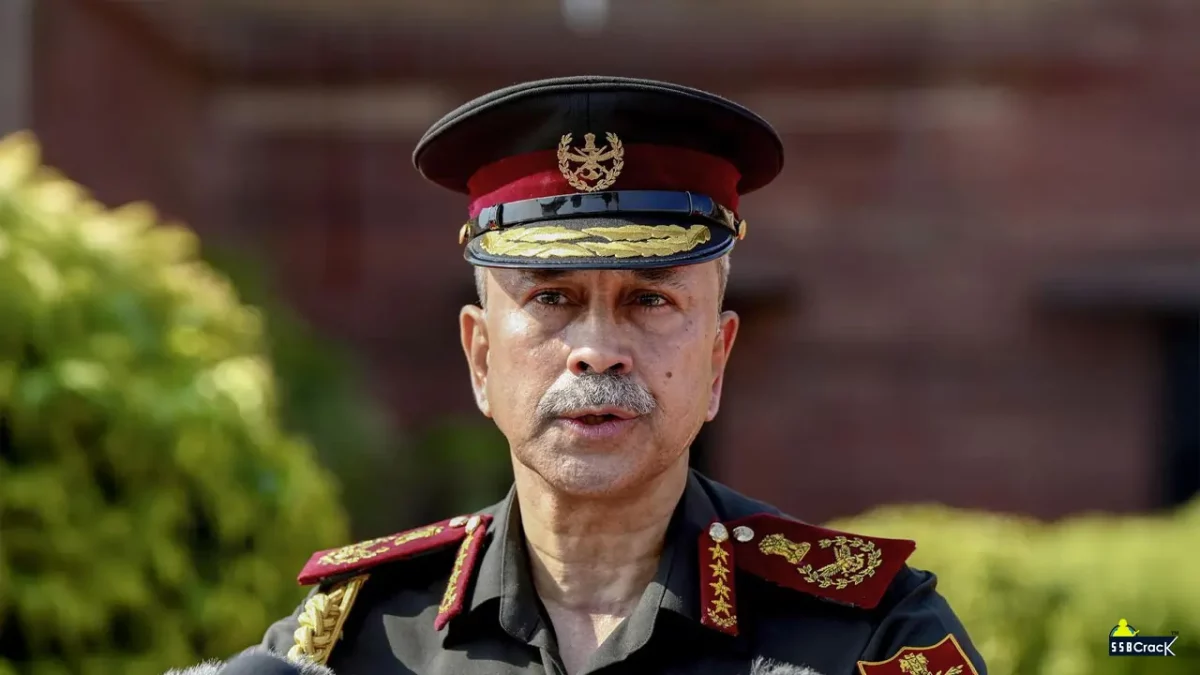
New Delhi, May 31, 2026 — Lieutenant General N.S. Raja Subramani, PVSM, AVSM, SM, VSM (Retd), a highly decorated officer with over four decades of distinguished service, formally assumed charge as India’s third Chief of Defence Staff (CDS) on Sunday. He succeeds General Anil Chauhan, whose tenure concluded on May 30, 2026.





The assumption of office marks a significant transition in India’s apex military leadership. General Subramani will also serve as Secretary to the Government of India in the Department of Military Affairs. The changeover was marked by a ceremonial Tri-Services Guard of Honour at the South Block lawns in New Delhi. General Subramani paid homage to the nation’s fallen soldiers by laying a wreath at the National War Memorial.
Official Appointment and Transition
The Government of India announced the appointment on May 9, 2026. Lieutenant General N.S. Raja Subramani was named the next CDS, effective from the date of assumption of charge. General Anil Chauhan, PVSM, UYSM, AVSM, SM, VSM, completed his tenure after serving as the second CDS since September 2022.
The Ministry of Defence stated that the appointment underscores the government’s commitment to strengthening tri-service integration and advancing structural reforms in the armed forces. General Subramani’s extensive operational experience, particularly along India’s northern and western borders, positions him well to lead these initiatives.
Profile and Military Career of General N.S. Raja Subramani
Born on 21 July 1965, General Subramani is an alumnus of the 67th course of the National Defence Academy (NDA) and the 77th course of the Indian Military Academy (IMA). He holds a Master of Arts degree from King’s College London and an MPhil in Defence Studies from the University of Madras. He also attended the Joint Services Command and Staff College in Bracknell, United Kingdom, and the National Defence College in New Delhi.
Commissioned into the 8th Battalion of the Garhwal Rifles on 14 December 1985 (service number IC-43245K), General Subramani has held a wide range of command, staff, and instructional appointments. His early service included counter-insurgency operations in Assam as part of Operation Rhino, where he commanded the 16th Battalion of the Garhwal Rifles. He later served as Defence Attaché at the Embassy of India in Astana, Kazakhstan, and held key staff roles at Army Headquarters and Eastern Command.
As a Brigadier, he commanded the 168 Infantry Brigade in Samba, Jammu and Kashmir. Promoted to Major General, he commanded the 17th Mountain Division in Sikkim. He subsequently served as Chief Instructor (Army) at the Defence Services Staff College, Wellington.
Elevated to Lieutenant General on 3 February 2020, he commanded the Uttar Bharat Area and later the II Corps (a key strike corps oriented towards the western border). He served as Chief of Staff, Headquarters Northern Command, before assuming command of the Central Command as General Officer Commanding-in-Chief from March 2023 to June 2024. From 1 July 2024 to 31 July 2025, he served as the 47th Vice Chief of the Army Staff. Following retirement from active service, he was appointed Military Adviser at the National Security Council Secretariat with effect from 1 September 2025.
Awards and Decorations
General Subramani has been conferred with the Param Vishisht Seva Medal (2024), Ati Vishisht Seva Medal (2020), Sena Medal (2005), and Vishisht Seva Medal (2015). He has also received numerous campaign and service medals, including the Special Service Medal, Siachen Glacier Medal, Operation Vijay Medal, Operation Parakram Medal, and long-service medals.
Vision and Priorities as CDS
In his first address after assuming charge, General Subramani expressed gratitude for the trust placed in him and outlined his commitment to the Prime Minister’s vision of JAI — Jointness, Atma Nirbharta (self-reliance), and Innovation.
He stated: “Strengthening jointness, synergy and integration among the Army, Navy and Air Force would remain a key focus area.” He emphasised accelerating the development, induction and integration of indigenous weapons and defence technologies, noting that self-reliance forms a cornerstone of national security. Innovation in thought and action, he added, would drive capability development through greater collaboration with industry, academia, startups and the research ecosystem.
General Subramani paid tribute to his predecessors, acknowledging the foundational contributions of the late General Bipin Rawat, India’s first CDS, and General Anil Chauhan in advancing military integration and reforms. He reaffirmed the armed forces’ unwavering commitment to safeguarding India’s sovereignty and territorial integrity while prioritising the welfare of serving personnel, veterans and Veer Naaris.
Strategic Context and Significance
The appointment comes at a pivotal juncture as India pursues ambitious defence reforms, including the long-anticipated creation of integrated theatre commands and enhanced tri-service synergy. As the professional head of the Department of Military Affairs and principal military adviser to the Defence Minister, the CDS plays a central role in policy formulation, capability development and operational coordination across the three services.
General Subramani is widely regarded as a sharp, visionary and technology-savvy leader known for quick decision-making, professional empathy and a results-oriented approach. His deep understanding of operational dynamics on both the western (Pakistan) and northern (China) borders, combined with extensive experience in counter-insurgency, mountain warfare and intelligence, equips him to address contemporary security challenges effectively.
Concurrently, Vice Admiral Krishna Swaminathan has been appointed as the next Chief of the Naval Staff, completing the latest round of top-level military leadership changes.
Outlook
General N.S. Raja Subramani’s assumption of charge as the third Chief of Defence Staff heralds a new chapter in India’s defence leadership. With his proven track record of operational excellence, strategic insight and commitment to jointmanship, he is expected to accelerate the ongoing transformation of the Indian Armed Forces towards greater integration, self-reliance and technological advancement.
The nation extends its best wishes to General Subramani as he takes on this critical responsibility at a time when India’s defence posture continues to evolve in response to emerging geopolitical realities.