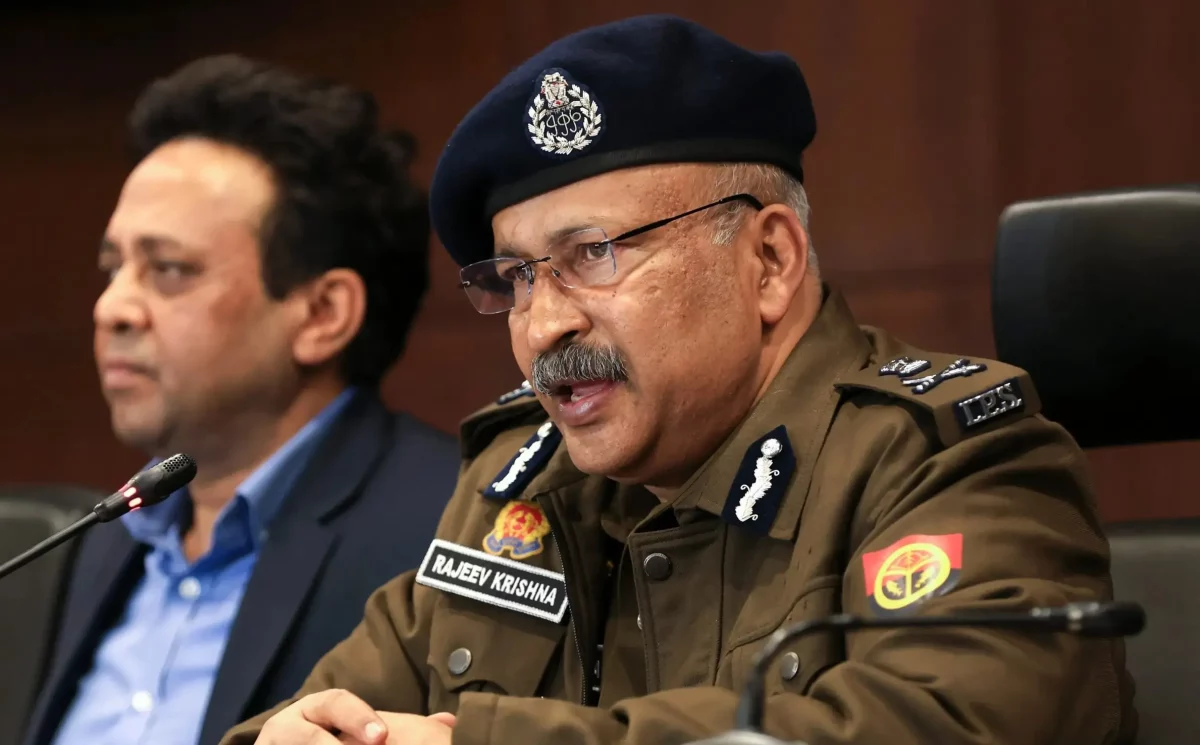
Lucknow, May 31, 2026 — In a significant development for Uttar Pradesh’s law enforcement apparatus, senior Indian Police Service (IPS) officer Rajeev Krishna has been appointed as the full-time Director General of Police (DGP) of Uttar Pradesh. The appointment marks the end of nearly four years without a permanent police chief in the state, providing much-needed stability to the leadership of India’s largest police force.





Krishna, a 1991-batch IPS officer (IPS:1991:UP), who has been serving as Acting DGP since June 1, 2025, succeeds Prashant Kumar. He becomes the first regular DGP since Mukul Goel (IPS:1987:UP) was removed from the post in May 2022. Official sources confirmed that the state government has formalised his appointment following the receipt of a panel from the Union Public Service Commission (UPSC). An official government order (GO) has been issued or is expected imminently, in line with Supreme Court guidelines on fixed tenures for state police chiefs.
Background to the Appointment
Uttar Pradesh has operated under a series of acting or officiating DGPs since 2022, including D.S. Chauhan, R.K. Vishwakarma, Vijay Kumar, and Prashant Kumar. This prolonged period of interim arrangements had drawn criticism for creating uncertainty in the police hierarchy and affecting long-term strategic planning. The process for a permanent appointment gained momentum earlier this year when the state government forwarded names of eligible senior IPS officers — those with at least 30 years of service — to the UPSC. A high-level UPSC meeting in New Delhi on May 26, 2026, resulted in a shortlist of three officers: Renuka Mishra (IPS:1990:UP), Piyush Anand (IPS:1991:UP, currently on central deputation as DG, NDRF), and Rajeev Krishna. Krishna emerged as the state government’s preferred candidate.
As per Supreme Court directives in the Prakash Singh case and UPSC norms, the selected DGP is entitled to a minimum fixed tenure of two years. Krishna, born on June 26, 1969, is scheduled to retire in June 2029, positioning him to serve nearly three years in the role and bring sustained leadership.
Profile and Distinguished Career of Rajeev Krishna
Rajeev Krishna, a native of Gautam Buddha Nagar in Uttar Pradesh, is an engineering graduate with a Bachelor of Engineering (B.E.) degree in Electronics and Communication. He joined the Indian Police Service on September 15, 1991, after clearing the Civil Services Examination. Throughout his more than three-decade career, he has built a reputation for operational excellence, technological innovation in policing, integrity, and administrative acumen. He is widely regarded as one of the younger officers to ascend to the top post in the state.
Key career milestones include:
- Field and District Leadership: Served as Superintendent of Police (SP) and Senior Superintendent of Police (SSP) in several critical districts, including Mathura, Etawah, Agra, Noida, and Lucknow. As SSP Agra in 2004, he led decisive operations against notorious kidnapping gangs operating in the ravines of western Uttar Pradesh, earning widespread recognition.
- Founding of UP Anti-Terror Squad (ATS): Appointed as the founding chief of the Uttar Pradesh Anti-Terror Squad, where he played a pivotal role in establishing its operational framework and counter-terror capabilities during a period marked by heightened security challenges.
- Training and Institutional Development: Headed the Uttar Pradesh Police Academy, contributing significantly to the training and professional development of young officers.
- Central and Border Security Experience: Served as Inspector General (Operations) in the Border Security Force (BSF), overseeing operations along the Indo-Pakistan and Indo-Bangladesh borders. He implemented sensor-based surveillance systems under the Comprehensive Integrated Border Management System, enhancing border security infrastructure.
- Technology-Driven Policing Initiatives: As Additional Director General (ADG) of the Agra Zone, he launched Operation Pehchaan, a mobile-based platform for identifying and tracking repeat offenders. He has consistently championed digitisation, including the e-Malkhana system for case property management, online monitoring of women’s beat policing and Anti-Romeo squads, and enhanced cybercrime prevention and investigation capabilities through specialised training and public awareness programmes.
- Recent Administrative Roles: Prior to and alongside his acting DGP tenure, Krishna served as Director General (Vigilance) and Chairman of the Uttar Pradesh Police Recruitment and Promotion Board. In 2024, following allegations of paper leaks in the constable recruitment examination, he was entrusted with overseeing the fresh recruitment process. Under his supervision, more than 60,000 constables were recruited through a transparent, efficient, and strictly monitored exercise involving millions of applicants.
His service record includes prestigious decorations such as the Police Medal for Gallantry (2002, with a bar in 2009), the President’s Police Medal for Distinguished Service (2015), the Police Medal for Meritorious Service (2007), and multiple Director General’s Commendation Discs (Silver, Gold, and Platinum).
Significance and Way Forward
The appointment of Rajeev Krishna is expected to inject continuity, professionalism, and a renewed focus on modern policing priorities in Uttar Pradesh. Key challenges ahead include tackling organised crime, cybercrime, and maintaining robust law and order in the state, alongside accelerating police modernisation and welfare measures.
Government sources have indicated that Krishna’s extensive experience in vigilance, recruitment, counter-terror operations, and technology integration makes him well-suited to lead the force. His tenure is anticipated to strengthen the professional image of the Uttar Pradesh Police while ensuring alignment with the state government’s vision for a technology-led and citizen-centric policing model.
As the new full-time DGP assumes charge, the focus will remain on sustaining the momentum in recruitment transparency, enhancing cyber capabilities, and fostering closer coordination with central agencies. The Uttar Pradesh Police, with its vast network and responsibilities, stands to benefit from stable leadership at the helm after an extended period of interim arrangements.
This development underscores the state government’s commitment to adhering to established procedures for senior police appointments while prioritising merit and operational competence. Official confirmation and any subsequent directives from the Home Department are awaited to formalise the transition.