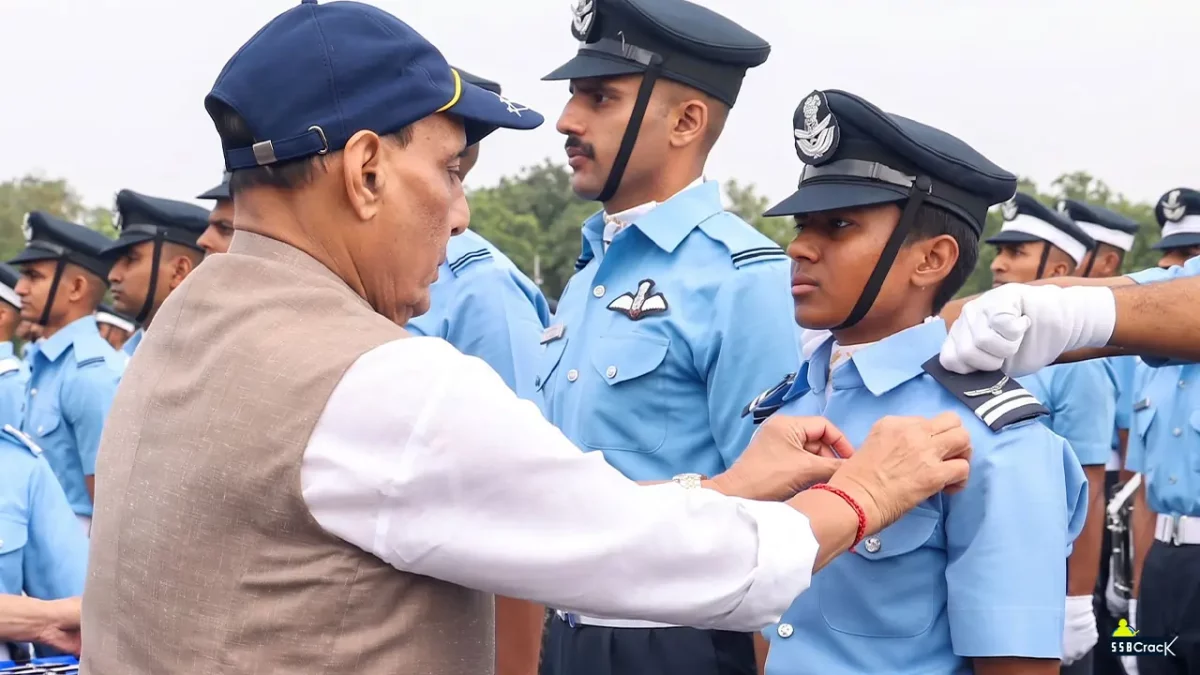
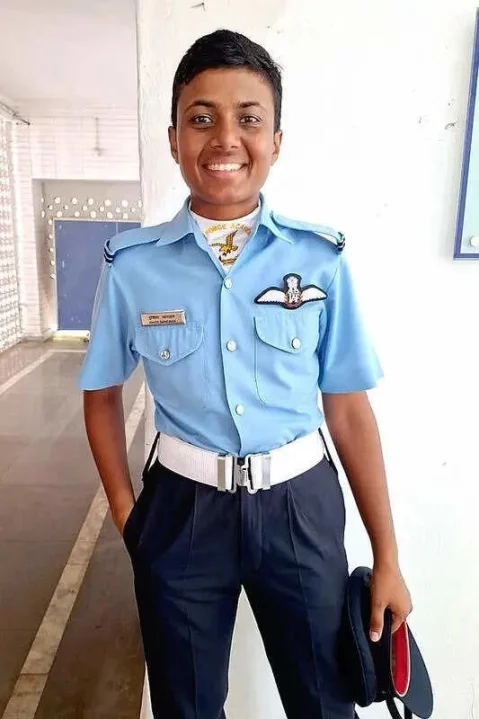
Flying Officer Ishita Sangwan has scripted a landmark chapter in Indian military aviation by becoming one of the first women to enter the fighter stream of the Indian Air Force through the National Defence Academy route. The young officer from Haryana received the President’s Commission during the Combined Graduation Parade of the 217 Course held at the Air Force Academy, Dundigal, Hyderabad, on June 13, 2026.





Her commissioning represents much more than an individual achievement. It marks the emergence of the first generation of women officers trained through the National Defence Academy for a permanent career in the Indian Armed Forces.
Historic commissioning at Air Force Academy
Defence Minister Rajnath Singh reviewed the Combined Graduation Parade and conferred the President’s Commission upon the graduating flight cadets.
A total of 231 flight cadets, comprising 194 men and 37 women, were commissioned into the Flying and Ground Duty branches of the Indian Air Force. The graduating course included the first batch of women cadets who had entered the Armed Forces through the NDA.
Ishita was among the pioneering women selected for the fighter stream, placing her in the cockpit of one of the most demanding and prestigious branches of military aviation.
The ceremony marked the culmination of years of intensive academic, physical, military and flying training. In the presence of their families and senior officers, the newly commissioned personnel took an oath to protect the sovereignty and honour of the country.
The parade was accompanied by a coordinated flypast featuring the Pilatus PC-7 Mk II, Hawk, Kiran and Chetak aircraft. Aerobatic displays by the Su-30MKI, the Sarang helicopter display team and the Suryakiran Aerobatic Team formed part of the ceremonial finale.
From Chhapar village to the fighter cockpit
Ishita Sangwan traces her family roots to Chhapar village in the Charkhi Dadri district of Haryana. Although her ancestral home is in Haryana, she spent a significant part of her childhood and school years in Rajasthan.
She studied in Churu until Class VIII and subsequently completed her schooling in Nagaur. Her family is presently settled in the Jhunjhunu region of Rajasthan.
Ishita grew up in a family that placed great emphasis on education, discipline and personal development. Her father, Charan Singh Sangwan, serves as the principal of a private school, while her mother, Anita Sangwan, is a Hindi teacher.
Her twin sister, Aastha Sangwan, is pursuing medical studies, while her brother, Aryan Sangwan, is reportedly studying engineering in Pune.
Despite growing up away from her ancestral village, Ishita maintained a close connection with her family’s roots in Haryana. Her commissioning has now become a moment of pride for Chhapar village, Charkhi Dadri district and the entire state.
A phone call that changed her life
Ishita’s journey towards the National Defence Academy began after the Supreme Court opened the institution to women candidates in 2021.
She was studying in Class XII and preparing for competitive examinations when her father called her with the news that girls would now be permitted to appear for the NDA entrance examination.
Until then, a direct entry into the Armed Forces through the NDA had not been available to women. The court’s decision created an entirely new career opportunity for school-going girls aspiring to become permanent commissioned officers.
Encouraged by her father, Ishita decided to attempt the NDA examination while simultaneously preparing for her board examinations. Despite the limited preparation time, she cleared the written examination.
She subsequently qualified in the Services Selection Board interview, the detailed medical examination and the Computerised Pilot Selection System. The CPSS is a specialised aptitude assessment that candidates must clear to become pilots in the Indian Air Force.
Successfully completing every stage placed Ishita among the small group of women selected for the Air Force wing of the historic first female NDA batch.
Part of the NDA’s pioneering women’s batch
The admission of women to the National Defence Academy followed the Supreme Court’s landmark intervention in 2021. The first group of women cadets joined the academy at Khadakwasla in 2022.
At the NDA, Ishita underwent rigorous joint-services training alongside cadets preparing to join the Indian Army, Indian Navy and Indian Air Force.
The programme was designed to develop physical endurance, military discipline, academic knowledge, leadership abilities and the mental resilience required of future officers.
She was part of the first batch of women cadets to graduate from the National Defence Academy during the Passing Out Parade held in May 2025.
After completing her training at NDA, she moved to the Air Force Academy at Dundigal for specialised pre-commission training. Here, she was exposed to the demanding flying syllabus, aviation subjects, ground training and professional standards required of an Indian Air Force pilot.
Her selection for the fighter stream placed her on a path that requires exceptional physical fitness, quick decision-making, situational awareness and the ability to operate high-performance military aircraft in complex environments.
Excellence in academics and sports
Members of Ishita’s family describe her as a highly focused student who consistently performed well academically.
According to her father, she possessed the ability to study for several hours without losing concentration and regularly ranked among the leading students in her class.
Her accomplishments, however, were not limited to academics. Ishita was also a state-level basketball player and actively participated in outdoor activities.
Her involvement in competitive sports helped develop qualities such as teamwork, stamina, coordination and the determination to perform under pressure. These attributes later proved valuable during her demanding military and flying training.
Her twin sister has described Ishita as energetic, adventurous and willing to accept difficult challenges from childhood. She reportedly enjoyed climbing trees, playing sports and testing her physical abilities—characteristics that reflected her independent and fearless personality.
While Aastha aspired to enter the medical profession, Ishita wanted to pursue an unconventional career that would allow her to test her limits and serve the country.
A promise made to her grandmother
Ishita’s achievement also carries deep emotional significance for her family because of the close relationship she shared with her grandmother, Lichhma Devi.
Her grandmother passed away several years before Ishita entered the National Defence Academy. Family members recall that Ishita often told her grandmother that she would one day become a senior officer.
Although her grandmother could not witness the commissioning ceremony, the family believes that her encouragement and blessings remained an important source of strength throughout Ishita’s journey.
The promise made during her childhood has now been fulfilled, with Ishita receiving her commission as an officer in the Indian Air Force and beginning her career in the fighter stream.
Remaining connected to home
Despite the intensity of life at military academies, Ishita remained closely connected with her family.
During training, she frequently asked her mother to send homemade gond laddoos. Traditional dishes such as churma and khoya peda also remained among her favourites.
These small reminders of home provided emotional comfort during the long periods of physical training, academic instruction and separation from family.
Her parents supported her throughout the journey, from filling out the NDA application form and preparing for the selection process to completing training at Khadakwasla and Dundigal.
A new generation of women fighter pilots
Women were first inducted into the fighter stream of the Indian Air Force in 2016, when Avani Chaturvedi, Bhawana Kanth and Mohana Singh were commissioned through the Short Service Commission route.
Ishita Sangwan’s achievement belongs to a new phase in this journey. She is part of the first generation of women who entered military service directly after school through the NDA and trained for a permanent commission alongside their male counterparts.
The NDA route is particularly significant because it provides officers with joint-services exposure at an early stage and prepares them for long-term leadership responsibilities in the Armed Forces.
Ishita’s commissioning demonstrates how institutional reforms introduced after the 2021 Supreme Court judgment are now producing visible results within the services.
Defence Minister congratulates women officers
Addressing the graduating cadets, Defence Minister Rajnath Singh said the growing presence of “Nari Shakti” would make the Indian Air Force stronger, more robust and better balanced.
He described the induction of more women officers as evidence of the strength of an inclusive Armed Force.
The Defence Minister also advised the newly commissioned officers to remain vigilant against emerging threats and continuously adapt to advances in military technology.
He noted that modern warfare increasingly involves drones, satellites, radars, sensors, robotics and cyber systems. Young officers, he said, would frequently be required to make critical decisions within seconds.
Inspiration for aspiring women officers
Ishita Sangwan’s journey from a school student preparing for competitive examinations to a commissioned fighter-stream officer highlights the importance of opportunity, family support and individual determination.
Her accomplishment is expected to inspire young women preparing for the NDA examination, the Services Selection Board and careers in military aviation.
It also demonstrates that candidates from villages and modest educational families can reach the highest levels of military training through merit, discipline and sustained effort.
For the people of Chhapar village and Charkhi Dadri, Ishita is now a symbol of Haryana’s long-standing contribution to the Armed Forces. For the Indian Air Force, she represents a new generation of officers entering service through a more inclusive and integrated training system.
From the basketball court and classrooms of Rajasthan to the parade ground of the Air Force Academy, Flying Officer Ishita Sangwan’s journey reflects both personal courage and a historic transformation within India’s defence institutions.
As she begins the next stage of fighter flying training, her story carries a powerful message for young aspirants across the country: opportunities may open the door, but determination, preparation and courage are what enable a person to take flight.