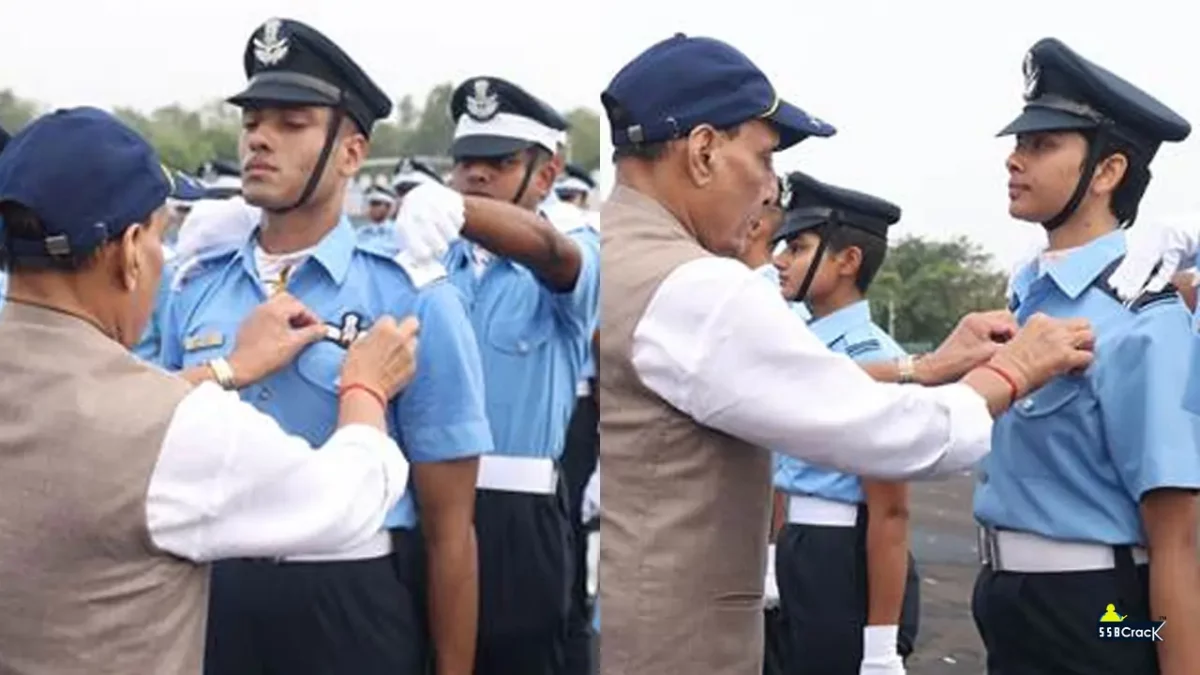
A total of 231 Flight Cadets, including the first group of women cadets who entered the National Defence Academy, were commissioned as officers in the Indian Air Force during the Combined Graduation Parade of the 217 Course at the Air Force Academy in Dundigal, Hyderabad, on June 13, 2026.





Defence Minister Rajnath Singh reviewed the ceremonial parade and conferred the President’s Commission upon the graduating cadets. The ceremony marked the successful completion of rigorous pre-commissioning training by cadets belonging to the Flying and Ground Duty branches of the Indian Air Force.
Of the 231 Flight Cadets commissioned during the parade, 194 were men and 37 were women. The presence of the first batch of women NDA entrants among the newly commissioned officers added historic significance to the occasion and reflected the expanding participation of women in the operational and leadership roles of the Armed Forces.
The graduation parade also witnessed the award of flying wings to nine officers of the Indian Navy, three officers of the Indian Coast Guard and two officers from the Socialist Republic of Vietnam. Three officers received brevets after successfully completing their navigation training.
Congratulating the newly commissioned officers, Rajnath Singh said they were joining a service that had consistently served as both a shield and a sword for the country. He highlighted the Indian Air Force’s decisive contributions during some of the most critical periods in India’s military history.
The Defence Minister recalled how the Indian Air Force altered the course of the 1947-48 conflict in Jammu and Kashmir through the strategically important Srinagar airlift. He also referred to the force’s decisive air operations during the 1971 war, which contributed to India achieving victory in just 13 days.
Rajnath Singh further praised the courage, precision and professionalism demonstrated by the Indian Air Force during Operation Sindoor in 2025. He said the successful destruction of terrorist hideouts during the operation was made possible not only by advanced and indigenous military platforms but also by the courage, discipline and training of Indian Air Force personnel.
Expressing confidence in the future role of the service, the Defence Minister said the Indian Air Force would continue to play a pivotal part in protecting the country and supporting future military operations. He urged the graduating officers to remain constantly vigilant and prepared to respond to emerging security challenges.
Addressing the changing nature of warfare, Rajnath Singh said traditional conflicts generally involved two visible components—the soldier and the equipment used by the soldier. Modern warfare, however, increasingly involves invisible adversaries and systems that can attack without being physically present on the battlefield.
He said radars, satellites, unmanned aerial vehicles, sensors, robotics, artificial intelligence and cyber systems were transforming military operations. In several modern conflict scenarios, adversaries could compromise traffic-management systems, communication networks and closed-circuit television infrastructure without deploying conventional forces.
The Defence Minister told the officers that the training programmes and exercises conducted at the Air Force Academy had prepared them to face unexpected challenges and uncertain operational situations. He stressed that constant alertness and awareness would remain essential throughout their careers.
Rajnath Singh called upon the graduating cadets to understand, adapt, adopt and, wherever necessary, modify emerging technologies and futuristic warfare strategies. He emphasised that innovation and rapid execution would be essential for securing a decisive advantage across all domains of conflict.
He said every conflict provided valuable lessons and encouraged the officers to combine hard work with smart work and professional brilliance. According to the Defence Minister, technologically capable nations were gaining an increasingly important place in the global strategic environment.
He observed that military superiority was no longer determined only by the possession of large and expensive platforms. Comparatively smaller powers could now cause significant damage to major military assets by deploying compact but lethal weapons, innovative technologies and unconventional tactics.
The newly commissioned officers were urged to never stop learning and training. Rajnath Singh said the wings worn on their shoulders were not merely badges of qualification but symbols of the trust placed in them by every citizen of the country.
He reminded the officers that the responsibilities awaiting them would frequently require decisions to be made within seconds or even fractions of a second. Such situations would demand sound judgement, professional competence, discipline and the ability to remain calm under pressure.
The Defence Minister asked the officers to maintain the highest standards of professional conduct and personal integrity throughout their service. Their conduct, he said, should inspire their colleagues, juniors and future generations of Indian Air Force personnel.
Extending special congratulations to the women officers, Rajnath Singh said the growing presence of Nari Shakti would further strengthen the Indian Air Force and make it more robust and balanced. He described the commissioning of the first batch of women NDA entrants as a demonstration of the strength and inclusiveness of the Armed Forces.
Women cadets were admitted to the National Defence Academy for the first time in 2022. After completing joint-services training at the NDA, those selected for the Indian Air Force proceeded to specialised pre-commissioning training at the Air Force Academy. Their commissioning represents an important milestone in the integration of women into permanent commission and operational roles.
Rajnath Singh also congratulated the Vietnamese officers who completed their training in India. He expressed confidence that their experience at the Air Force Academy would contribute to strengthening defence cooperation and friendship between India and Vietnam.
The Defence Minister commended the Indian Air Force for its contribution to humanitarian assistance and disaster-relief operations in India and abroad. He said the force had played a critical role in numerous rescue and evacuation missions, often operating in difficult weather conditions and challenging terrain.
These humanitarian missions, he said, reflected India’s culture and ethos of assisting people without discrimination based on nationality, language or geographical borders. The Indian Air Force’s ability to rapidly deploy aircraft, helicopters, medical teams and relief material has made it a central component of India’s disaster-response capabilities.
Referring to the popular expression that the sky is the limit, Rajnath Singh told the newly commissioned officers that the Indian Air Force must move forward with the belief that the sky is its home. He said this vision would help the country progress towards its objective of becoming a developed nation by 2047.
The ceremonial parade began with the graduating cadets presenting a General Salute to the Reviewing Officer. This was followed by an impressive march past that showcased the discipline, coordination and high standards of drill maintained at the Air Force Academy.
The parade was accompanied by a synchronised flypast led by Chief of the Air Staff Air Chief Marshal A.P. Singh. The flypast featured four types of training aircraft used by the Indian Air Force and associated services, including the Pilatus PC-7 Mk II, Hawk, Kiran and Chetak.
The inclusion of these aircraft highlighted the different stages of flying training undertaken by cadets before they are assigned to operational aircraft and specialised roles. The flypast also demonstrated the coordination between aircrew, ground personnel and air traffic controllers involved in conducting large ceremonial formations.
The Combined Graduation Parade culminated with the newly commissioned officers marching out in two columns to the sound of martial music. In keeping with Air Force Academy tradition, their immediate juniors offered them their first salute as commissioned officers.
Rajnath Singh also presented awards to officers who achieved exceptional results across various training disciplines. Flying Officer Ashish Kumar Yadav received the President’s Plaque and the prestigious Nawanagar Sword of Honour for securing first position in the overall order of merit in the Pilot Course.
Flying Officer Ekta Gupta was awarded the President’s Plaque for standing first in the overall order of merit in the Navigation stream. Flying Officer Divyanshi Singh received the President’s Plaque for securing first position in the overall order of merit among officers of the Ground Duty branches.
The ceremony included an aerial display by the Akash Ganga skydiving team, which demonstrated precision parachuting skills. The Shakti Woman Air Warrior Drill Team also presented a coordinated drill display that was widely appreciated by the audience.
The grand finale featured an aerobatic demonstration by a Su-30MKI fighter aircraft, a performance by the Sarang helicopter display team and a formation display by the Suryakiran Aerobatic Team. The demonstrations showcased the flying skills, precision and operational capabilities of Indian Air Force personnel.
Air Officer Commanding-in-Chief of Training Command Air Marshal S. Shrinivas, Air Force Academy Commandant Air Marshal Rahul Bhasin and several other senior Indian Air Force officers attended the ceremony. Parents and family members of the graduating cadets were also present to witness the commissioning of the young officers.
The commissioning ceremony holds special importance for every graduating officer as the President’s Commission formally authorises them to serve as officers in the Indian Armed Forces. During the ceremony, the officers took an oath pledging to safeguard the sovereignty, integrity and honour of the country.
The graduation of the 231 Flight Cadets marked the beginning of their professional careers in the Indian Air Force. After completing further specialised training, they will assume responsibilities in flying, navigation, air traffic control, administration, logistics, meteorology, technical services and other operational and support branches.
For the first batch of women officers who entered the Armed Forces through the National Defence Academy, the parade represented the completion of a demanding journey that began with joint-services training and continued through specialised instruction at the Air Force Academy.
Their commissioning is expected to encourage more young women to pursue careers in the Armed Forces and compete for leadership and operational appointments. It also marks another step towards creating a more inclusive, capable and balanced Indian Air Force prepared to meet the security requirements of the future.