

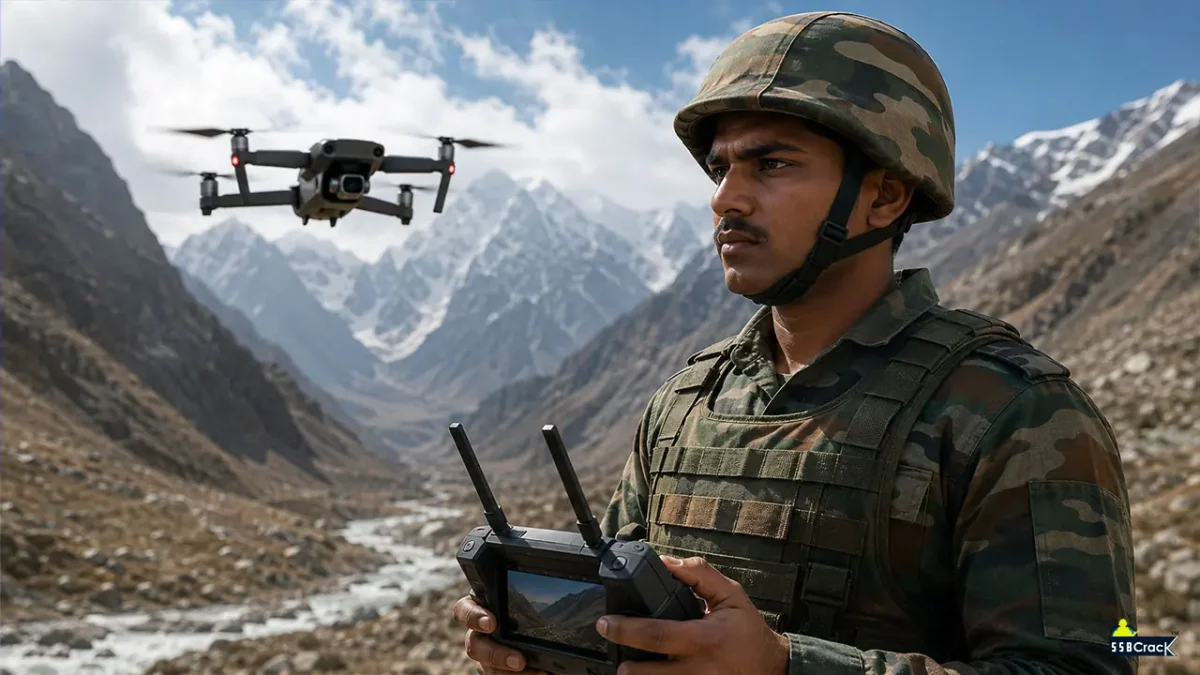
New Delhi, June 29, 2026 — The Indian Army will raise dedicated Baaz Battalions to manage the large-scale induction, upgrading, and replenishment of drones and Remotely Piloted Aircraft (RPAs), Army Chief General Upendra Dwivedi has stated.





The move aims to create a specialist pool of trained personnel capable of operating and sustaining the full RPA ecosystem, significantly boosting the force’s Intelligence, Surveillance, and Reconnaissance (ISR) capabilities.
Key Announcement
In a statement reported by Asian News International (ANI), General Dwivedi said:
“The Army will require continuous induction, upgrades and replenishment of drones on a large scale. To maintain pace with this requirement, one of the most important initiatives is raising Baaz Battalions. This will be built upon the existing Remotely Piloted Aircraft Flights. These battalions will comprise a specialist pool of personnel trained to operate and manage the ecosystem of Remotely Piloted Aircraft. This will enhance Intelligence, Surveillance and Reconnaissance capabilities through integrated aerial surveillance, persistent battlefield awareness and rapid response.”
The accompanying file photograph released with the statement shows General Dwivedi in formal uniform.
Evolution from Existing RPA Flights
The Baaz Battalions (named after the Hindi word for hawk or falcon, symbolising aerial prowess) represent an organisational upgrade from the Army’s current Remotely Piloted Aircraft Flights. Rather than maintaining dispersed or ad-hoc drone units, the new battalions will consolidate expertise into dedicated formations with specialised manpower.
This structure is designed to handle the full lifecycle of RPA operations — from deployment and maintenance to data exploitation and integration with ground forces — ensuring sustained operational tempo.
Part of Broader Army Transformation
The announcement aligns with the Indian Army’s ongoing “Decade of Transformation” under General Dwivedi’s leadership. The Army has rapidly expanded its drone inventory from a few hundred platforms to over 50,000 systems, accompanied by the establishment of multiple Drone and Counter-Drone Hubs across the country.
Complementary initiatives already underway include:
- Ashni drone platoons at the infantry battalion level for organic surveillance and target acquisition.
- Bhairav Battalions and Rudra All-Arms Brigades focused on high-tempo, multi-domain operations.
- Divyastra Batteries and Shaktibaan Regiments for precision artillery and extended-reach targeting.
- The “Eagle on the Arm” doctrine, which emphasises training every soldier in basic drone operations.
These reforms reflect lessons from recent conflicts, particularly the extensive use of drones for ISR, precision strikes, and contested airspace dominance.
Strategic Rationale
General Dwivedi has consistently highlighted that the Army’s approach to drones is not limited to procurement but focuses on absorption — integrating unmanned systems into training, doctrine, and combat operations in a tiered, role-based, and terrain-specific manner.
Unified Control Centres at the division level are also being established to coordinate the growing number of Unmanned Aerial Systems (UAS) and Counter-UAS assets on the modern battlefield.
The raising of Baaz Battalions addresses the requirement for persistent battlefield awareness and rapid response capabilities, which are critical along India’s northern and western borders as well as in counter-insurgency environments.
Significance and Legacy
The initiative comes as General Dwivedi’s tenure as Chief of the Army Staff nears its conclusion. His leadership has been marked by accelerated induction of drones, counter-drone systems, and the creation of new technology-enabled formations designed for future multi-domain warfare.
By institutionalising drone operations through specialist battalions, the Army is moving from experimental and supplementary use of unmanned systems to a core, professionally managed capability.
Defence analysts view the development as a logical progression that will enhance the Army’s ability to maintain real-time situational awareness, support precision targeting, and respond swiftly in dynamic operational scenarios.
The Indian Army has not yet released further details on the number of Baaz Battalions to be raised, their locations, or the precise timeline for raising. Additional information is expected in the coming weeks as the force continues its structured modernisation drive.
This development is expected to feature prominently in discussions on the evolving character of warfare and the Indian Army’s adaptation to emerging technologies.