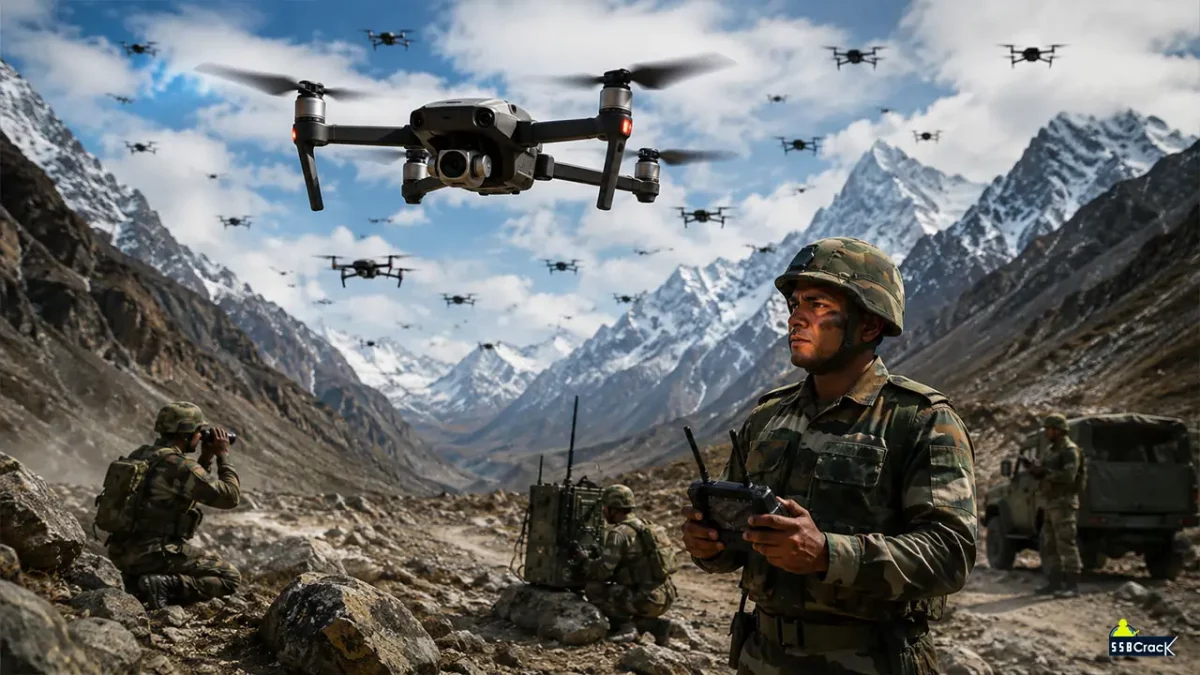
The Indian Army has significantly expanded its unmanned aerial vehicle (UAV) and loitering munition capabilities since 2020. This expansion addresses operational requirements along the Line of Actual Control (LAC) and Line of Control (LoC), driven by lessons from the 2020 Galwan standoff and subsequent developments, including validation during Operation Sindoor in 2025. The inventory now encompasses imported platforms for high-end intelligence, surveillance, and reconnaissance (ISR), alongside a rapidly growing array of indigenous systems for tactical ISR, precision strike, and decentralised operations.





Overall, India’s armed forces operated more than 140 UAV platforms across nine categories by March 2026, a substantial increase from fewer than a dozen in 2020. For the Indian Army specifically, the focus lies on persistent ISR at medium altitudes, battalion- and company-level tactical drones, man-portable and vehicle-launched loitering munitions, and low-cost FPV (first-person view) systems. Exact quantities remain largely classified, but open-source estimates and procurement records provide a reliable overview.
The Army prioritises Atmanirbhar Bharat (self-reliance) through DRDO projects, private-sector partnerships (ideaForge, Solar Industries, Tata Advanced Systems, Adani Defence, among others), and in-house development. At the same time, it retains proven Israeli systems for critical long-endurance ISR and specialised loitering roles. A flagship initiative, the Ashney Drone Platoon Programme, aims to equip approximately 380 infantry battalions with dedicated drone platoons (typically 4 surveillance + 6 armed/FPV/loitering drones each), targeting over 100,000 UAVs in total. This programme accelerated after Operation Sindoor and reflects a doctrinal shift toward decentralised, attritable drone warfare at the unit level.
1. Medium-Altitude Long-Endurance (MALE) ISR UAVs
These platforms provide persistent, wide-area surveillance and are the backbone of strategic ISR along India’s borders.
Heron Mk-I and Mk-II (Israel Aerospace Industries – IAI)
The Heron family remains the primary MALE UAV in Indian Army service. The Mk-I offers long-endurance ISR with electro-optical/infrared (EO/IR) payloads and real-time video downlink. The more advanced Mk-II adds satellite communication (Satcom) links, improved sensors, and higher operational flexibility. Indian Army holdings include more than 30 Heron Mk-I airframes (with notable concentrations under Eastern Command) and at least four Mk-II units inducted by 2022–2023 (two deployed in Ladakh and two in the Northeast). Additional Mk-II procurements have occurred via emergency routes following operational feedback from Operation Sindoor.
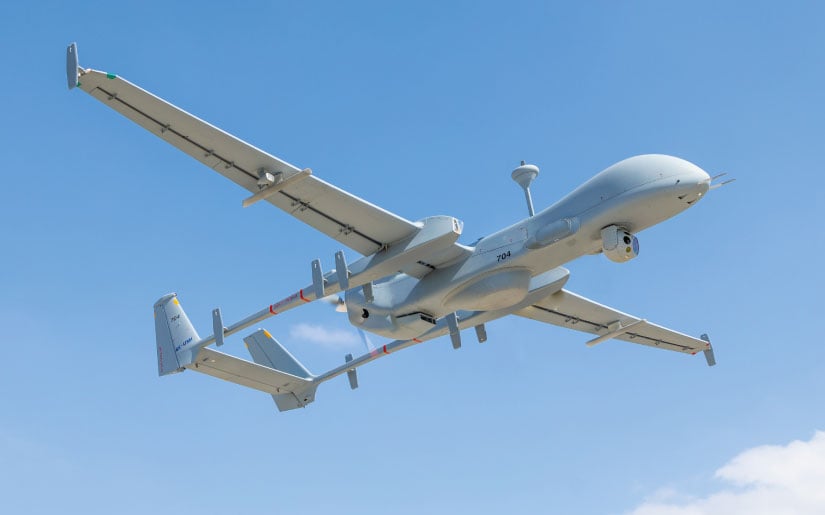
Heron TP (IAI)
Limited numbers of the larger, armed-capable Heron TP variant have been leased or operated on a tri-service basis, primarily for extended endurance and strike-capable ISR missions.
Searcher Mk-II (IAI)
A tactical MALE workhorse with approximately 18 hours endurance and day/night EO/IR sensors. It supports a wide range of Army units for medium-range ISR and has been in service for many years across the three services.
Indigenous MALE Efforts – TAPAS-BH-201 (Rustom-2) and Archer-NG (DRDO)
The TAPAS-BH-201 (formerly Rustom-2) programme encountered challenges meeting joint services qualitative requirements for altitude and endurance; it was demoted from mission-mode status, with focus shifting to the Archer-NG armed MALE UAV. Archer-NG, optimised for high-altitude operations along the LAC, has completed initial flights and entered user trials/production planning (including Bharat Electronics Limited manufacturing batches for the Army and Air Force). It features weapons integration potential (ULPGM/LGB-class) and represents the most advanced indigenous MALE effort currently progressing toward induction.
Other indigenous MALE prototypes (e.g., Flying Wedge Kaala Bhairav, Cingularity Bravo Tango) remain in testing and are not yet in operational service.
2. Tactical, Mini, and Micro UAVs for ISR
These systems support close-range reconnaissance, artillery spotting, and infantry-level situational awareness. They are often hybrid VTOL or fixed-wing designs capable of high-altitude and electronically contested environments.
ideaForge SWITCH Series (including SWITCH V2) and ZOLT (ideaForge Technology, India)
ideaForge platforms dominate the Army’s tactical/mini UAV inventory. The SWITCH hybrid VTOL mini UAVs have received multiple emergency procurements (including a ₹137 crore order in 2025) and are battle-tested for ISR missions. Variants such as ZOLT have been procured specifically for high-altitude and jammed environments. These systems offer rapid deployment, good endurance for their class, and compatibility with Army logistics.
Black Hornet Nano and Other Micro/Nano Systems
The Indian Army has inducted ultra-light palm-sized nano drones such as the Black Hornet for soldier-level reconnaissance in confined or high-threat areas. Additional indigenous mini platforms (Johnnette JF2, Raphe mPhibr family, Nimbus, Throttle Aerospace, and tethered hexacopters) supplement the inventory for persistent or specialised surveillance.
Swarm and Multi-Rotor Systems
NewSpace Research & Technologies and other Indian firms supply swarm-capable drones. In-house Army FPV and autonomous swarm development (including programmes initiated in late 2025 for main battle tank neutralisation) are expanding rapidly.
3. Loitering Munitions and Kamikaze Drones
Loitering munitions (LMs) proved highly effective during Operation Sindoor and now form a critical precision-strike layer at tactical and operational depths.
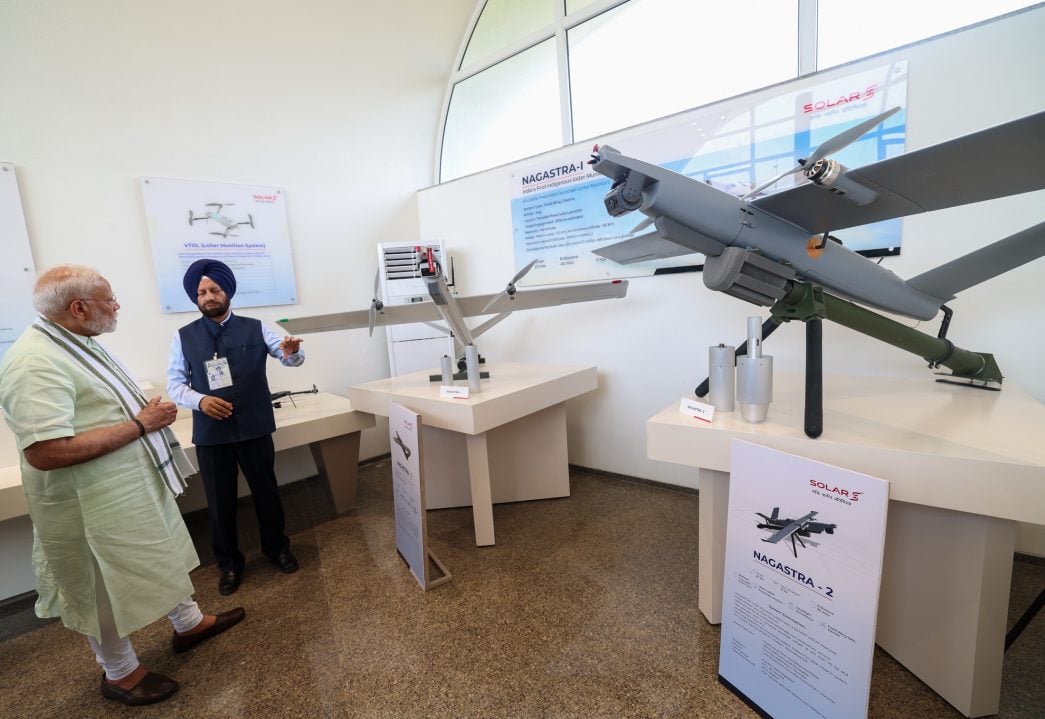
Nagastra-1 / Nagastra-1R (Solar Industries / Z-Motion, India)
India’s first indigenous man-portable electric loitering munition. It features a 1 kg high-explosive fragmentation warhead, approximately 30 km range, 60-minute endurance, GPS/NavIC guidance, and optional parachute recovery. Over 480 units have been inducted, with additional hundreds (Nagastra-1R with improved EW resistance) ordered post-Operation Sindoor. It is combat-proven and widely deployed.
SkyStriker (Adani Defence / Elbit Systems)
Tactical autonomous LM with 100 km range and 5–10 kg warhead options. More than 120 units were contracted and employed effectively against armoured and infrastructure targets during Operation Sindoor.
ALS-50 (Tata Advanced Systems, India)
VTOL-capable loitering munition with 50 km range and 5 kg warhead. It demonstrated high-altitude performance and was used against Pakistani armoured vehicles in 2025 operations.
Harop / Agnikaa and Harpy (IAI / Adani)
Long-range anti-radiation (SEAD) loitering munitions. Harop offers up to 9 hours endurance and extended range; both systems were used extensively against Pakistani air-defence radars during Operation Sindoor. The Army has publicly displayed the compact Mini Harpy variant, which fuses EO/IR and anti-radiation seekers.
Other Tactical LMs
Warmate (Polish-origin micro LM), JM-1, PALM-120/400 series, and several other indigenous systems (Kadet, SMPP Peacekeeper, Munitions India Limited) have entered service or completed deliveries. Belarusian Berkut-BM jet-powered kamikaze drones were also acquired in early 2026.
In-House FPV Kamikaze Drones
The Indian Army’s Rising Star Drone Battle School and Fleur-De-Lis Brigade have produced over 100 low-cost FPV kamikaze drones (approximately ₹1.4 lakh per unit) optimised for anti-tank roles. Several have been inducted into units such as 2 Para, with further orders placed. These attritable systems emphasise simplicity, dual-safety triggers, and real-time FPV relay.
4. Target Drones and Specialised Systems
DRDO’s Lakshya (supersonic) and Abhyas (subsonic) target drones support air-defence training and weapon-system validation. Emerging logistics and heavy-payload drone programmes (via Defence Innovation Organisation challenges) are in early stages but not yet operationally fielded in significant numbers.
Summary and Outlook
As of mid-2026, the Indian Army’s drone inventory reflects a pragmatic two-tier approach:
- High-end persistent ISR relies primarily on the Heron family and Searcher Mk-II, supplemented by limited Heron TP assets.
- Tactical edge and precision strike are increasingly indigenous and attritable, led by ideaForge mini UAVs, Nagastra-1, SkyStriker, ALS-50, in-house FPV systems, and a broad ecosystem of loitering munitions validated in combat.
The Ashney Drone Platoon Programme represents the most transformative structural change, pushing drone capabilities down to infantry battalions and fostering a new generation of operator expertise. While gaps remain in fully indigenous MALE-class platforms (Archer-NG is the leading contender), the pace of private-sector innovation and DRDO development indicates these will narrow in the late 2020s.
The Army continues to emphasise electronic-warfare resilience, AI-enabled autonomy, swarm tactics, and seamless integration with artillery, infantry, and special forces. Future procurements are expected to prioritise fibre-optic or AI-guided FPV/LM variants and accelerated induction of long-range indigenous loitering munitions.
This dynamic inventory positions the Indian Army to conduct persistent surveillance, precision strikes, and decentralised operations with increasing effectiveness and self-reliance. Continued rigorous testing, training, and iterative procurement will be essential to maintain operational superiority in contested environments.