
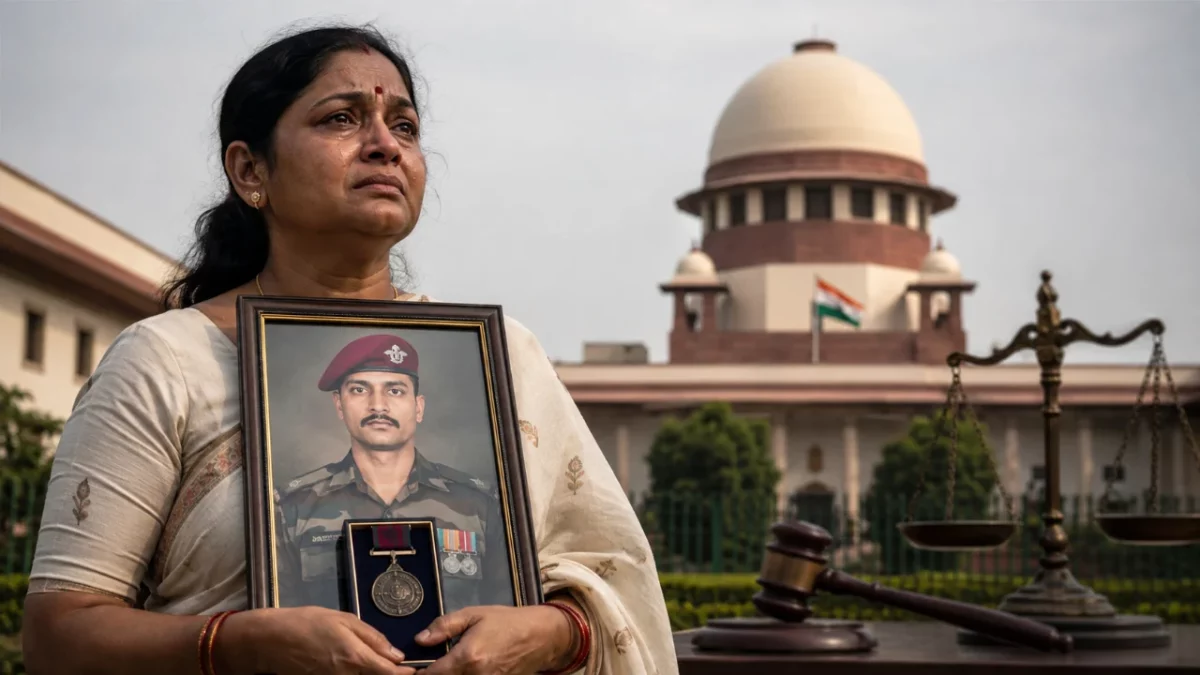
New Delhi, August 2026: Ending a 26-year legal struggle marked by official rejection and procedural hurdles, the Supreme Court has directed the Union of India to grant extraordinary family pension from the date of death to Kuldeep Kaur, widow of late Mohan Singh, a General Reserve Engineering Force (GREF) Overseer who was posthumously awarded the Shaurya Chakra. The Court further ordered an additional consolidated payment of ₹10 lakh under its powers under Article 142 of the Constitution.





A Division Bench of Justices K.V. Viswanathan and Arun Palli, in its order of 5 August 2026, observed that Mohan Singh had made the “supreme sacrifice” while performing his duty and that families of such personnel should not be compelled to approach courts for benefits that ought to have been extended promptly.
The Act of Supreme Sacrifice
Mohan Singh was serving as Overseer and In-charge Works with the General Reserve Engineering Force (part of the Border Roads Organisation) on the strategically vital Hayliang–Metangliang–Chaglohagom road in Arunachal Pradesh. The approximately 57-kilometre road held significant importance for the management of the Sino-Indian border.
On 10 July 2000, while supervising formation-cutting and dozer operations at a treacherous, rocky site, a large boulder accompanied by substantial debris began rolling down from the hillside towards the machinery and workers. Singh immediately raised an alarm, directed the dozer and compressor operators to safer ground, and then assisted in moving the equipment itself out of the danger zone to protect both lives and government property.
In the process, he was unable to escape the path of the boulder. He was swept away and fell approximately 70 metres into the valley. He succumbed to his injuries (the incident occurring on 10 July 2000, with death recorded around 12 July in official proceedings).
Recognising his exemplary courage and selflessness in saving fellow workers and equipment under hazardous conditions on a national-security project, the Government of India posthumously conferred the Shaurya Chakra on him on 19 October 2001. The Shaurya Chakra is India’s third-highest peacetime gallantry award.
Decades-Long Battle for Rightful Benefits
Despite the gallantry award, Kuldeep Kaur was initially sanctioned only an ordinary family pension. She sought extraordinary family pension under the Central Civil Services (Extraordinary Pension) Rules, 1939. Her representations (including one in December 2005) were rejected, primarily on the ground that she had already received compensation of ₹1,84,170 under the Workmen’s Compensation Act, 1923, which the authorities treated as a bar to liberalised pensionary benefits.
She approached the Punjab and Haryana High Court. A Single Judge held that the case fell under Category “C” of the CCS (Extraordinary Pension) Rules and that she was entitled to extraordinary family pension, while directing her to return the workmen’s compensation amount with interest. The High Court declined higher categorisation under Categories “D” or “E”. Cross-appeals followed. The Division Bench of the High Court upheld the Category “C” finding but, relying on a statement by the widow’s counsel, restricted the monetary arrears to the three years preceding the filing of the writ petition.
The matter reached the Supreme Court. By the time of the final hearing, the Union of India (through Attorney General R. Venkataramani) informed the Court that, pursuant to the High Court directions, it had already released ₹14.28 lakh as principal and an additional ₹4.12 lakh towards arrears of extraordinary family pension. The widow had also returned the earlier workmen’s compensation amount.
Supreme Court’s Observations and Directions
The Supreme Court accepted the High Court’s classification under Category “C” of the CCS (Extraordinary Pension) Rules, 1939, holding that the authorities had earlier erred in classification. The Bench emphasised that Mohan Singh’s death while saving lives and equipment in the course of duty on a strategic border road qualified for extraordinary family pension benefits.
Critically, the Court held that the relief should not be confined to the three-year period preceding the writ petition. It observed that these are not matters in which the family or the widow of a person who has made the supreme sacrifice should be expected to approach the courts for relief. The long delay in seeking judicial remedies, the Court said, should not stand in the way of rendering complete justice.
Invoking its extraordinary powers under Article 142 of the Constitution to do complete justice in the peculiar facts and circumstances of the case, the Bench directed the Union of India to pay a consolidated sum of ₹10 lakh covering the period from 13 July 2000 to 12 July 2015. This amount was fixed in lieu of further detailed calculations of arrears and interest components after accounting for payments already made and adjustments relating to the returned workmen’s compensation. The Court directed that the ₹10 lakh be released within four weeks of the order.
The Bench appreciated the positive response of the Attorney General and the subsequent departmental processing of benefits once judicial directions were in place, while reiterating that such benefits ought to have been extended soon after the death itself.
Broader Significance
The judgment underscores that personnel of the General Reserve Engineering Force engaged in construction of strategically critical border infrastructure perform duties of national importance and that acts of gallantry and self-sacrifice by them must be recognised not only through awards but also through timely and complete pensionary support to their families. It reinforces that technical or procedural objections — including prior receipt of workmen’s compensation or delay in approaching the court — cannot be allowed to defeat the entitlement arising from a recognised supreme sacrifice.
For the widow of a Shaurya Chakra awardee who waited more than a quarter of a century, the Supreme Court’s intervention has finally secured the extraordinary family pension from the date of her husband’s death along with an additional consolidated relief of ₹10 lakh. The order brings judicial closure to a prolonged ordeal and serves as a reminder of the duty of the State towards the families of those who lay down their lives in the service of the nation.