
Raksha Mantri Rajnath Singh has said that military modernisation driven by a self-reliant and future-ready defence sector remains one of the Government’s highest priorities as India prepares to celebrate its 80th Independence Day.





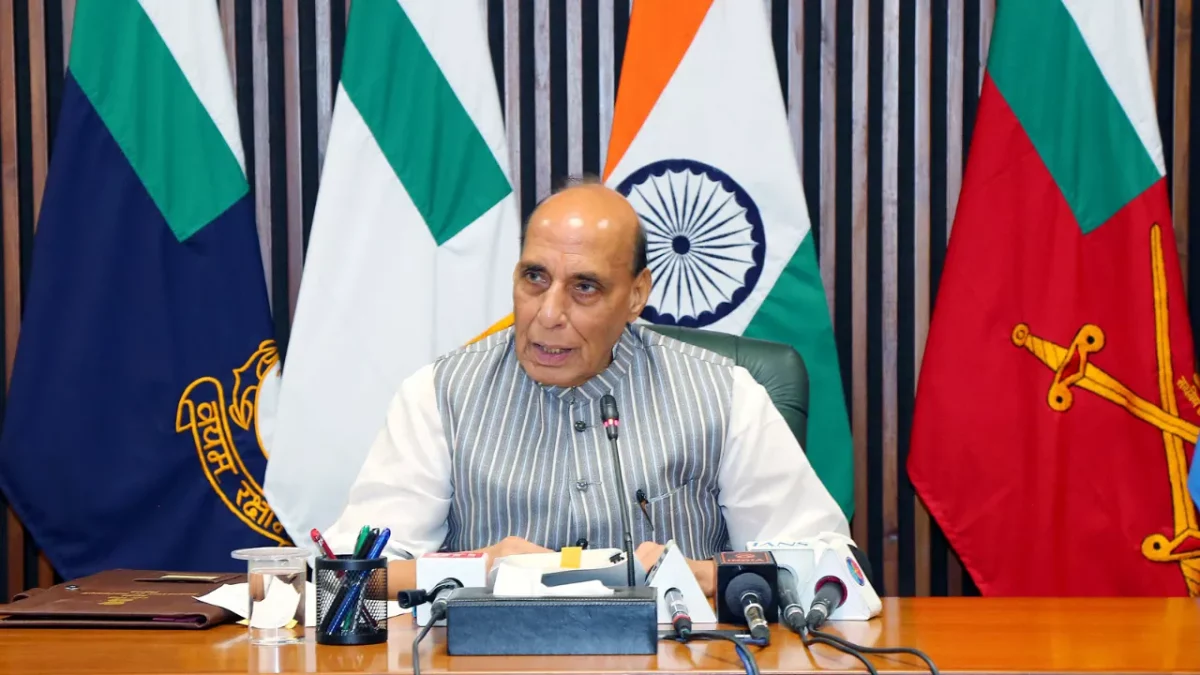
Addressing soldiers through Akashvani on August 14, Rajnath Singh highlighted the transformation of India’s defence sector over the past 12 years, driven by initiatives such as Aatmanirbhar Bharat and Make in India. He said India is increasingly meeting its own security requirements while emerging as a global defence manufacturing hub and a net defence exporter.
The Raksha Mantri said India’s defence production has risen from Rs 46,000 crore in 2014 to a record Rs 1.78 lakh crore in FY 2025-26, representing nearly a four-fold increase over the past decade. Defence Public Sector Undertakings and other public-sector entities accounted for around 76 per cent of total production, while the private sector contributed 24 per cent.
India’s defence exports have also witnessed significant growth, rising from Rs 686 crore in FY 2013-14 to an all-time high of Rs 38,424 crore in FY 2025-26. Rajnath Singh said India now has 145 defence exporters and Indian defence products are being exported to more than 80 countries. He expressed confidence that the country will achieve its target of Rs 50,000 crore in defence exports by 2029.
Highlighting the growing financial focus on defence modernisation, Rajnath Singh said the defence budget has increased from Rs 2.53 lakh crore in FY 2013-14 to Rs 7.85 lakh crore in FY 2026-27. Capital expenditure has increased from Rs 94,588 crore to Rs 2.19 lakh crore, while the defence research and development budget has risen from Rs 15,283 crore in FY 2014-15 to Rs 29,100 crore in FY 2026-27.
The Raksha Mantri said the Defence Acquisition Council has granted Acceptance of Necessity for projects worth more than Rs 8.75 lakh crore over the past year. He also highlighted reforms in defence procurement, including an increase in the financial ceiling available to Field Commanders and procurement worth more than Rs 1.25 lakh crore through the revenue route to promote indigenisation.
Rajnath Singh highlighted several recent technological achievements by DRDO and the Armed Forces, including the successful testing of the Tactical Advanced Range Augmentation system, which is aimed at enhancing the precision capabilities of conventional weapons.
He also referred to the testing of the Advanced Agni missile equipped with MIRV technology, along with the Long-Range Land Attack Cruise Missile, Rudra-MII Air-to-Surface Missile, Naval Anti-Ship Missile-SR and Pinaka Long-Range Guided Rocket. These developments, he said, are strengthening India’s strategic deterrence and strike capabilities.
The Raksha Mantri further highlighted the successful test of an Active Cooled Full-Scale Scramjet Combustor for more than 1,200 seconds, describing it as an important achievement in India’s pursuit of hypersonic missile technology. He also mentioned the first successful test of the indigenous Kusha long-range surface-to-air missile, aimed at further strengthening the country’s air-defence capabilities.
Rajnath Singh said border-area development remains a key focus of the Government, with improved connectivity and infrastructure contributing to both national security and the development of strategically important regions. He also praised the Armed Forces for their role as first responders during natural disasters and their contribution to rescue and relief operations.
The Raksha Mantri reiterated the Government’s commitment to the welfare of serving personnel, veterans and their families. He said the budget for the Ex-Servicemen Contributory Health Scheme has increased by 300 per cent over the past five years.
Under the Armed Forces Flag Day Fund, the Penury Grant has been increased from Rs 4,000 to Rs 8,000, the Education Grant from Rs 1,000 to Rs 2,000 and the Marriage Grant from Rs 50,000 to Rs 1 lakh. Rajnath Singh said these measures reflect the Government’s commitment towards the welfare and dignity of soldiers and their families.
He also highlighted the increasing participation of women in the Armed Forces, including the commissioning of the first batch of female cadets trained at the National Defence Academy. He described the milestone as proof that courage and leadership are not confined by gender.
Rajnath Singh also referred to Samudra Pradakshina, the first tri-service all-women circumnavigation sailing expedition aboard Indian Army Sailing Vessel Triveni, as a symbol of Nari Shakti and the expanding role of women in national security and nation-building.
Concluding his address, the Raksha Mantri paid tribute to India’s freedom fighters and the Armed Forces, stating that the responsibility for safeguarding the country’s sovereignty, unity and integrity rests with its soldiers. He praised their courage, discipline and dedication, which enable citizens to pursue their aspirations in a secure environment.
He also noted that 2026 marks the 150th anniversary of the National Song Vande Mataram and called upon citizens to celebrate the occasion with renewed patriotism and a spirit of service.
Rajnath Singh urged citizens to become active participants in nation-building and contribute towards the vision of a Viksit Bharat.