
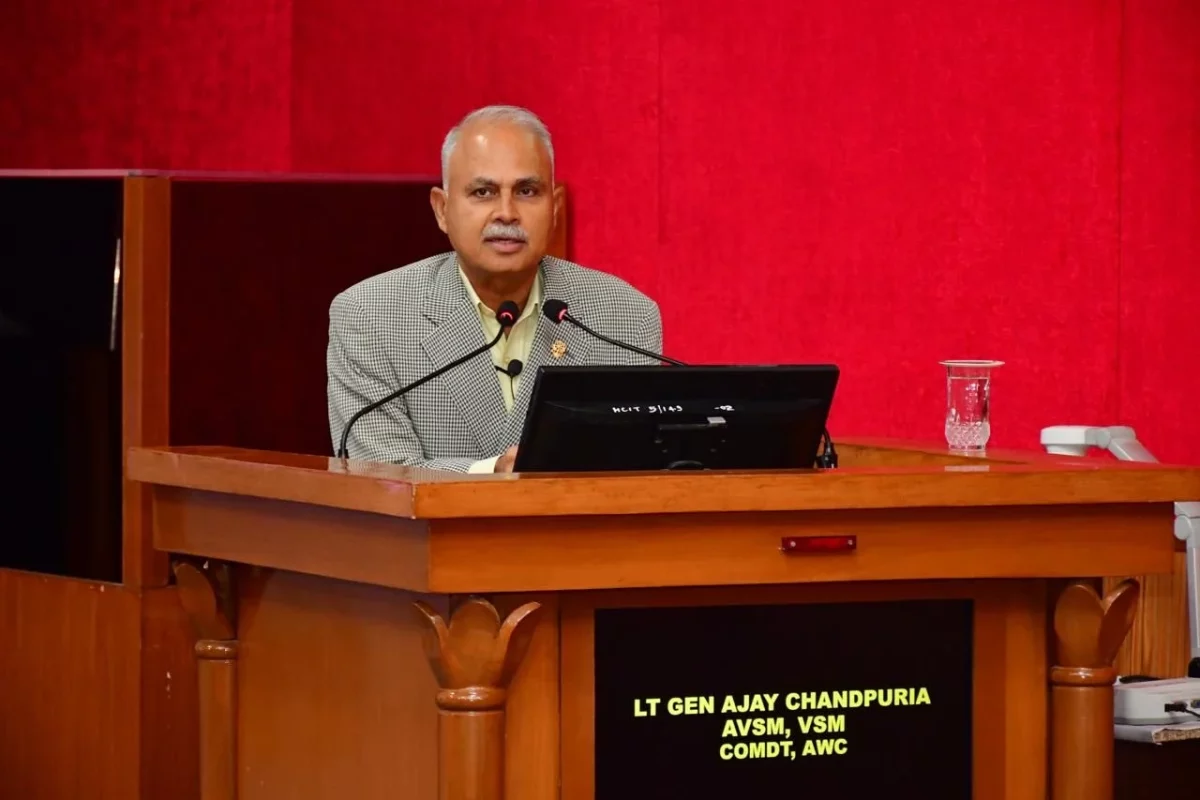
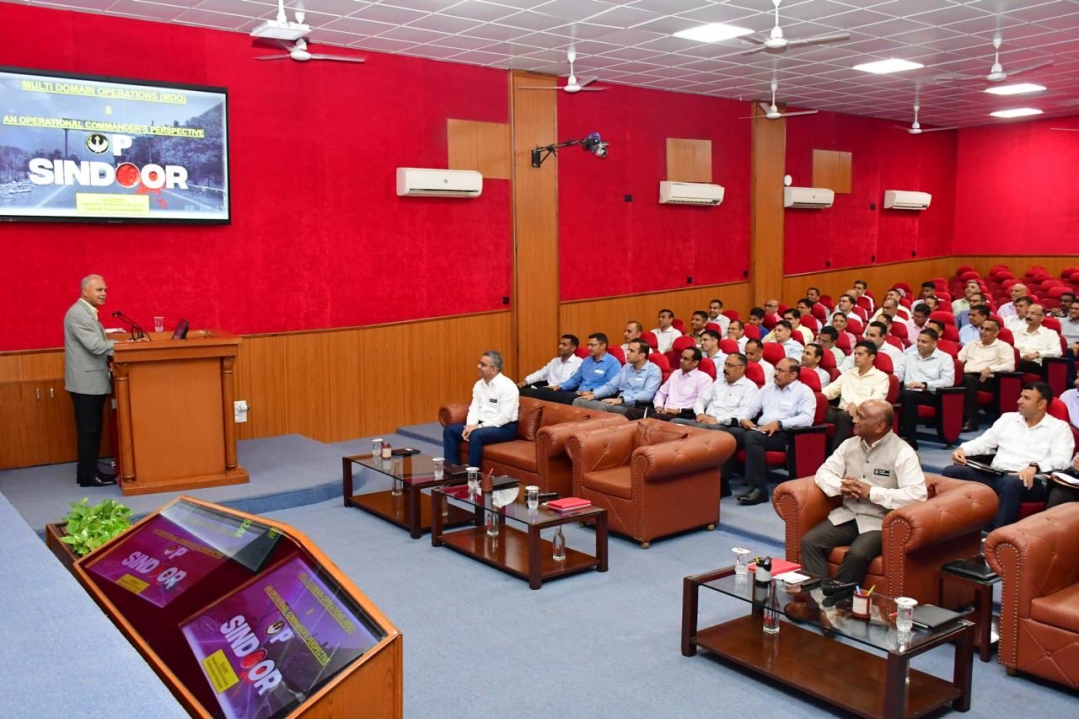
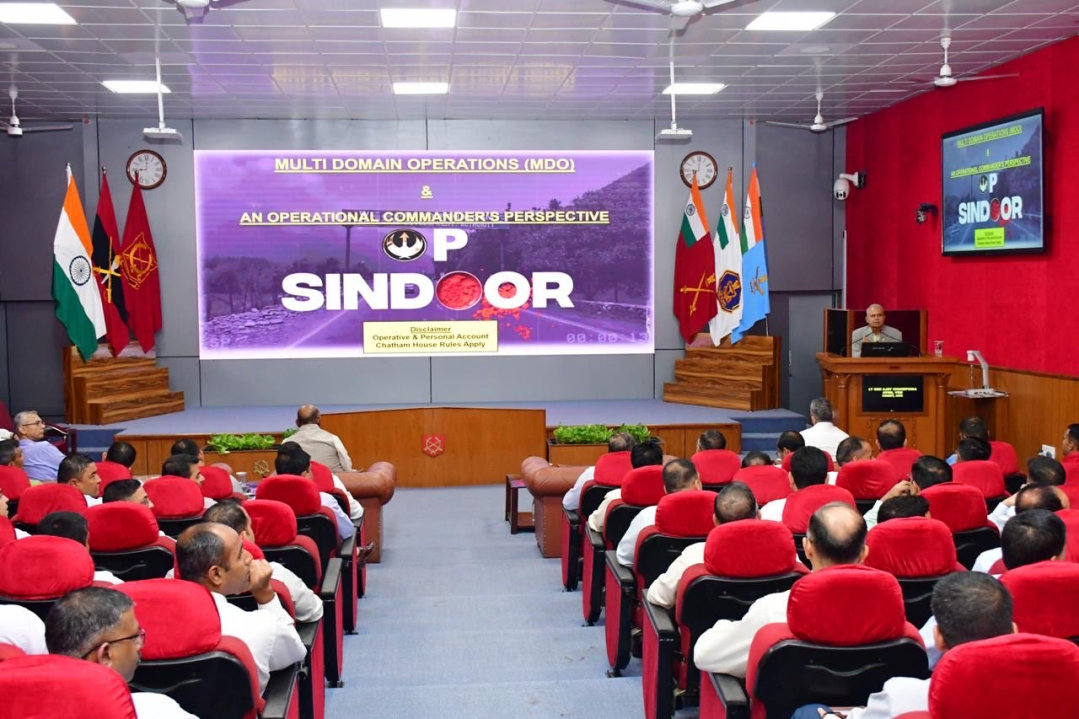
Lieutenant General Ajay Chandpuria, Commandant of the Army War College, shared an insightful and analytical perspective on the conduct of Multi Domain Operations during Operation Sindoor while addressing officers undergoing the Higher Command Course, highlighting critical lessons for the planning and execution of modern military campaigns.





During the interaction, Lt Gen Chandpuria examined Operation Sindoor through the framework of contemporary multi-domain warfare, where military success increasingly depends upon the coordinated employment of capabilities across land, air, maritime, space, cyber, electromagnetic and information domains.
The Army War College Commandant highlighted synchronised Higher Defence Planning as one of the key imperatives emerging from Operation Sindoor. Modern military operations require close coordination between the Services and other elements of national power, with strategic objectives, operational planning and tactical actions aligned towards clearly defined national goals.
Such synchronisation becomes particularly important during fast-moving military situations, where decisions taken at the strategic level can rapidly influence operations across multiple domains. Effective coordination enables military commanders to employ available capabilities coherently while maintaining the flexibility required to respond to an evolving security environment.
Lt Gen Chandpuria also emphasised the effective execution of Multi Domain Operations as a crucial requirement for winning modern wars. The concept goes beyond the traditional employment of individual military services and focuses on creating coordinated effects through capabilities operating simultaneously across different domains.
Modern battlefields are increasingly shaped not only by conventional weapons but also by drones, precision-guided munitions, surveillance systems, satellites, electronic warfare, cyber capabilities, communication networks and information operations. The ability to integrate these elements can provide commanders with significant operational advantages.
Operation Sindoor offered an important contemporary context for examining how military capabilities can be synchronised to achieve specific objectives while responding to developments across a complex operational environment.
Another major lesson highlighted by the Commandant was the importance of escalation control accompanied by a clear exit strategy. Military operations, particularly those conducted in a sensitive strategic environment, require planners to consider not only how an operation begins and achieves its immediate objectives but also how escalation can be managed and the confrontation eventually terminated on favourable terms.
A clearly defined exit strategy enables military action to remain connected with the larger political and strategic objectives of the nation. It can also provide decision-makers with options for controlling the intensity and duration of a confrontation while retaining sufficient military capability to respond if the situation changes.
The emphasis on escalation management reflects the increasingly complex nature of modern conflicts, where military actions can have consequences extending far beyond the immediate battlefield. Strategic communication, diplomatic activity, economic considerations and international perceptions can operate alongside military actions and influence the overall outcome of a crisis.
Lt Gen Chandpuria further highlighted credible Information Operations as another essential component of contemporary warfare. In an environment dominated by instantaneous communication, social media and competing narratives, the information domain has become an increasingly important element of military and national strategy.
Information Operations can play a critical role in communicating national intent, countering misinformation and hostile narratives, maintaining public confidence and ensuring that factual information reaches domestic and international audiences.
The Commandant stressed the importance of credibility in such operations. Effective strategic communication depends upon consistency and reliability, particularly during rapidly developing military situations where inaccurate or misleading information can spread quickly.
He also emphasised a Whole of Nation Approach as an imperative for succeeding in modern wars. Contemporary conflicts are no longer determined exclusively by forces operating on the battlefield. National resilience, technological capability, economic strength, industrial capacity, diplomatic engagement, intelligence, cyber capabilities, media awareness and public support can collectively influence a country’s ability to sustain and achieve strategic objectives.
The Whole of Nation Approach therefore requires greater coordination between the Armed Forces, government institutions, industry, technological organisations and other elements of national power. Such integration becomes particularly relevant as warfare becomes increasingly technology-intensive and interconnected.
The interaction with the Higher Command Course assumes significance as the programme prepares senior military officers for higher command, staff and operational responsibilities. Discussions based on contemporary military operations provide officers with an opportunity to examine the relationship between strategic decision-making and operational execution.
The Army War College plays an important role in developing military leadership and encouraging professional military education on emerging concepts of warfare. Analysing recent operational experiences enables future commanders to examine evolving threats, technological changes and doctrinal requirements in a realistic strategic context.
Lt Gen Ajay Chandpuria’s analysis of Operation Sindoor brought together four interconnected requirements for contemporary military success: synchronised Higher Defence Planning, effective execution of Multi Domain Operations, escalation control backed by a clearly defined exit strategy, and credible Information Operations supported by a Whole of Nation Approach.
Together, these imperatives underline the transformation of warfare from predominantly platform-centric and service-specific operations towards integrated campaigns involving military, technological, informational and national capabilities.
The discussion at the Army War College also reinforced the importance of continuously studying contemporary operations and translating operational experience into professional military education. Lessons emerging from Operation Sindoor are expected to contribute to the continuing evolution of concepts related to jointness, multi-domain warfare, strategic communication and integrated defence planning.
By sharing these operational perspectives with officers of the Higher Command Course, Lt Gen Ajay Chandpuria underscored the need for future military leaders to understand warfare not simply as a contest of forces on the battlefield, but as a coordinated application of national power across multiple interconnected domains.