

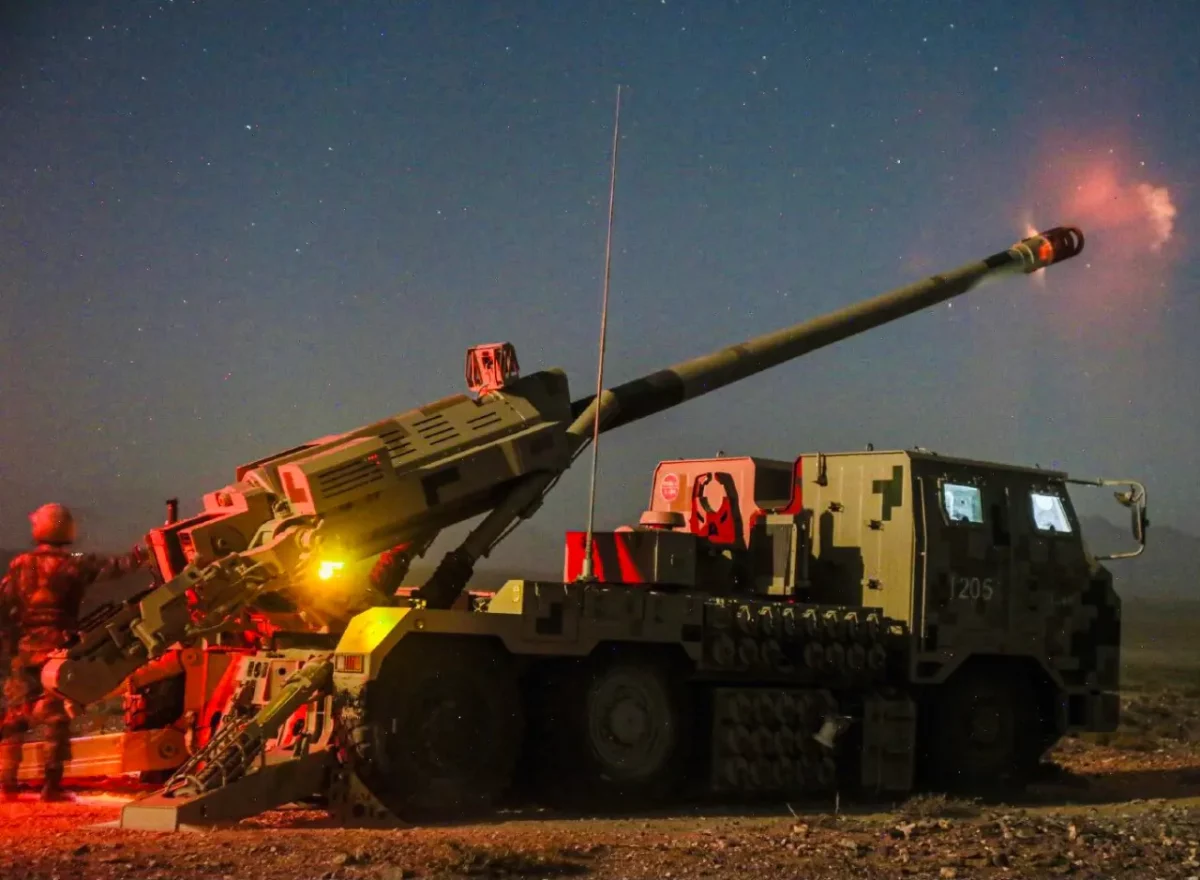
Pakistan has reportedly deployed a significant number of Chinese-made SH-15 wheeled self-propelled artillery guns along sectors facing India, marking a major enhancement of its long-range conventional firepower. According to reports, the deployment forms part of Pakistan’s ongoing artillery modernisation programme aimed at improving its stand-off strike capability along the western front.



The SH-15, designated as the PCL-181 in Chinese service, is a 155mm, 52-calibre wheeled self-propelled artillery system developed by Chinese state-owned defence manufacturer Norinco. Pakistan placed an order for 236 SH-15 artillery systems in 2019, with deliveries commencing in 2022 and additional consignments arriving in 2023.
Reports indicate that a majority of these artillery systems have been deployed with Pakistani formations opposite India, particularly in Gujranwala, Sialkot and Jalalpur Jattan. These locations are strategically positioned behind the Shakargarh Bulge, a militarily significant region situated south of Jammu and north of Amritsar, with Pathankot lying to its east. The deployment is expected to strengthen Pakistan’s artillery coverage across important sectors along the International Border.
According to reports, the SH-15 systems were also deployed during Operation Sindoor, reflecting Pakistan’s effort to integrate newly acquired long-range artillery into its operational plans. In northern Punjab and Pakistan-occupied Kashmir, the SH-15 has reportedly become Pakistan’s primary wheeled self-propelled artillery platform. Meanwhile, formations deployed opposite Rajasthan and Gujarat continue to rely largely on the older US-origin M-109 tracked self-propelled howitzers, which are considered better suited for desert operations.
Pakistan’s acquisition of the SH-15 is part of a broader programme to modernise its artillery arm in response to regional military developments. The country has also secured a Transfer of Technology (ToT) agreement with China, enabling local production of the artillery system at Heavy Industries Taxila. Indigenous manufacturing is expected to support long-term fleet expansion and sustainment while reducing dependence on imports.
The SH-15 provides Pakistan with a significant capability upgrade over its older artillery systems. Mounted on a high-mobility 6×6 truck chassis, the system combines strategic mobility with rapid deployment. It is capable of firing a wide range of 155mm ammunition, including rocket-assisted projectiles with reported engagement ranges exceeding 50 kilometres, offering improved precision, flexibility and responsiveness on the battlefield.
Military analysts note that the combination of long-range artillery, rockets and missile systems enhances Pakistan’s ability to conduct stand-off precision strikes while increasing the effectiveness of its conventional fire support. The mobility of the SH-15 also enables faster repositioning, improving survivability against counter-battery fire.
India, meanwhile, continues to pursue an extensive artillery modernisation programme focused on indigenous capability development. The Indian Army has inducted M777 Ultra-Light Howitzers, K-9 Vajra-T self-propelled guns and Dhanush artillery guns, while also placing orders for 307 Advanced Towed Artillery Gun Systems (ATAGS), an indigenously developed 155mm, 52-calibre artillery platform designed to significantly enhance long-range firepower.
Although the Indian Army does not currently field a wheeled self-propelled artillery system comparable to the SH-15, development of an indigenous Mounted Gun System (MGS) based on the ATAGS platform is progressing. Initial firing trials have already been completed, and the programme is expected to provide the Army with a highly mobile artillery capability in the coming years.
The deployment of the SH-15 reflects the continuing modernisation of conventional artillery capabilities in South Asia, with both India and Pakistan investing in longer-range, more accurate and highly mobile artillery systems. As technological advancements reshape battlefield dynamics, artillery remains a critical component of deterrence, rapid response and conventional military operations along the region’s sensitive frontiers.