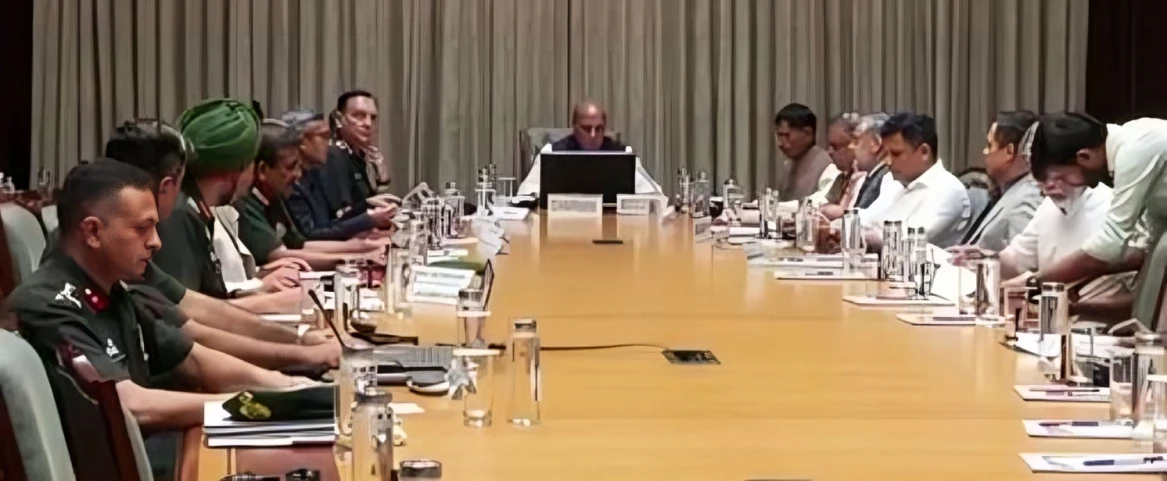
Raksha Mantri Rajnath Singh chaired a meeting of the Parliamentary Consultative Committee for the Ministry of Defence in New Delhi on 6 August 2026, with discussions centred on the Territorial Army and its expanding role in strengthening India’s defence preparedness and nation-building efforts.





During the meeting, senior Ministry of Defence officials presented a comprehensive briefing on the Territorial Army’s mandate, organisational structure, operational responsibilities and key achievements. Members of the Parliamentary Consultative Committee also shared valuable suggestions aimed at further enhancing the force’s capabilities and overall effectiveness.
Addressing the committee, Rajnath Singh described the Territorial Army’s contribution as significant in advancing the vision of Viksit Bharat envisioned by Prime Minister Narendra Modi. He stated that while the regular Armed Forces primarily focus on national defence and security, the Territorial Army makes valuable contributions across several other sectors, including environmental conservation, disaster response and social service.
The Defence Minister emphasised that the Territorial Army represents the true spirit of the “Citizen-Soldier” concept. He noted that its personnel continue their civilian professions while remaining trained and ready to wear the uniform whenever the nation requires their service, whether for safeguarding borders or maintaining internal security.
Highlighting the force’s strategic importance, Rajnath Singh said the Territorial Army provides critical surge capacity to the Armed Forces by maintaining a pool of trained personnel who can be mobilised rapidly during emergencies. He added that once Territorial Army personnel return to civilian life after completing their tenure, they continue to serve the nation by acting as a vital bridge between society and the military, inspiring citizens, particularly the youth, to join the Armed Forces.
The Defence Minister noted that the Territorial Army currently comprises approximately 44,400 personnel organised into 59 diverse units, making it a trained, motivated and highly capable reserve force supporting the country’s defence and internal security requirements.
Rajnath Singh also commended the Territorial Army’s outstanding contribution to disaster management, describing its personnel as among the nation’s first responders during natural calamities. He acknowledged their relief and rescue operations, humanitarian assistance and medical support during major disasters, including the Kerala floods, Odisha cyclone and the recent floods in Assam.
Praising the force’s contribution to environmental protection, the Defence Minister highlighted the work of the Territorial Army’s Ecological Task Forces, which have planted nearly 10 crore saplings across the country with an impressive survival rate of 80 to 85 percent. He said these initiatives are making a meaningful contribution towards achieving the objectives of Mission LiFE and the Panchamrit commitments by promoting ecological restoration and sustainable environmental practices.
Rajnath Singh also appreciated the Territorial Army’s efforts in Jammu and Kashmir, particularly its contribution to expanding the reach of the Har Ghar Tiranga campaign and strengthening public participation in national initiatives.
The meeting was attended by Raksha Rajya Mantri Sanjay Seth, Chief of Defence Staff General N.S. Raja Subramani, Chief of the Army Staff General Dhiraj Seth, Defence Secretary Rajesh Kumar Singh, Secretary (Defence Production) Sanjeev Kumar, Secretary (Defence Finance) Vishvajit Sahay and other senior officials of the Ministry of Defence.
The discussions reaffirmed the Government’s commitment to further strengthening the Territorial Army as an indispensable component of India’s defence architecture, recognising its unique contribution not only to national security but also to disaster response, environmental conservation, community engagement and nation-building.