

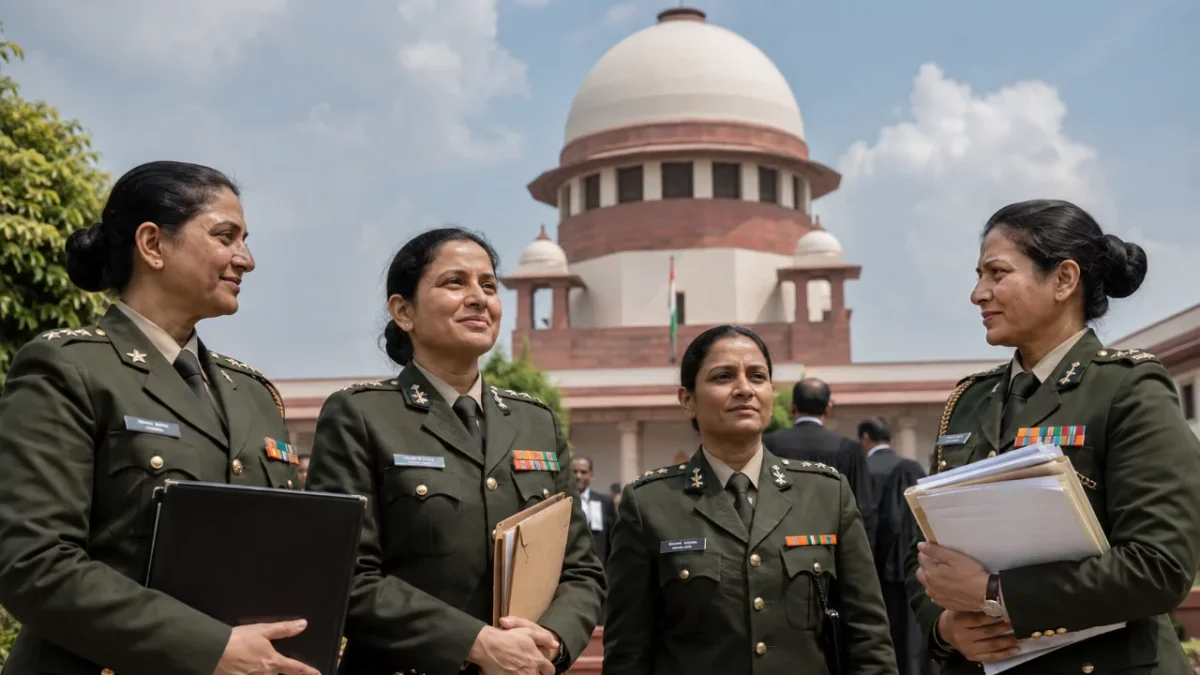
New Delhi, March 24, 2026: In a significant ruling reinforcing principles of fairness and constitutional equality in the armed forces, the Supreme Court has held that women Short Service Commission (SSC) officers of the Army, Navy, and Air Force who were denied Permanent Commission (PC) due to arbitrary and structurally flawed evaluation processes are entitled to full pensionary benefits.

A bench led by Chief Justice of India Surya Kant, along with Justices Ujjal Bhuyan and N. Kotiswar Singh, ruled that these officers shall be treated as having completed the minimum 20 years of qualifying service required for pension eligibility, even if they were released earlier after completing their SSC tenure of up to 14 years. The Court invoked its extraordinary powers under Article 142 of the Constitution to grant this relief as a one-time measure to do complete justice.
The decision came while disposing of a batch of petitions, including those filed by Wing Commander Sucheta Edan and other women officers, challenging the denial of Permanent Commission following policy changes introduced around 2019 and subsequent orders of the Armed Forces Tribunal (AFT).
Background of the Dispute
Under the Short Service Commission scheme, officers are initially commissioned for 10 years, with the possibility of extension up to a maximum of 14 years. Those not selected for Permanent Commission are released from service at the end of their tenure. Unlike Permanent Commission officers, who serve until the age of retirement and become eligible for pension after 20 years of service, SSC officers released after 14 years traditionally received only terminal benefits such as gratuity, leave encashment, and limited ex-servicemen facilities, without a regular pension.
Women officers began entering the armed forces in larger numbers through the SSC route from the early 1990s. Landmark judgments — notably Babita Puniya (2020) for the Army and Annie Nagaraja (2020) for the Navy, followed by Lt. Col. Nitisha (2021) — opened the pathway for women SSC officers to be considered for Permanent Commission on the same terms as their male counterparts. However, the implementation of these directions through subsequent policy circulars (particularly those of 2019 onwards) led to widespread challenges.
Selection Boards held in 2019, 2020, and 2021 considered many women officers for PC. A large number were denied the commission and subsequently released. The officers contended that the evaluation process was neither transparent nor fair.
Court’s Key Observations on Systemic Shortcomings
The Supreme Court examined the assessment methodology in detail and found serious structural deficiencies. It observed that Annual Confidential Reports (ACRs) of women SSC officers had often been written in a “casual” manner. Assessing officers frequently operated under the preconceived assumption that these women would not be eligible for long-term career progression or Permanent Commission. As a result, the reports did not adequately evaluate their potential for higher responsibilities, command roles, or sustained service.
When Permanent Commission opportunities were later extended, these earlier ACRs — prepared without a long-term career horizon in mind — were used to judge comparative merit. This created an inherent disadvantage. The Court noted that the denial of Permanent Commission in many cases could not be attributed solely to individual performance but stemmed from a systemically skewed evaluation framework.
The bench also flagged the hurried introduction of new performance and service-length criteria in 2019, particularly in the Indian Air Force, which did not give officers a reasonable opportunity to meet the revised benchmarks. Similar concerns regarding lack of disclosure of evaluation criteria and vacancy calculations were noted in the Navy and Army processes.
Exact Relief Granted
Exercising powers under Article 142, the Court directed the following as a one-time measure:
- Women SSC officers (and intervenors) who were considered for Permanent Commission in the Selection Boards of 2019, 2020, and 2021, and who were released from service during the pendency of proceedings, shall be deemed to have completed 20 years of substantive qualifying service.
- They shall be entitled to pension and all consequential benefits, except arrears of pay.
- Pension shall be fixed on the basis of the deemed completion of 20 years of service. Arrears of pension, where payable, shall generally be effective from 1 January 2025 (as clarified in related directions).
- Permanent Commissions already granted by Selection Boards or by earlier judicial orders shall not be disturbed.
- Officers still in service who met the prescribed cut-offs (subject to medical fitness and disciplinary/vigilance clearance) were granted or confirmed Permanent Commission in appropriate cases.
- The Court declined to order reinstatement of officers already released, citing operational requirements and the need to maintain the organisational structure of the forces. It also rejected claims for notional time-scale promotions for those no longer in service.
The relief is limited to the specific cohort of officers affected by the flawed boards of 2019–2021 and is explicitly a one-time equitable measure rather than a general change in service rules.
Wider Implications
The judgment has important consequences for gender equity and institutional fairness in the Indian Armed Forces. By recognising that systemic assumptions embedded in the appraisal system can produce discriminatory outcomes even without overt intent, the Court has reinforced the principle that constitutional equality must be meaningful in practice, not merely formal.
For the affected women officers — many of whom served for over a decade, including in challenging operational environments — the grant of pension provides long-term financial security that was previously unavailable. Pension eligibility also brings associated benefits such as access to medical facilities under the Ex-Servicemen Contributory Health Scheme (ECHS) on a more comprehensive footing and other consequential entitlements.
At the same time, the Court balanced individual justice with the operational needs of the forces by refusing wholesale reinstatement or disruption of existing Permanent Commission grants. The ruling leaves room for the services to refine their evaluation systems going forward so that future assessments of both male and female SSC officers are free from historical assumptions about career trajectories.
This decision forms part of a continuing judicial engagement with the integration of women into the permanent cadre of the armed forces. Earlier rulings established the right to be considered for Permanent Commission; the present judgment addresses the consequences of imperfect implementation of that right and ensures that officers who served the nation are not left without the financial security that long service ordinarily attracts.
The detailed judgments in the batch of cases (including Sucheta Edan v. Union of India and connected matters) elaborate on service-specific directions for the Army, Navy, and Air Force.