

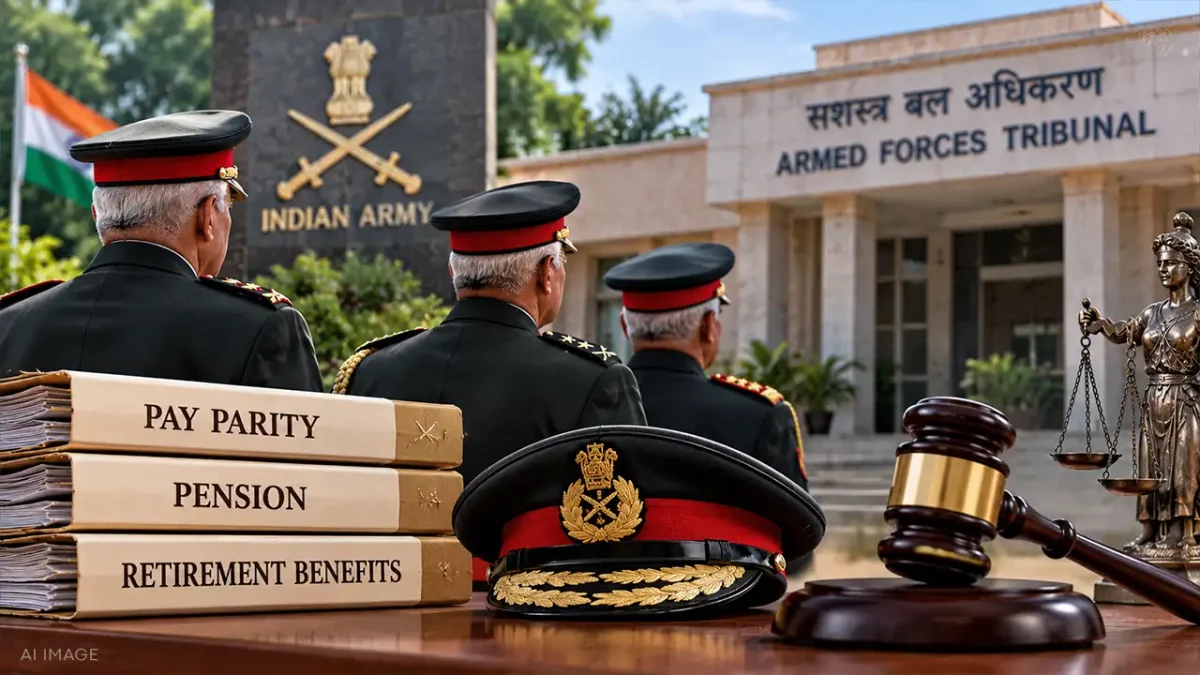
More than 200 retired Major Generals and Lieutenant Generals are preparing a fresh petition before the Armed Forces Tribunal (AFT) seeking pay and pension parity with immediate juniors, after the Ministry of Defence granted relief only to 82 officers who had already litigated the same anomaly.


The move follows an August 2026 government order that stepped up the emoluments of those 82 Major Generals and equivalent officers of the Navy and Air Force, but left a much larger group of similarly placed officers without the same correction. Counsel for the earlier petitioners has stated that a new AFT filing is imminent.
The anomaly: a senior rank drawing less than a junior
The dispute arises from the structure of Military Service Pay (MSP) introduced under the Sixth Central Pay Commission and continued under the Seventh. MSP is admissible to commissioned officers only up to the rank of Brigadier and equivalent. It is counted for dearness allowance and pension. Generals and equivalent ranks do not receive MSP as a separate element.
Under the Seventh Pay Commission pay matrix, a Brigadier’s maximum pay, including MSP, could reach Rs 2,33,100. The maximum prescribed pay for a Major General, without a separate MSP component, was Rs 2,18,200. In a number of cases, promotion from Brigadier to Major General therefore produced a lower reckonable pay—and, after retirement, a lower pension—than that of an immediate junior who had remained a Brigadier.
The inversion did not stop at two-star rank. Officers later promoted to Lieutenant General carried the suppressed Major General fixation into the higher rank. Personal pay notified in 2023 to bridge the Brigadier–Major General gap was applied narrowly and did not travel cleanly with subsequent promotion.
The principle at issue is a settled one in service jurisprudence: promotion to a higher rank should not leave an officer in an adverse financial position compared with an immediate junior, particularly when pension is calculated from last pay drawn.
How the litigation unfolded
The matter had been pending with the government since at least 2019. A batch of petitions by Major General-rank officers and equivalents in the Navy and Air Force was allowed by the AFT Principal Bench on 14 March 2023. The Tribunal directed the Union government to step up the petitioners’ pay to the level of their immediate juniors, grant arrears from the date of assumption of Major General rank until superannuation, and fix pension and other consequential benefits accordingly.
The government did not implement the order despite execution proceedings. It challenged the AFT award in the Delhi High Court in a connected matter involving Air Vice Marshal Laxmi Narayan Sharma. The High Court admitted the writ but declined to stay the Tribunal’s directions. Eighty-two officers then filed contempt petitions against the Defence Secretary and the Controller General of Defence Accounts. After notices were issued, the Ministry sanctioned conditional implementation on 31 August 2026—restricted to the named litigants.
The August order treats the difference as “Personal Pay,” which is to count as pay for all purposes. Arrears and revised pension follow, subject to an undertaking that the amount will be refunded if a higher court later reverses the benefit. Equivalent orders were issued for Navy and Air Force officers who had obtained AFT relief. The hike was not extended across the board to all similarly situated officers.
The fresh AFT battle
Col Indrasen Singh (Retd), who represented 82 petitioners, has said that more than 200 officers of the ranks of Major General and Lieutenant General have approached him to file a fresh petition so that the same relief is applied universally.
“To get it implemented across the board, over 200 officers of the ranks of Maj and Lt Generals have approached me to file a fresh petition in the AFT to obtain a similar order, and I’m moving to the tribunal soon,” he said. He described as ironic the government’s decision to step up pay and pension only for those who had already obtained favourable judicial orders.
Maj Gen Ranjan Chand (Retd), who commanded an Armoured Division, served as Chief of Staff of a Corps in the Northeast, and later held the appointment of Additional Director General, Mechanised Forces, is among those preparing to approach the Tribunal. He has stated that the Ministry’s approval for removal of the anomaly is selective and restricted to officers who litigated, rather than being applied to all similarly affected officers.
Retired two- and three-star officers now planning litigation are in many cases septuagenarians and octogenarians. Commentators have noted that they are being required to spend time and money to obtain a benefit already granted—and thereby accepted as legally correct—to their contemporaries.
Air Vice Marshal Manmohan Bahadur (Retd) has asked whether the executive, or the judiciary acting suo motu, could avoid the spectacle of hundreds of senior officers returning to court after a favourable order already exists for 82 of their brother officers. Brig SK Chatterji (Retd) has argued that granting the raise and arrears only to the 82 defies logic if the same criterion applies to others.
A dissenting view on equalisation
Not all veterans support an automatic equalisation of General Officer pay with the feeder rank of Brigadier. Brig Anil Srivastava (Retd) has pointed out that only about 7 to 10 per cent of Brigadiers are selected for General Officer rank. He has argued that until the Sixth Pay Commission, General Officers received a notional MSP that preserved the differential, and that the withdrawal of that notional element under the Seventh Pay Commission produced the present inversion. He has also been associated with a writ challenging aspects of the AFT judgment and with execution proceedings covering a larger group of officers.
The government has previously used personal-pay and stepping-up mechanisms in civil service and earlier defence cases. Critics of the current approach say those tools were available without requiring each affected cohort to obtain a separate Tribunal order.
What happens next
The forthcoming AFT petition will seek an order comparable to the March 2023 common judgment, covering Major Generals, Lieutenant Generals and equivalent ranks who did not figure in the August 2026 sanction list. Implementation of any fresh direction would still sit against the pending Delhi High Court challenge and any further appeal.
The episode has revived a longer debate about how pay-commission anomalies in the armed forces are resolved—whether by administrative extension of a principle already accepted in court, or by successive individual petitions. For the officers now assembling a new case, the immediate object is narrower: that a Major General or Lieutenant General should not retire drawing less pension than a Brigadier who served under him.