
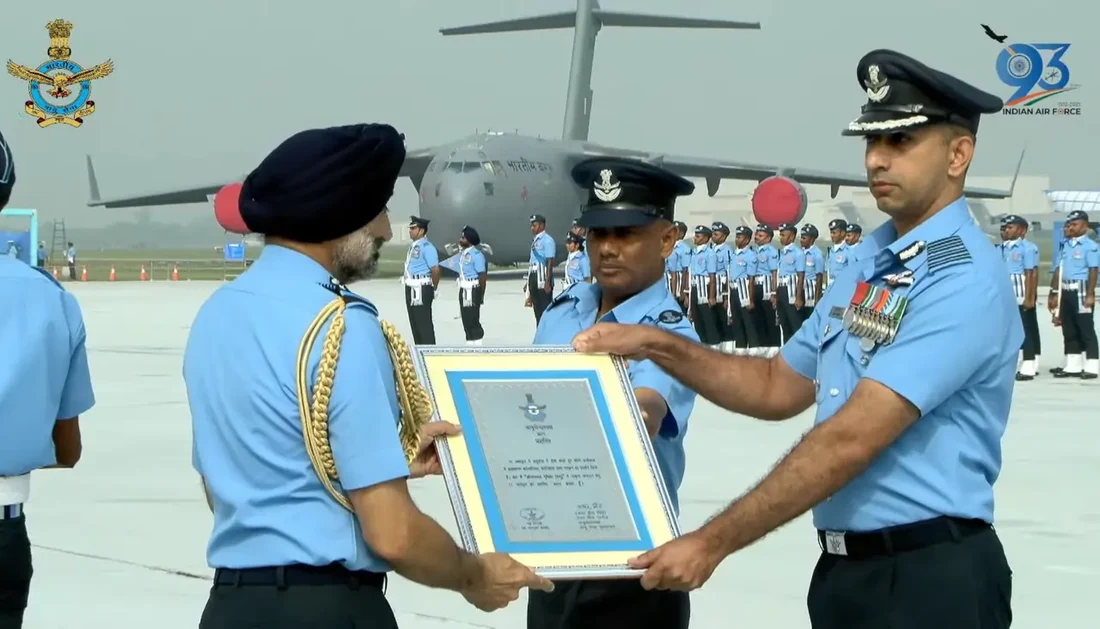
The Indian Air Force’s No. 17 Squadron, the Golden Arrows, marked its Platinum Jubilee at Air Force Station Ambala on 1 October 2026, seventy-five years after it was raised at the same base.
Ambala, 1 October 2026: Serving and retired air warriors gathered at Ambala for a static display, the release of a special first-day cover, a barakhana for squadron personnel, and a social evening. The squadron is the Indian Air Force’s first Dassault Rafale unit and remains under Western Air Command.
No. 17 Squadron was formed on 1 October 1951 under Flight Lieutenant Doughlas Llewellyn Springett of the 27 Pilot Course, who had received his wings in February 1945. It was the last of four fighter squadrons — Nos. 14, 15, 16 and 17, later called the “Emergency Teens” — raised in an eight-week expansion between August and October 1951. It began as a tactical reconnaissance unit with 12 Harvard-IIB aircraft. The motto is Udyam Ajasram (Arise Forever).
The squadron entered the jet age on the de Havilland Vampire in November 1955 and converted to the Hawker Hunter in 1957. It re-equipped with the MiG-21 in 1975 and moved to Bhisiana, near Bathinda. After the MiG-21s were phased out, the unit was number-plated in 2016. On 10 September 2019, then Chief of the Air Staff Air Chief Marshal B. S. Dhanoa resurrected the Golden Arrows at Ambala; Group Captain Harkirat Singh, Shaurya Chakra, took command of the re-raised squadron. The first Rafales joined the unit in 2020. Former Air Chief Marshal Dhanoa has said the squadron was selected for the Rafale because it was the highest-decorated unit of the Kargil war.
Its combat record covers every major Indian air campaign since the 1960s. In the 1961 Goa liberation, six Hunters under Squadron Leader Jayawant Singh struck Bambolim. In 1965 the squadron provided air defence for New Delhi. In 1971, under Wing Commander Narinder Chatrath, it flew close air support, counter-air and fighter reconnaissance from the eastern theatre in support of 20 Mountain Division, including a strike on Kurmitola near Dhaka in which Chatrath engaged two Pakistan Air Force Sabres and shot one down. He and Flying Officer V. K. Neb were awarded the Vir Chakra. The President’s Standard was presented on 8 November 1988 at Palam by President R. Venkataraman.
During Operation Safed Sagar in 1999, the Golden Arrows, then commanded by Wing Commander B. S. Dhanoa, flew MiG-21 reconnaissance and low-level night bombing in the mountains along the Line of Control, often at about 1,000 metres above ground. Squadron Leader Ajay Ahuja, the flight commander, was killed on 27 May 1999 when his MiG-21 was hit by a missile while searching for Flight Lieutenant K. Nachiketa, whose MiG-27 had suffered an engine failure. Ahuja was awarded the Vir Chakra posthumously. The squadron later took part in the Balakot strikes.
In May 2025 it flew in Operation Sindoor, both in air defence and in precision strikes. On Air Force Day in October 2025, Group Captain Amit Gehani, the commanding officer, received a Unit Citation for the squadron’s performance. Reporting on the jubilee states that the unit’s Operation Sindoor honours include two Vir Chakras, four Vayu Sena Medals and ten Mentions-in-Despatches. On 4 October 2021 the squadron formalised an affiliation with the Sikh Light Infantry at Ambala.
From Harvard trainers to Rafale, the Golden Arrows have remained on the order of battle through four generations of aircraft and every major conflict since Independence. The platinum jubilee returns the unit to the station where it was raised.